How To Create Super Happy Customers
Watch
Listen
Profit Activator 5. Storyboard the whole experience benchmark by benchmark, then ask two questions at each one. Where's the wow, and where's the friction?
Good morning.
Day nine of Profit Activator week, and we're into number five.
Yesterday was the offer. Today is what happens after somebody says yes.
Deliver a dream come true experience.
In 1997 I was calling it deliver a world-class service. The words have got better since then. The job hasn't changed.
And it splits into two things.
There's the result. The actual thing people are paying you to do.
And there's the experience. What they're touching, holding, hearing and feeling on the way to it.
Most people manage the first one carefully, and let the second one just happen to them.
So here's the exercise we used to run at the main events. It was always the most popular thing we did.
Six or eight hundred realtors in a room. We'd put some music on and give everybody a few minutes to write a letter.
Not from your own perspective. From the perspective of somebody who has just come all the way through the process of working with you.
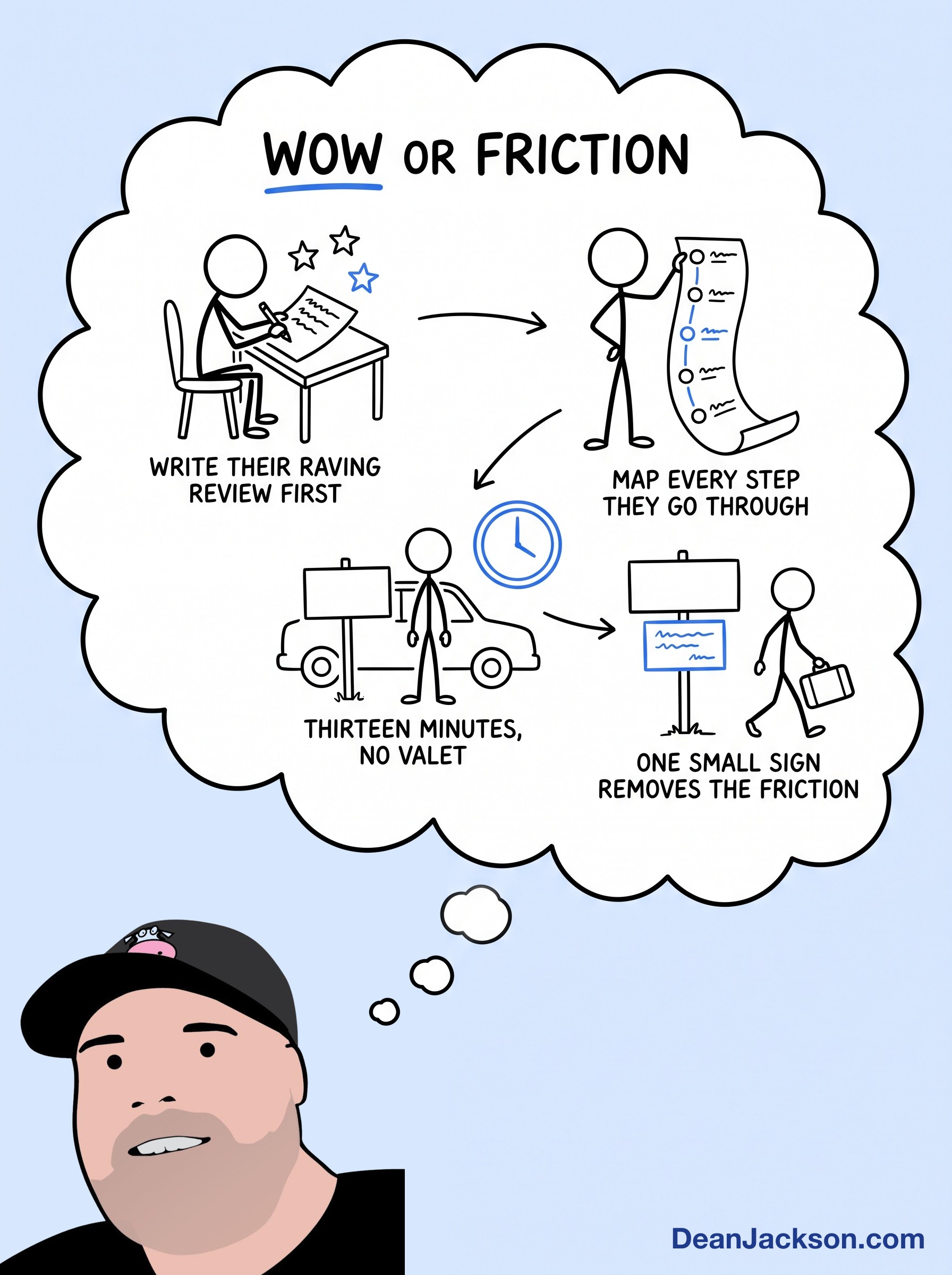
And it had to be the most raving review anybody could possibly write about that experience.
I was reading Raving Fans around that time, and that's the whole idea of it. Not satisfied customers. Raving ones.
So imagine what that person would love to be able to say about working with you... then write it as though they already had.
What you've got now is a vision for the entire journey. From the moment your process starts to the moment it's over.
And that's the baseline you lay your storyboard on top of.
Because there are two halves to any experience.
There's the above the line half. Everything people actually see and hear and feel.
And there's the below the line half. The systems, the processes, the checklists, all the behind the scenes machinery that makes the top half possible.
Your guest only ever experiences the top half. It only ever happens because of the bottom half.
Now, the way to get at it is to think in benchmarks. An experience timeline.
I've used real estate ones for years, so let me do a restaurant instead.
It starts with the reservation. Then there's a gap of a few days.
Then arriving. Then checking in with the hostess. Then being walked to the table.
Then all those little vignettes... somebody brings the menu, somebody brings water, maybe some bread arrives.
Looking over the menu. Ordering. The wait while the food is being made. Somebody topping up the water, saying it won't be long.
The food arrives. Did everybody get the right thing.
The meal is eaten. The table gets cleared. Then it's dessert, coffee, something after dinner.
Then the check. Paying. Leaving.
That's the whole During Unit for a restaurant, and every one of those is a checkpoint.
So go back through them and ask two questions at each one.
What would be a wow here?
And what friction could happen here?
The second question is the one that pays, because friction is almost invisible from the inside.
There was a show on the Travel Channel called Hotel Impossible, with Anthony Melchiorri. A career hotelier who'd go into a struggling hotel and help them turn it around.
And every single episode started the same way. With him arriving.
Just walking up to the place and looking at it the way a guest would.
A run-down sign. A light that isn't working. Paint cracking and peeling. Shrubbery overgrown. Cigarette butts on the path up to reception.
And his read on it was always the same. This is a general manager who has checked out. They're on autopilot.
Because the number one job of a general manager is to walk the property every day and notice the things that need doing.
My favorite one was in Miami. One of those beautiful old art deco hotels on the ocean, where there's no parking out front at all.
There's a sign that says valet. So he pulls up right in front of it, and they start a timer running.
And you know this feeling. Any second now a guy in a polo shirt is going to come running round the corner. He's probably just parking somebody's car.
Twelve, thirteen minutes go by.
Eventually he gives up, pokes his head through the door and asks the receptionist whether the valet is on duty.
Oh, no. Just leave the keys with us.
Think about how many people had already had exactly that experience. Sitting out front, waiting on somebody who was never coming.
Here's how he fixed it.
A little sign rider underneath the valet sign. Leave keys at reception.
That's it. That's the entire fix.
And now nobody sits out there for thirteen minutes wondering what's supposed to happen.
It sounds like a small thing. It isn't.
Somebody arriving at a hotel has been on a plane, or driving for hours. All they want is the room, a shower, and ten minutes of not doing anything.
And the very first thing that happens to them is a frustration.
These little things are dominoes. One goes over at the front door and everything after it is being done from a deficit.
You spend the rest of the stay climbing back to zero.
So that's the work. Find the benchmarks, and at every one of them, raise the wow and remove the friction.
And the secret to all of it is experiencing it through the eyes of your guest. Not through the eyes of the person running the process.
Tomorrow we'll talk about how to enhance it.
Here's your nudge for today.
Write the ultimate scenario for your own During Unit. From the moment somebody says yes, to the moment they've got the outcome you promised them.
Then list every benchmark along the way, and put two columns beside it. Where's the wow. Where's the friction.
Join me live on the next free 50-Minute Profit Finder call, Friday, October 30 at 1:00pm ET. Save your spot →
Transcript
Auto-generated transcript, provided as supporting material. It may contain errors, and speaker labels are occasionally mis-attributed.
Good morning. Welcome back. We are winging our way through profit activator week and we are into profit activator 5 right now which at the time so you know in 1997 this is the first time that I've put all of the words to what these seven I wasn't calling them profit activators one but this sevenst step process here um and at that time I was calling profit activator 5 deliver a worldclass service. Now we've evolved that to be a dream come true experience and one of the things that we have an opportunity in in the during unit is to focus on two things.
The result getting the actual delivery of whatever it is that people are paying you to do. The experience of what they're uh actually touching, holding, hearing, experiencing as they're going through the process. And then in profit activator six which is part of the during unit is providing after sales service and looking for the strategic opportunities that you have while you're doing business with uh with someone. So we start out with taking this process of storyboarding the experience that you want people to have.
One of the best exercises that we did, the most popular things that we did at the main events, we'd have 6 or 800 people, all realtors, and we would be we would put on some music, some, you know, ultimate scenario writing music. And we would give people a few minutes to write a letter from the perspective of someone who has just gone through the process of working with you to sell their home or to buy a home or to do whatever it is that you help them do. And we want it to be the most raving review that somebody could write about that experience. like just imagine what would be possible.
Um at the you know one of the a popular book at the time and when I start talking about uh the books I was reading at this time coming up was a book called raving fans and it was create talking about creating these experiences. So, if you imagine from uh the perspective of somebody that's going to work with you, what would you really love for them to have uh to say about that experience? How could you create it? How could you visualize it?
create a vision for the total journey that somebody's going to go on you from the moment that they uh the moment that your process starts. Now, thinking that way and and just narratively thinking through and describing in detail what that outcome is for people. gives you the baseline now to go in and overlay your story board on top of it. So so much of what you're managing in any process is the what we call above the line experience.
That's the things that people actually see, hear and feel. and the below the line experience which is all the systems and the processes and the checklists and the behind the scenes stuff that make that experience possible. So if you were to think in terms of a experience timeline for your uh for your we haven't called a guest experience timeline. If you think hospitalitywise that people are under your in your process, what would be the benchmarks along the way in the timeline?
So I've used a lot of real estate ones. I'll use a restaurant experience here to to give you an example. So a restaurant experience would start from the moment somebody makes a reservation. So they make a reservation then there's a period of time between when they are actually going to have their uh their dining experience.
So the first thing is arriving at the uh at the restaurant. That's one thing. The next thing might be checking in at the the front uh with the with the hostess that they're getting uh we're here and uh everything starts getting prepared. You get to the table, you're brought to your table and that whole experience that little I think of them as individual vignettes, little scenes in the things that somebody brings you the menu, they bring you some water or maybe they bring bread or whatever it is.
You're looking over the menu, they take your order is the next sort of benchmark in this. So now your food is being prepared and there's a little period of time while things are coming. Maybe they come back, refresh your water, just say, "Hey, the food's almost ready." We write out and then your food arrives and the journey of course is making sure that everybody got the right thing and everybody's happy with that.
The meal is eaten and now it's time to clear the uh clear everything from the table. And then people need to decide are you going to have dessert or coffee or after dinner uh drink whatever's happening there. Then it comes to the end where they get the uh the bill is presented. I don't know why they call it a check but they get the check uh delivered and they pay the bill and then they leave and that is the during unit experience of somebody.
So all of those are the uh the kind of um checkpoints along the way. And when you look at them, if your goal uh is to create a great experience for you, what would be a wow at each of those things? just kind of looking through it and asking yourself the the question, right? That it would be what would be a wow uh for you in arriving at the restaurant or what would be some friction that might happen when you're arriving at the restaurant.
There's a great show on either the travel I think it was on the travel channel with Anthony Mccori who did a show called Hotel Impossible. And the whole premise of the show was that Anthony was a a hotel executive, had been in hotels, been a hotelier his whole uh career and he would go to struggling hotels and he would help them turn it around, help them with a turnaround plan. And every show started, every episode started with him arriving at the hotel. So he would be giving his commentary on the way things.
He would look at things with a critical eye and he'd see it through the eyes of a guest. So if a sign is run down or a light's not working or the paint is cracking and peeling or the, you know, the shrubberies are overgrown or there's garbage all over cigarette butts on the way to the front reception. He would look at those and say, "This is a sign of a general manager that has checked out. They're on autopilot.
They're not keeping an eye on the property." Number one job of a a general manager is to walk the property every day to look through and notice the things that need to be done. So, one particular experience in Miami, he was arriving and on Collins uh Avenue or Ocean uh Avenue, they have these, you know, beautiful old art deco hotels where there's no parking at the thing. Parking is either behind or off site.
And he arrived at the hotel and there's a sign that says valet. So he parks right in front and then they start a timer on the thing because he's waiting and waiting and we've all been in that experience. You you go to a thing and if the valet is not there any minute there's going to be a guy in a polo shirt running around the corner to get to you. You think, "Oh, he's probably parking a car."
But the timer's running and the timer's running and it's, you know, 12 or 13 minutes that he's waiting on somebody to come. Finally, he pokes his head in the door, asks the receptionist, says, "The valet on duty." And they go, "Oh, yeah. No, just leave the keys with us."
And he's like, "Is that the pro?" Oh, yeah. Yeah. No, just leave the keys with us.
And then they'll park the car. So you imagine how many people have had that first experience of arriving at that hotel, seeing the valet sign, sitting there expecting a valet to arrive, and then finally giving up and going inside and them saying, "Oh yeah, no, just leave the keys with us." Immediately, you're starting out with a negative experience. So, how he fixed it was he put a sign rider underneath the valet sign that said, "Leave keys at reception."
That's it. Now, everybody would know that you just come and you see the thing and you know, oh, I'm just supposed to leave the keys. How many minutes did that save for people and how much frustration? And these little things make such a big difference.
You know, if you think about the experience of somebody arriving at a hotel, you've been traveling, you've maybe been driving for a while or you just got off a flight and you're finally arriving with your rental car at the hotel and you just want to get in your room and get a shower and unpack and just relax for a minute. And the first experience you have is a frustration. Now, that may seem like a little thing, but these little things are like dominoes that go all the way down the line that now they're working from a deficit to create that experience. So, it's one of the most helpful things that you can do.
This is where that whole storyboarding idea led to what were the sevenstep process here that's now become the eight profit activators is recognizing what are the benchmarks along the way and you have them you have those benchmarks that would that could either be a wow or it could be a negative experience for people and your goal should be what would elevate this to a wow and what would remove any of the friction that could happen in the way. And the secret is experiencing it through the eyes of your guest, the eyes of the person that you are engaged with. So that's a good start. I think the exercise for you to really experience it is to map out and write that ultimate scenario for your experience from the moment somebody says yes till the moment that you are uh the transaction is over and you've helped them get the outcome that you want and tomorrow we'll talk about how to enhance that.
I got a funny email the other day from Rick. It says, "Dean, question. Are you saying you can teach me to make fat stacks by hanging out at a pub drinking coffee like you?" And I laughed to myself because I was thinking, you know, yes, I I can do that.
That's what I do. is the funny thing. What I really realized is that every idea that I've had, every dollar that I've made over the last 30 years has gone through my brain, through my pen onto a piece of paper in my journal before it went out into the real world. And if I can turn people on to that activity as a driver for what to do, what to think about, what to ask yourself to draw out, what the next most valuable action is for you, and how to find the most profitable things that you can install in your business.
I'm all for it. m. I'm going to do for the first time a 50inute profitfinder workshop and you're going to join me live on Zoom and we're going to go through a 50inute exercise. Bring your pen.
Bring a notebook or piece of paper. And I'm going to guide you through a thinking process that will help you identify where the lowest hanging fruit is in your business and maybe some fruit that you didn't even know was there. But I'm going to show you where to look for it. So, it's free.
It's for you. m. this Friday. Just watch.
Go to What did we call the website, Josh? >> 50inut profitfinder. m.
Get BreakthroughDNA Free
Discover the 8 Profit Activators that can transform your business. Get the complete framework, free.