How I Gamify My Day For Structure & Freedom As An ADHD Entrepreneur
Watch
Listen
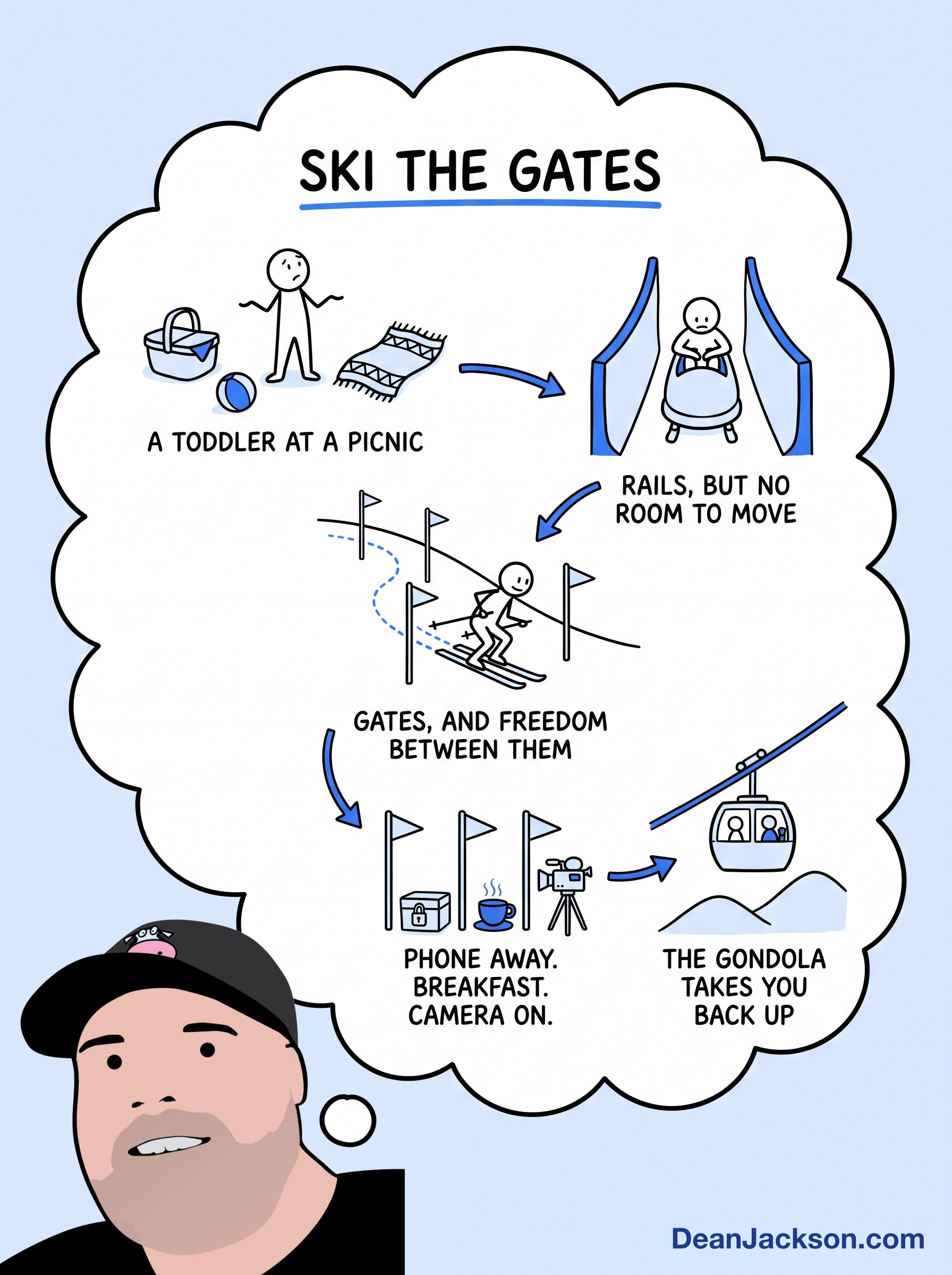
Ned Hallowell told me to run my days like a bobsled run. Too constraining. So I turned mine into a freestyle slalom instead... and just ski the gates.
Good morning.
I've been going back through thirty years of journals, and the thing that keeps striking me isn't how long ago it was.
It's that none of it feels like thirty years ago.
Every one of those entries was today when I wrote it.
Which means these videos we're making right now are just today, thirty years from now, when somebody looks back at them.
That's really why I'm doing them.
Now, here's the pattern I keep finding in those pages.
Yes, I was working out marketing concepts. Yes, I was doing the personal development things.
But underneath all of it, over and over, I was trying to answer one question.
How do I want to navigate my life through the fixed framework of twenty four hours in a day?
That's all any of us have.
And it matters more when you've got ADHD.
I didn't know I had it back then. I just thought everybody had trouble focusing... that it was a character defect I needed to work on.
Then I met Ned Hallowell.
He may be the world's leading expert on ADHD. Harvard trained psychiatrist, lots of books, the whole thing.
And Ned told me I need structure in my days.
He said to look at a day like a bobsled run. You get in at the top, you go down the course, and the rails keep you on track. You come out at the bottom having gone all the way through the trail you designed.
Otherwise, he said, you're going through your days like a toddler at a picnic.
That one landed. Because that IS a lot of my days... wandering around after whatever catches my attention.
But the bobsled never fit me.
Getting in at the top of the day with every moment already determined feels constricting.
What I actually respond to is urgency and novelty.
And what I value above almost everything else is freedom. Options. Sovereignty over my own day.
So I've been playing with ways to wrangle myself into getting things done without giving that up.
Here's where I've landed.
Not a bobsled run. A freestyle slalom.
I'm at the top, I'm going downhill, which is just time moving whether I like it or not.
In between, I can do whatever I want. All the artistry I like.
But I have to hit the gates.
The gates are times. And they're the few things that keep me on track for the best outcome I can get that day.
Here's my course.
It starts the night before, when I'm still firing on all cylinders. At ten, my phone goes in a lockbox... free of that dopamine addiction from ten at night until noon the next day.
That's the first gate for having an amazing day.
Lights out at eleven.
Out the door at eight.
Breakfast at Honeycomb, every morning. They know what I have. I've got an account there, so there's nothing to pay and nothing to decide.
No friction anywhere in it. That's the part that makes sure it actually happens.
Over breakfast I'm in my journal, working out what the insight for the day is.
At nine the camera goes on and I talk to you like this for eight to twelve minutes.
Ten until noon is blocked off as focus time. Creating, being in my journal, working on whatever I'm working on.
At twelve we leave. I watch that morning's video, put it on Facebook, and turn the transcript into the emails that go out to you.
Tuesday, Wednesday and Thursday, one until six is everybody else. Workshops, consulting calls, anything with another person in it. All of it lives in those hours.
Six thirty is a gate we call “meal 30”.
I'm down thirty six pounds now, by making sure the right food shows up at particular gates and taking the choice out of it.
That's been the big lesson in all of this. Eliminate the choice.
Then the evenings are free. Movies, Netflix, whatever we feel like doing.
Lights out at eleven, and round we go again.
I don't entirely know why my brain works this way, but it responds to the game.
Real consequences or ones I completely made up... it doesn't seem to matter. If there's a gate there, I hit it.
So that's the day. A series of slalom runs.
At seven we get in the gondola, and it carries us back up the hill, so we're at the top and ready to go again in the morning.
I'd love to know what would have happened if I'd had this approach back then, with all the ideas I was generating.
But we're here today. And we get to see where this path leads over the next thirty years.
Just keep skiing.
Here's your nudge for today.
Don't plan the whole day. Pick the three gates that would make it a good one, and put those in.
Then ski however you like in between them.
Transcript
Auto-generated transcript, provided as supporting material. It may contain errors, and speaker labels are occasionally mis-attributed.
Good morning. I am finding, in looking back in my journals, 30 years ago, what I'm struck by is the realization that it doesn't feel as much like 30 years ago as it feels like every moment I wrote in there was today. It sounds kind of meta, but the reality is these journal entries were literally today, back in 1997. And the things we're doing today — these videos we're creating — will just be today, 30 years from now, when we look back at it. That's really the reason I'm doing these, as a record of all of this.
A pattern I've recognized going through my journal is: yes, I was figuring out marketing concepts, yes, I was working on personal development, organizing and processing my thinking — but the thing that really comes up is figuring out how I want to navigate my life through the fixed framework of 24 hours in a day. That's really what we have, and it's especially important when I have ADHD. I've had to figure out workarounds for a lot of these things, and right now I'm at one of the best places ever for understanding it and compensating around it.
I didn't know I was ADHD at this point — I just thought everybody had trouble focusing, or that it was a character defect I needed to work on. Then I met Ned Hallowell, who may be the world's leading expert on ADHD — he's written lots of books, been on Oprah, a world-renowned, Harvard-trained psychiatrist. One of the things Ned told me in conversation was that I need structure in my days. He suggested I look at my days like a bobsled run — you start at the top, go through the course, there are rails that keep you on track, and you end up at the end of the day going all the way through the trail you've designed.
I thought, that's true, but he compared the alternative to going through your days like a toddler at a picnic — and I thought, that sounds like a lot of my days, just wandering around with whatever catches my attention. But for me, the bobsled idea always felt a little too constraining — getting locked in at the top of the day, then every moment going down a predetermined path, that feels constricting to me.
I've realized what's really important is that I respond to urgency and novelty, and I really prefer options and sovereignty over my day. I value freedom above everything else. But there are certain things I want to get done. So I've been playing with different ways to wrangle myself into getting things done, and I've hit on this approach: setting up my days not so much like a bobsled run, but like a freestyle slalom race.
I start at the top, I'm going downhill — representing that time is continually moving, I'm making progress — and I can do whatever I want in between, in the "artist's tree," whatever I want to do with the time. But I have to hit certain gates along the race course — certain times — that keep me on track for the best outcome.
It starts the night before, when I'm firing on all cylinders at 10 p.m. — my phone goes into a lockbox, freeing me from that dopamine addiction, from 10 p.m. to noon the next day. That's the first gate for having an amazing day: 11 p.m. lights out. I play these almost like there are consequences — I don't know why my brain works that way, but it responds to gamification, whether the consequences are real or imagined and self-imposed. 11 o'clock, lights out.
Then I'm out the door at 8 a.m. every day. To create these videos, for instance, we've attached them to things I'm already doing. We're out the door at 8, we're here at Honeycomb for breakfast every morning — they know what I have, everything's set up for no friction, I have an account, they just prepare the breakfast, I don't have to pay for anything, it's effortless.
While we're having breakfast, I'm looking through my journal and recognizing what the insight for the day is. Then at 9 a.m. we flip the camera on and I talk like this for 8 to 12 minutes. The next gate: from 10 a.m. to noon, I've blocked off as focus time — creating, working on things I'm working on. At 12 we leave, and I go through the process of watching the video we created that day, because we post it on YouTube to land at 11 a.m.
So at noon I'm watching this, uploading it to Facebook, and creating the daily emails from the transcript. Then from 1 o'clock, the whole afternoon on Tuesday, Wednesday, Thursday, from 1 to 6 — every Zoom appointment, everything involving other people, whether lead conversion workshops, consulting calls, or any kind of meeting, happens in that 1 p.m. to 6 p.m. window.
At 6:30, that's a gate we call "meal 30" — I'm down 36 or 37 pounds now by setting up a systematic way of making sure the right food is being consumed at particular gates along the day, eliminating choice from that. That's the big thing I've learned doing this. Then the evenings are free for doing whatever you want — I love watching movies, Netflix, just relaxing. Then lights out at 11, and back again.
So I look at it — it's a pretty fun thing to see your life as this series of slalom runs every day. Imagine at 7 o'clock we get in the gondola, and the gondola takes us back up the hill, so when we wake up in the morning we're ready to go again. That's kind of how I've been gamifying my time. I'd love to see what could have happened had I had this kind of approach and strategy with all the ideas I was generating in 1997. But we're here today, and we get to see in 30 years where this path leads. It's the fun thing — just keep skiing.
I got a funny email the other day from Rick. It says, "Dean, question. Are you saying you can teach me to make fat stacks by hanging out at a pub drinking coffee like you?" And I laughed to myself, because I was thinking — you know, yes, I can do that. That's what I do. The funny thing I really realized is that every idea I've had, every dollar I've made over the last 30 years, has gone through my brain, through my pen, onto a piece of paper in my journal before it went out into the real world.
And if I can turn people on to that activity as a driver for what to do, what to think about, what to ask yourself to draw out what the next most valuable action is for you, and how to find the most profitable things you can install in your business — I'm all for it. So this Friday at 1 p.m., I'm going to do, for the first time, a 50 Minute Profit Finder workshop. And you're going to join me live on Zoom. We're going to go through a 50-minute exercise. Bring your pen, bring a notebook or piece of paper, and I'm going to guide you through a thinking process that will help you identify where the lowest-hanging fruit is in your business — and maybe some fruit you didn't even know was there, but I'm going to show you where to look for it. So it's free. It's for you. It's Friday at 1 p.m. This Friday. Just go to 50minuteprofitfinder.com and I'll get you all the details. And hopefully you can join us then, Friday at 1 p.m.
Get BreakthroughDNA Free
Discover the 8 Profit Activators that can transform your business. Get the complete framework, free.