What Would You Do If You Could Count on You To Do It?
Watch
Listen

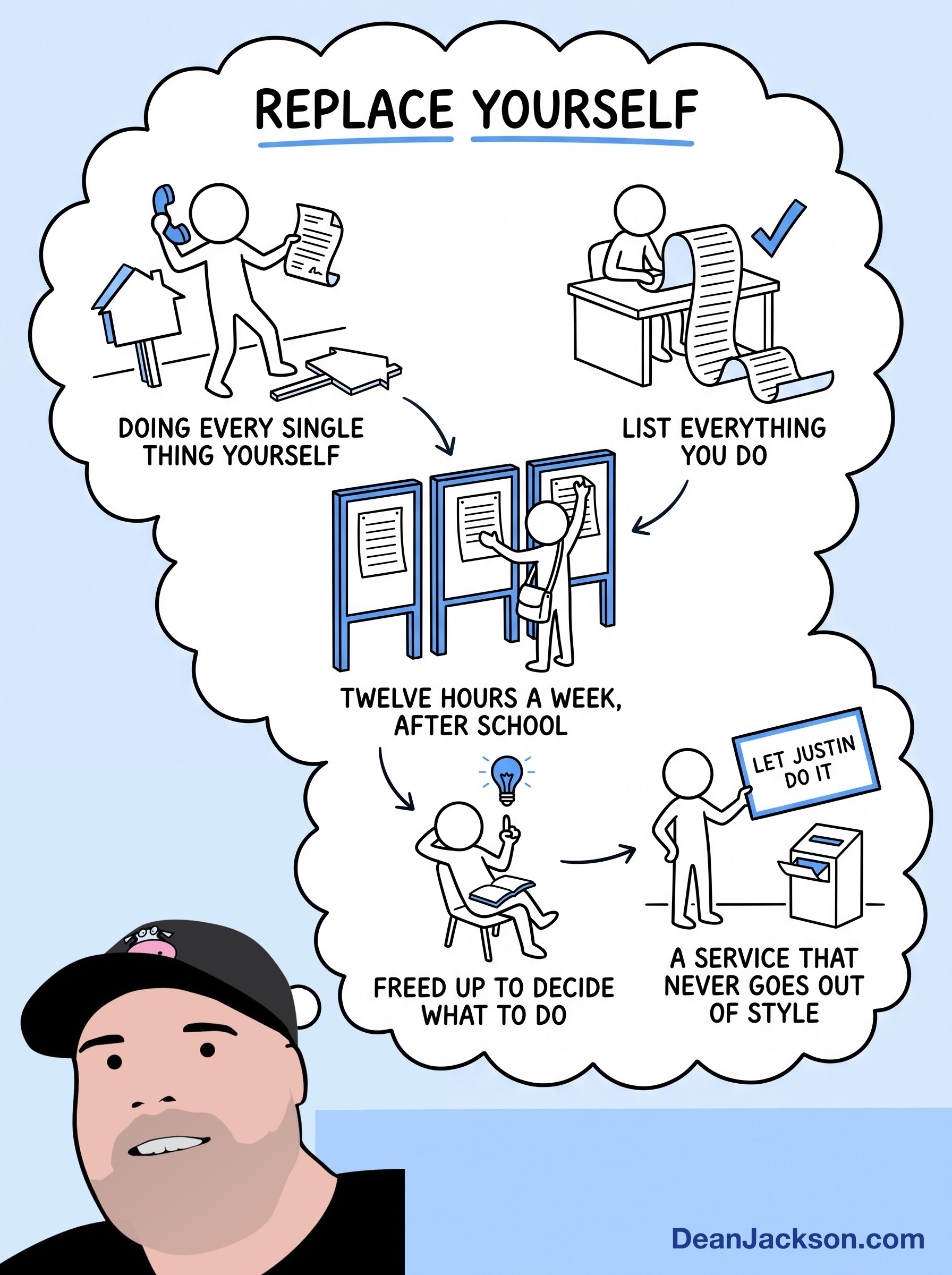
My cousin Steven worked twelve hours a week after school, and it left me doing only what only I could do. So what would you do if you could count on you?
Good morning.
I keep finding a through line in these journals.
We're back in journal number six, middle of 1997, and I came across something that reminded me of what happened five years before that in my own business.
I think this one is so reliable it's still true today, and it'll keep being true.
Here's the shape of it.
You start out in business and you're the sole proprietor. You're doing all the things. You're busy.
Then you start applying marketing, and you reach a point where there's more to do than you have time to do.
But here's what's easy to miss. Most of what marketing creates is leverage.
A lot of it doesn't require you to do it yourself.
This started for me with The E-Myth. Michael Gerber, working on your business instead of in it.
Before that book I was making cold calls every day, setting the appointments, going to the appointments, doing all of it.
Then I read Tom Peters' The Pursuit of Wow.
He challenged you to make a list of everything you do... and then work out what it would take to replace yourself in each one.
Ten years later he turned that into The Professional Service Firm 50. His idea was that every department inside a business should be thought of as its own service firm, delivering an outcome, with exactly one customer.
So I went and looked at my real estate business, and it turned out almost nothing that needed doing actually depended on me doing it.
By the end I was down to the listing presentations, talking with people about selling their house, and negotiating the contracts.
A very narrow area in Halton Hills. That was the whole of it.
Now here's the part I want you to hear.
I had a cousin, a few years younger than me, still in high school.
I gave him a job. Minimum wage was about five dollars back then.
Steven would come to my office and we'd set a cadence.
He'd go and replace all the infobox flyers on my listings.
We had a route of forty or fifty bulletin boards around town, public notice flyers with a tear-off tab pointing to a recorded message. He'd refresh every one of them.
He'd replenish the take-one boxes at the cash registers of local businesses... the Guide to Halton Hills, the Six Steps to Home Ownership.
Signs to put up, he put them up. Documents to deliver, he delivered them.
Twelve to fourteen hours a week, after school.
And it completely freed me up to do the creative work of deciding what to do.
That's the real prize.
Because the great thing about being a creative thinker is that there's never a shortage of ideas about what we could do.
The trick is getting those things to actually happen.
So here's the question.
What would you do if you could count on you to do it?
We filter ourselves constantly. We don't even let the idea finish, because somewhere underneath we already know we don't want to do the work it would take.
But set it up as a recurring cadence and it's a different thing entirely.
Every single week I could have fresh flyers on all of those bulletin boards. I didn't have to do it. It just continued to work.
Now, here's what brought all this back to me.
I had an even younger cousin who'd just got his driver's license.
I told him what Steven had been doing for me in Toronto five years earlier, and we made him business cards.
They said "Let Justin Do It."
Underneath that: don't spend your time doing low-value activities.
And then the list. Delivering documents. Putting up signs. Taking pictures. Getting pictures delivered. Dropping off and picking up keys. Filling infoboxes.
All available services from Justin.
He walked into a couple of real estate offices and set up a little drop box in each one.
An intake form so people could tick off what they wanted done, and an envelope for keys or anything that needed replacing.
Every day after school he'd collect whatever was in his box and go and do all of it, charging pro-rated on the time it took.
Completely self-directed. I loved it.
But here's the thing sitting underneath it, and it's really why I'm telling you this.
He was providing a service that will never go out of style.
People want things done and can't count on themselves to do them... or it simply isn't worth their time.
They're nowhere near ready for a full-time assistant. They just need the specific things doing.
There's an opportunity sitting right there.
And it goes all the way up.
Start thinking about the highest-level things you could take off somebody's plate.
If you can predictably deliver an outcome they really want, and it saves them time on something they'd otherwise have to do themselves, that's an amazing position to be in.
Package what you do as a way for people to save time, save effort, have the thing happen push-button without them touching it.
You're on the right track.
Here's your nudge for today.
Write down the three things you keep quietly deciding not to do, because you'd have to be the one to do them.
Then work out what it would cost to have somebody else do them on a cadence.
Transcript
Auto-generated transcript, provided as supporting material. It may contain errors, and speaker labels are occasionally mis-attributed.
Good morning. I'm starting to see a through line in a lot of the concepts and things I was thinking about in my journals. We're back in 1997, journal number six, mid-year 1997, and I saw something that reminded me of something that happened five years earlier in my own business. I think this one thing is so reliable that it's absolutely true today and will continue to be true.
If you start out in business, most of the time you're the sole proprietor, you're doing all the things, you're getting busy. If you start applying marketing, you'll get to a point where there's more to do than you have time to do. But at the same time, a lot of the things marketing creates are leverage — a lot of it doesn't require you to do it yourself.
The beginning of this was when I read The E-Myth by Michael Gerber, and he talked about the concept of working on your business instead of in it. Prior to Michael Gerber, I was making cold calls every day, setting up appointments, going to the appointments, doing all the stuff. Then I read Tom Peters' great book, The Pursuit of Wow, and he challenged readers to make a list of everything you do and see what it would take to replace yourself in that. He viewed this as the beginning of a concept that, 10 years later, he'd put into a book called The Professional Service Firm 50 — his contention was every division, every department of a business should be thought of as a professional service firm providing an outcome for the parent organization, with only one customer.
So many of the things that needed to be done in my real estate business didn't depend on me doing them. I started thinking: how could I replace myself in this? By the end, it was really just me doing the listing presentations, talking to people about selling their house, and negotiating the contracts — a very narrow area in Halton Hills.
Part of my first thought, doing the marketing things — the little lead-gen business cards, the public notice flyers, the infobox flyers — was putting all of those in place. I had a young cousin, a few years younger than me, in high school at the time. I gave him a job as a service provider for me — minimum wage was like $5 back then. Steven would come to my office, and we'd set up a cadence: he'd go replace all the infobox flyers on the listings I had. We had a route of about 40 or 50 different bulletin boards around town where we'd put up public notice flyers with a tear-off tab directing people to a recorded message. He'd refresh the bulletin boards, replenish the "take one" boxes at cash registers of local businesses that offered the Guide to Halton Hills and the Six Steps to Home Ownership. Every time I needed a sign put up, he'd do it. He'd deliver documents to another office. All of this. He was working about 12 to 14 hours a week after school, and it completely freed me up to do the creative work of deciding what to do.
The great thing about being a creative thinker is there's no shortage of figuring out what we need or want to do — the trick is getting those things to happen. Think about what you would do if you could count on you to do it. So many things we filter ourselves on because we don't want to actually do the work it would take to make it happen. But when it's set up as a recurring cadence — every week I could have fresh public notice flyers on all the bulletin boards, and I didn't have to do it, it just continued to work.
What made me think of that was: I had an even younger cousin who'd just gotten his driver's license. I explained the thing I had my cousin do for me in Toronto five years earlier, and we set up little business cards for him that said "Let Justin Do It" — with the line "don't spend your time doing low-value activities" — and a list of things: delivering documents, putting up signs, taking pictures, getting pictures delivered, dropping off and picking up keys, filling infoboxes. All available services from Justin.
He went into a couple of real estate offices and set up a system with a little drop box in the office, with an intake form people could check off for what they wanted Justin to do, and an envelope for keys or anything that needed replacing. Every day after school, he'd go pick up what was in his inbox and go do it all, charging pro-rated on the time it took. It was such a great little self-directed thing.
But the value of it is providing a service that will never go out of style: people want to do things but can't count on themselves to do them, or it's not worth their time. If there's an easy solution — they're not ready for a full-time assistant, but setting up somebody to do the specific things that need doing — there's an opportunity there. If I were starting out as a young high school kid whose alternative is working at 7-Eleven or some minimum-wage job, this feels like it'd be a really good thing.
And by the way, this goes all the way up. When you start thinking about the highest-level things you can take off people's plates — and you can predictably deliver an outcome they really want and value, that saves them time on something they'd otherwise have to do themselves — that's an amazing thing. If you can package what you're doing as an opportunity for people to save time, save effort, do things completely push-button without having to do it themselves, I think you're on the right track.
I got a funny email the other day from Rick. It says, "Dean, question. Are you saying you can teach me to make fat stacks by hanging out at a pub drinking coffee like you?" And I laughed to myself, because I was thinking — you know, yes, I can do that. That's what I do. The funny thing I really realized is that every idea I've had, every dollar I've made over the last 30 years, has gone through my brain, through my pen, onto a piece of paper in my journal before it went out into the real world.
And if I can turn people on to that activity as a driver for what to do, what to think about, what to ask yourself to draw out what the next most valuable action is for you, and how to find the most profitable things you can install in your business — I'm all for it. So this Friday at 1 p.m., I'm going to do, for the first time, a 50 Minute Profit Finder workshop. And you're going to join me live on Zoom. We're going to go through a 50-minute exercise. Bring your pen, bring a notebook or piece of paper, and I'm going to guide you through a thinking process that will help you identify where the lowest-hanging fruit is in your business — and maybe some fruit you didn't even know was there, but I'm going to show you where to look for it. So it's free. It's for you. It's Friday at 1 p.m. This Friday. Just go to 50minuteprofitfinder.com and I'll get you all the details. And hopefully you can join us then, Friday at 1 p.m.
Get BreakthroughDNA Free
Discover the 8 Profit Activators that can transform your business. Get the complete framework, free.