How to Make Your Marketing Feel Like a One-on-One Conversation
Watch
Listen
Claude Hopkins taught me every purchase is made by one person. So stop broadcasting to the mass. Here's how I turn an opt-in into a one-on-one conversation.
Good morning. Maybe the deepest lesson I ever took from Claude Hopkins is this.
People buy things as individuals.
One person is the unit of measure. That's who we're trying to attract. One.
And here's his line from My Life in Advertising.
In a wide reaching campaign, we're too apt to regard people in the mass. We must get down to the individuals. We must treat people in advertising as we treat them in person.
Think about basketball for a second.
There's man to man, and there's the zone.
And the danger with modern funnels is that they play the zone. Everybody gets shuffled through the same process. You're hoping something appeals to somebody.
But there's no such thing as a national market.
Every market is local. Every purchase is made by an individual.
So what did Claude do about it?
Catalogs.
Instead of running ads to convince people to buy, they offered a catalog. And the catalog got people who were interested in a category to raise their hand.
Then they treated each one as an individual.
He worked with a company selling sewing machines. And a woman writes in. She's got that machine and nothing else on her mind.
The general plan was to send everybody the same catalog, all inquiries alike.
Claude said no. Every inquirer should be treated like a prospect who walked into the store.
And I say that all the time.
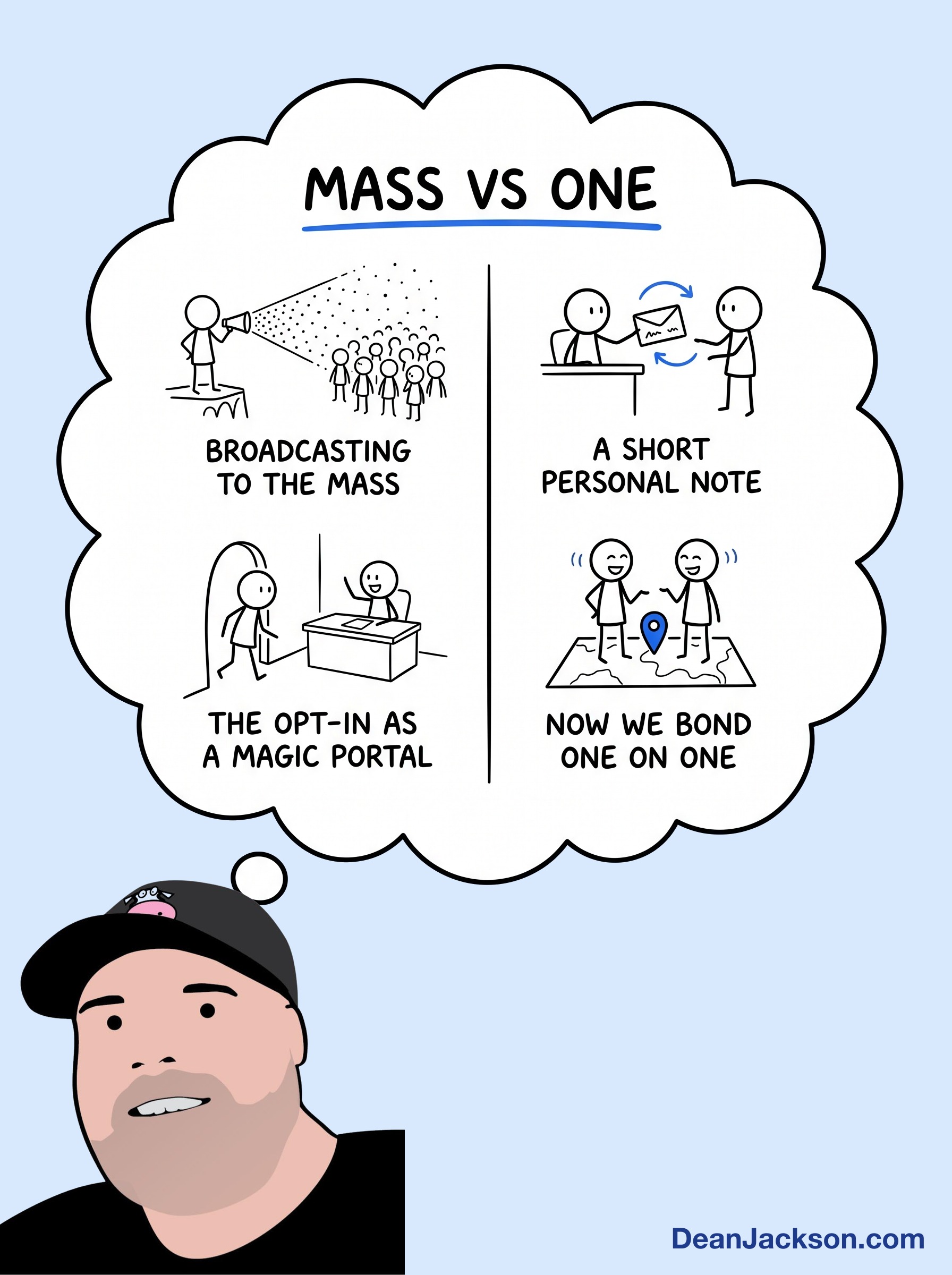
Imagine your opt-in page is a magic portal. Somebody hits submit to download your book, and they get transported straight into your office.
They stick their head in and say, hi, I'm here about the sewing machine catalog.
Now you know exactly who that person is.
So here's what I did with it.
We had a product called Money Making Websites. Websites for realtors. Five times more expensive than what they could get anywhere else.
And I did not try to convince anybody to buy a website.
I ran ads offering a free book about growing your real estate business.
Because that told me who was interested in growing. Not who wanted a website. Who wanted to grow.
And the next day, a note. Hi Josh, welcome aboard. Here's the book. What's your mailing address? I'd like to send you our welcome kit.
Simple. But now we're in a dialogue.
I'm offering to send them something else, free.
And as people replied with an address, I'd look at my map of where our clients already were.
Josh is in Lakeland. So I'd say, oh, you're in Lakeland. Do you know Julie Matthews? I worked with her on livinginwinterhaven.com, and I'm looking for someone in Lakeland. Would you have time to work with a couple of new buyer clients a month?
And look what just happened.
I know he wants to grow, because he downloaded the book.
I know he's in Lakeland, because he told me his address.
And now I'm just asking, would you have time to work with a couple of new buyers?
I never once explained how the website works.
I'm bypassing the whole thing.
All conversationally.
And this is the genesis of the 9-word email. The spear email. Short, personal, expecting a reply.
Email treated as a dialogue. Inviting a response. Not broadcasting a stack of pre-written messages that shuffle people through a machine.
Now we're bonding one person at a time.
We did the same with the birthday postcards.
Cold email, just asking, do you do birthday parties?
And that pulls a yes, we do.
Then, I've been working with Roy's Restaurant in Sarasota on some birthday marketing, and I'm looking for someone in Tampa. Could you accommodate five or six birthday parties next month?
We never mention what we want to sell them.
We just engage, one on one, about what they're interested in.
That lesson is one of the deepest things I ever took from Claude.
Stop broadcasting.
Talk to one person.
Transcript
Auto-generated transcript, provided as supporting material. It may contain errors, and speaker labels are occasionally mis-attributed.
Good morning. I think maybe one of the greatest lessons that I learned from Claude Hopkins in reading My Life in Advertising is that people buy things as individuals. That one person is the unit of measure that we're trying to go, that we're trying to attract. He said, I'm going to quote from the book here. He said there I learned another valuable principle in advertising.
In a wide reaching campaign, we're too apt to regard people in the mass. We try and broadcast our seed in the hope that some part will take root that's too wasteful to ever bring a profit. We must get down to the individuals. We must treat people in advertising as we treat them in person. And I see this, that I've come to describe this as playing a difference between if you're thinking sports or basketball now of playing man to man versus playing a zone.
And sometimes the danger with modern funnels is that they are treating everybody as a mass. That you're just funneling people through this zone process and hoping that you're appealing to everybody and that, that will, that that will get it. There's no such thing as a national market. Every market is local and every purchase is made by an individual. And one of the things that Claude would do here is they would, they would use, and I use this a lot and I know this is probably generated from subconsciously me reading about this all those years ago, nearly 40 years ago now they used catalogs a lot.
Finding people. Rather than trying to run ads that convince people to buy things, they would offer catalogs that would get people who are interested in a category to raise their hand to tell them that they were interested. And then they would treat each person as an individual. So one of the companies he was working with sold sewing machines. And he said my everlasting lasting argument was, was against dealing with people in the mass.
For instance, a woman wrote in about a sewing machine. She had that and nothing else on her mind. The general plan then was to send a catalog treating all inquiries alike. I urged that every inquirer should be treated like a prospect who came to a store. And I say that all the time.
That imagine if your opt in page was a magic portal that as soon as somebody pressed submit to download your book or your catalog or your lead magnet, whatever you're using, that, that magically transported them into your office. So they're sticking their head in the office and saying hey, I'm here about the sewing machine catalog. Now what you know is that you've got somebody who is interested in catalogs and you Know who that one is? So it was very interesting. So they had a special catalog on sewing machines showing every style and every price.
We sent every inquiry the names of all in her vicinity who had bought our sewing machines. Now I used this, this was a great thing. And I learned it reinforced in the Robert Collier letter book, which I would read in later years. And I'll go a little bit deeper on it then, but we had a product called money making websites. This was websites for realtors.
And rather than try and convince people to buy our websites, which were expensive at the time, I mean they were five times more expensive than a normal real estate website that people could get at the time. But I would run advertising offering a free book people about growing their real estate business. That's really what the thing was. I wanted people who were interested in growing their business, not trying to convince them to buy our website, but to indicate their interest in growing their business as a realtor and taking this one to one approach. We would welcome people when they here's the book.
And then the next day I would say, I would send a note to them welcoming them aboard, say, hi Josh, welcome aboard. Here's the book. What's your mailing address? I'd like to send you our welcome kit. Now that was a very just simple thing that we're engaging in a dialogue.
I'm offering to send them something else for free. And as people would respond with their mailing address, I would reckon see where they are. I would look at our map of where all of our money making websites clients were and I would mention the person immediately next to them. So let's say that Josh replies and he's in Lakeland. And I would say to him, oh, you're in Lakeland.
Do you know Julie Matthews? I worked with her on her website livinginwinterhaven.com and I'm looking for somebody to work with in Lakeland. Would you have time to work with a couple of new buyer clients a month starting or just. I would say that. Would you have time to work with a couple of new buyer clients?
And of course people, people would always now move forward A I know they're interested in growing their business because they downloaded a book about it. I know that they are in Lakeland, Florida because they told me what their mailing address was. And now I'm just inquiring, would you have time to work with a couple of new buyer. I'm bypassing the whole. I've never even mentioned how this works, but I'm getting to the point.
Where I'm finding people who live in a particular area who have an interest in growing and have time to take on a couple of new clients all very conversationally. This is the genesis of where the nine word email and the things that we call the spear email, short, personal, expecting a reply, treating our email as a dialogue where we're inviting a response and using email as the most powerful tool that it is is to engage in a dialogue rather than just broadcasting a series of pre written messages meant to funnel and shuffle people through a process where in an automated way they get generic messages about something. Now were bonding with them one person at a time. We did the same thing with my postcard males, Jim Morton with those guys they would do birthday prospecting and when people would, we would reach out to people in, you know, cold email basically just asking them do you do birthday parties? And that would elicit a reply of yes we do birthday parties.
We've got the whole thing perfect. I've been working with Roy's Restaurant in Sarasota on some birthday marketing and I'm looking for someone to work with in Tampa. Could you accommodate five or six birthday parties next month? We're not saying to. We're not at all focusing on what our desire is for them to buy my website or for them to buy a campaign of birthday postcards to people in their area.
We're just engaging with people one on one about what they are interested in. And that is a. That lesson is one of the deepest things that I've taken from my life in advertising. And it's been an integral part of my life. Applying my life in advertising.
Every idea that I've had, every dollar that I've made over the last 30 years has gone through my brain, through my pen, onto a piece of paper in my journal before it went out into the real world. And if I can turn people on to that activity as a driver for what to do, what to think about, what to ask yourself to draw out what the next most valuable action is for you and how to find the most profitable things that you can install in your business. I'm all for it. So, so this Friday at 1pm I'm going to do for the first time a 50 minute profit finder workshop and you're going to join me live on Zoom and we're going to go through a 50 minute exercise. Bring your pen, bring a notebook or piece of paper and I'm going to guide you through a thinking process that will help you identify what where the lowest hanging fruit is in your business and maybe some fruit that you didn't even know was there.
But I'm going to show you where to look for it. So it's free. It's for you. It's Friday at 1:00pm this Friday. Just watch.
Go to. What did we call the website, Josh?
Just go to 50minuteprofitfinder.com and I'll get you all the details and hopefully you can join us then. Friday 1:00pm.
Get BreakthroughDNA Free
Discover the 8 Profit Activators that can transform your business. Get the complete framework, free.