How I start every ad, letter, postcard or marketing piece
Watch
Listen
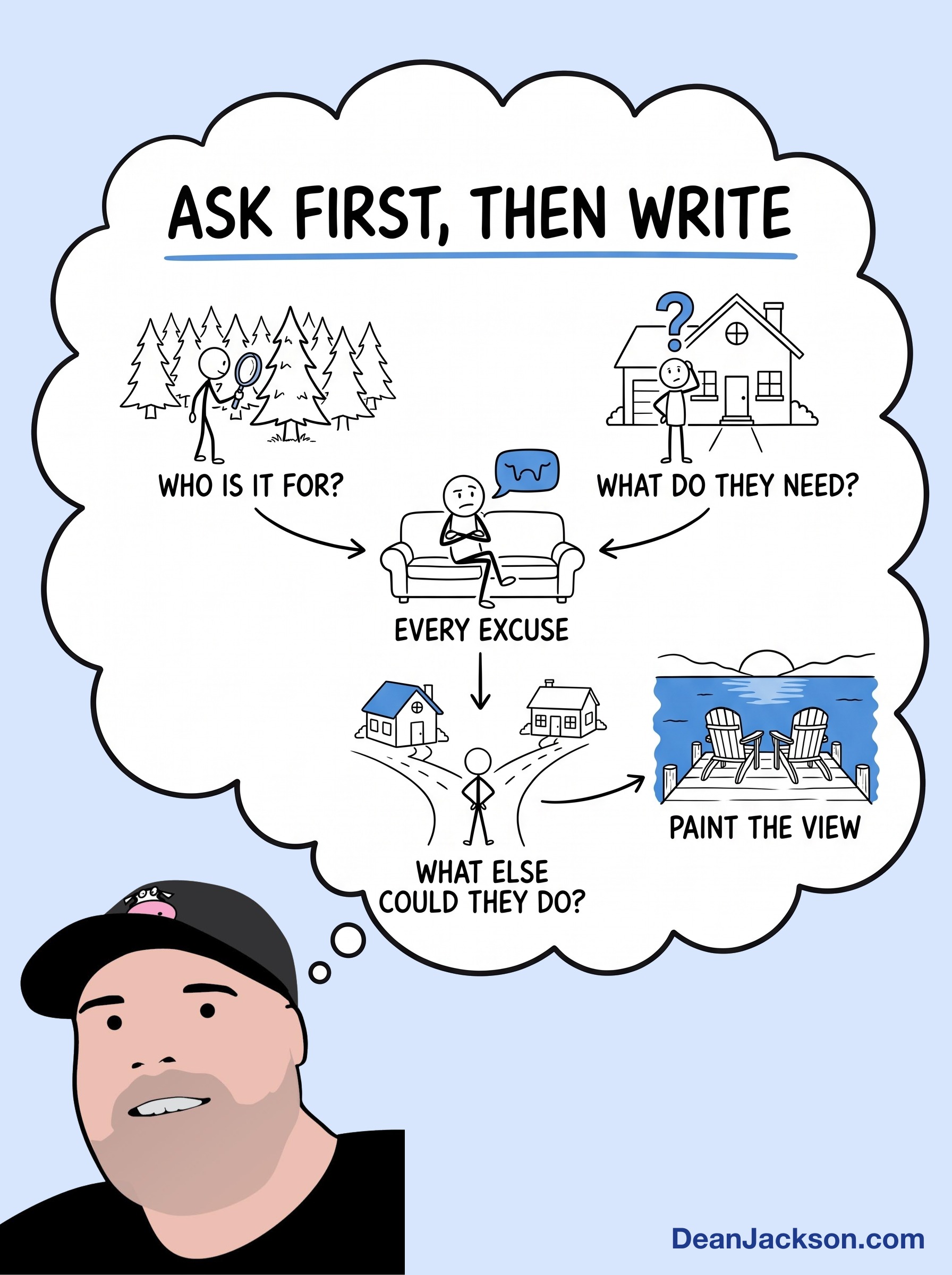
Before I write any ad, letter or postcard, I ask the same questions, adapted from Steve Scott's infomercial scripts. Start with who, then their excuses.
Good morning.
A couple of days ago I talked about how to get anything started and done.
One of the tools I use is having a framework. A checklist or a formula for doing things.
Because when you're creating marketing materials, whether it's a brochure, an ad, an email campaign or a funnel... we tend to think about the whole thing.
Not the steps that make it manageable.
"Work on the sales letter" gives you nothing to latch onto. It can even be a way of avoiding it.
In November 1997 I was introduced to a book called A Millionaire's Notebook, by Steve Scott.
Steve was one of the pioneers of infomercial marketing. Billions of dollars of products sold.
And in a couple of chapters he shows exactly how he writes the scripts.
So I adapted that into the procedure I use to start every new project.
It starts with questions.
Who is my ideal customer?
Not "homeowners." That's the forest. Get down to the individual trees.
Let's say you want listings in Winter Haven real estate. It could be condos, lakefront homes, acreage, horse farms...
When you list them out, some jump out at you. Especially the highest value prospects.
That's why you hear me talk about lakefront so much.
Then... what problem or need does this solve?
It's just as valuable to think about who's NOT likely to be your customer.
Then, what's every excuse for not taking any action at all?
Call it the enemy. The reason somebody does nothing.
Then, what's every excuse for not buying from me? Maybe their best friend is a realtor.
And what are the other possible solutions? What will people do instead of me?
Steve Scott would list every possible question and objection... and answer each one.
An infomercial is really just a VSL. A delivery device.
And the one I learned the most from... what images could I build emotional word pictures from?
We have an ad for lakefront homes in Winter Haven, and the picture isn't the house.
It's the view from the dock at sunset. Two Adirondack chairs looking out over the lake.
That's what people really want.
Nobody dreams of looking up at a high-rise condo. They want to be inside it, looking out over the city.
All of this becomes an idea palette you draw from for every headline, offer and email.
It's like stepping onto a moving sidewalk.
So before you write the next ad... ask the questions first.
Join me live on the next free 50-Minute Profit Finder call, Friday, October 9 at 1:00pm ET. Save your spot →
Transcript
Auto-generated transcript, provided as supporting material. It may contain errors, and speaker labels are occasionally mis-attributed.
Good morning. Welcome back. And I don't want to jinx it, but we are at something like 307 days in a row where we've shot outside in the morning in Florida, no rain, so knock on wood, we'll keep going.
A couple of days ago, I did a video about how to get anything started and done quickly. And. And part of the thing that I use as one of the tools is having frameworks or procedures having kind of a. I think of them as checklists or formulas for doing things. Because sometimes when, especially when you have a product, if you're going to create marketing materials, whether you're creating a brochure or an ad or an email campaign or funnel or whatever it is you're doing, we have a tendency to think about it as the whole thing without thinking about the steps that break down the process into something manageable.
And so I've learned this about me, that one of the easy things for me to do is to brainstorm. And sometimes having the vocabulary to describe what it is you're doing can make a big difference. And so, you know, work on or finish or just even the noun. Often when we say work on, sales letter or, you know, you're making your to do list and you just put the. The noun of what it is that you're going to do. It doesn't give you anything to latch onto, and it doesn't give you any. It can be an avoidant. So for me, the frameworks are what really helped me get all of the pieces together.
When I at this time, this is November 1997, I was introduced to a book by a gentleman called Steve Scott, and it was A Millionaire's Notebook. And Steve Scott was a guy who was one of the pioneers in infomercial marketing. He did things like "Where There's a Will, There's an A," and the Lori Davis hair care products and, you know, many, many different infomercial products, billions of dollars of things sold. And this book, I almost couldn't believe how valuable. Part of the. Part of this book is chapter six and chapter 11, for instance, show exactly the process of how he writes the scripts for these infomercials.
So I adapted that to create a procedure that helps me get all my ducks in a row, especially when I'm starting a new project. So the first thing that I start with, I start just asking the questions, right? Who is my ideal customer? And that always gets you started, because many times when you think about one thing, when you think about your product as just one thing or your service you think about the generalized word to describe who it is. So whether, you know, the worst thing would be men or women or homeowners or whatever it is is just a broad umbrella term. But the closer you can get to identifying not just the forest, but the individual types of trees in there.
So if we take, for instance, Winter Haven Real Estate, if our thing is to get listings in real estate in Winter Haven, there's lots of different ideal customers, and there's lots of different reasons that people would. Would sell. And so you start to think about, well, it could be condos, it could be lakefront homes, it could be acreage, it could be horse farms, it could be when you start listing out all of the potential people, some of them are going to jump out at you. Because one of the things that I've really learned as a shortcut is to identify the highest value prospects. And that's why you've heard me talk about lakefront as a, you know, as the most.
That's the most expensive homes in Winter Haven, they're the most desirable. So looking at those and getting clear on who your ideal customer is and then imagining them. So now you're thinking about this particular person. And then the next question that I ask is, what is the problem or need that this product or service is going to solve? So when you think about what are the reasons that somebody would need, what it is that you do, and it may go on a spectrum from we need, you know, we absolutely have to sell our house, or we absolutely need to get your product or service all the way down to, you know, I probably never would.
It's valuable for you to think who's not likely to be your customer, you know, what are the problems that this isn't going to solve? And I think about all these things as a palette, an idea palette that I'm going to draw from as I'm creating all of the marketing materials, the offers, the headlines as the most important thing, they might jump out at you. So now I start looking at what is every possible excuse or reason that someone could have for not taking any action on your. On this problem that you've identified. Because sometimes people, you know, it's good for you to understand the thinking behind why your prospect may or may not even do anything about it.
So if you start and identify who the. Let's call it the enemy, who's the enemy? The enemy is the reason somebody might not do it at all. And some of them might be valid, but when you look at it, it helps you eliminate people. Then I go on to a subcategory of that which is what is every possible excuse for not purchasing my solution? So why would they not do anything at all in the category or. And then why would they not do it with me? Why would they. What would be the possible excuse for not purchasing my solution? And it may be that their mother is a real estate agent or that they, you know, have a, their best friend as a realtor or whatever the reason is.
But even that we've found ways around and I'll tell you some of those in in future ones. Then the other, the completing out that trifecta is what are the other possible solutions? So if they're not going to do anything at all, why is that, why is it that they wouldn't maybe do something with me? And what are the other possible solutions? What are people going to do instead of me? That's a really valuable thing to realize is examining putting yourself in their shoes and wondering what are the other possible solutions for this? And then one of the things that Steve Scott would do is he would list all of the possible questions or objections and then he would answer individually those.
And that used to draw from that as in the way that you present the information is how we create the emails or the video script or whatever. You know, infomercial is really a VSL, you know, it's just a delivery device. And you know, often those have been pretty amazing. So if you look at what's available for you, you know, might be good to go back and look at some of the infomercial models because they work really well. And then what images could I build emotional word pictures from? And that was something that was really a valuable insight that I learned from listening to Steve Scott or reading about Steve Scott is building emotional word pictures.
So when you think about what are the images that are in people's minds when they are. When they're thinking about buying or selling a lakefront house or a oceanfront home or whatever it is. And I'm just realizing now that one of the greatest things that I've done is creating a. We've got an, We've got an ad that we've used very successfully for high end things. So, so even the lakefront homes and the headline is if you're looking for an amazing lakefront home in Winter Haven, read this. And above it is this amazing picture from the POV of the person. So not looking at the home.
It's not about the thing. The imagery that we use is what would be the, the point of view of the person who has the lakefront home. They're sitting on the dock at sunset in Adirondack chairs looking over the lake. That is why one of the major reasons that people want a lakefront home or an oceanfront home or a view home, you know, a lot of those things are what creates that emotion. And so we've used that with oceanfront condos. We've used it with oceanfront things. I've used it with view homes in, in Paradise Valley in Arizona looking over the, the lights, city views from Atlanta, high rise condos.
Nobody. It's not a dream to look up at a high rise and think, oh, that's what I want. What they really want is they want to be in the condo looking out over the city and seeing those amazing views. So looking at those things as the, the starting point, gathering all of your kind of taking a walk in their shoes, taking a walk and understanding from their perspective what's actually the emotional climate, what, what are the words and the images that are going through their mind. Having all of this to draw from makes creating your marketing materials so much easier, especially if you have a breakdown of what you need to be able to do it.
So I'll share my, the framework for my. For marketing materials next. But this is the starting point. This gets you all of the emotional and imagery and word pictures that you're going to be able to draw from when you create these things. And that makes this manageable. Instead of saying, finish it, brainstorm is a really good way. And when you're brainstorming from an outline like this, the ideas just kind of stimulate. It's like putting stepping on a moving sidewalk. You kind of have the framework laid out for you.
Every idea that I've had, every dollar that I've made over the last 30 years has gone through my brain, through my pen, onto a piece of paper in my journal before it went out into the real world. And if I can turn people onto that activity as a driver for what to do, what to think about, what to ask yourself to draw out, what the next most valuable action is for you and how to find the most profitable things that you can install in your business, I'm all for it.
So this Friday at 1pm, I'm going to do for the first time a 50 minute profit finder workshop. And you're going to join me live on Zoom. And we're going to go through a 50 minute exercise. Bring your pen, bring a notebook or piece of paper and I'm going to guide you through a thinking process that will help you identify where the lowest hanging fruit is in your business and maybe some fruit that you didn't even know was there.
But I'm going to show you where to look for it. So it's free. It's for you. It's Friday. At 1pm this Friday. Just watch.
Just go to 50minuteprofitfinder.com and I'll get you all the details and hopefully you can join us then. Friday 1:00pm.
Get BreakthroughDNA Free
Discover the 8 Profit Activators that can transform your business. Get the complete framework, free.