How to start a journal and watch it change your life
Watch
Listen
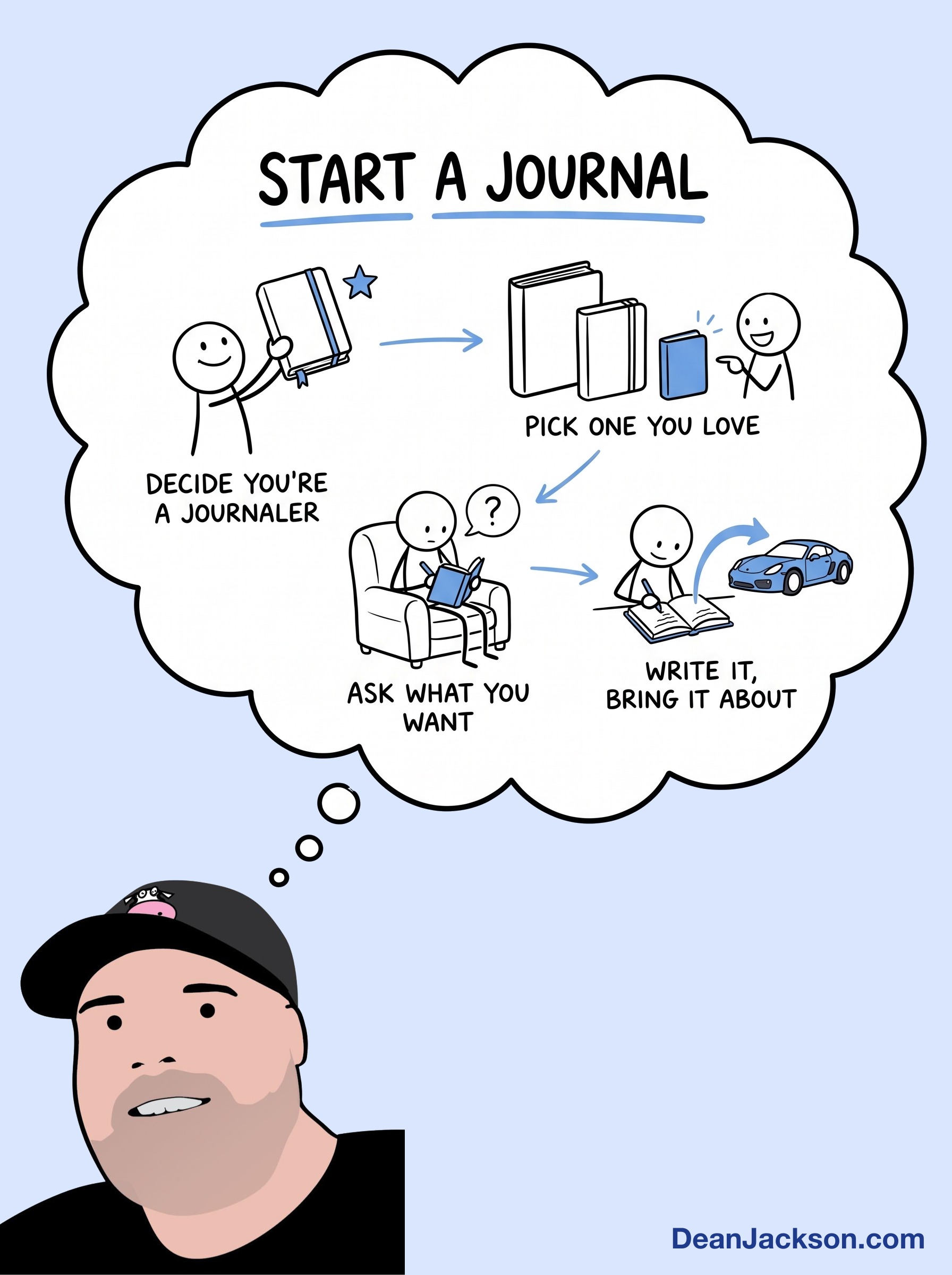
Dean's been journaling since April 1996. How to start: decide you're a journaler, pick a journal you love, and use lists and questions to begin.
Good morning.
We're leaving breakfast, heading to the cafe, and I want to talk about the practicalities of journaling.
I get a lot of questions about it. How do you actually do it? How do you get started?
The number one thing... decide that you're a journaler.
I made that decision in April of 1996.
I'd always written things down. Thinking on paper, notebooks, goals and affirmations going all the way back to tennis.
But I'd never kept any of it.
It was Joe Stumpf who showed me journaling as something worth archiving. So I followed his lead and bought an archival accounting record. Blue lines, one page, no columns.
That was my journal for the first 10 years.
Just deciding it was worth keeping made it feel different.
So that's decision one. Turn pro, and keep it.
Then get a journal you're happy with.
After the accounting books I had a whole Moleskine phase. About 10 years ago I switched to the pocket-size hardcover, and for me that's the perfect balance. I can write in a comfy chair, in the car, anywhere.
Then get into the routine.
I'll often take 20 or 30 minutes before a focused work session to free write in my journal.
Start with lists. Ask yourself questions.
I used to do what I called five by fives. Five questions, five answers each. What are five things that would make my life better right now? What are five things I want to do in the next 90 days?
Sometimes one question is enough. Dan Sullivan kept a daily journal for 25 years, and he'd just ask... what do I want?
When you write it down you see it, and you hear it in your mind as you read it back. It's a reinforcement loop. It tells you this matters.
Looking back through 30 years, the early journals have pages and pages of affirmations.
It's amazing how many came true. I wrote that I drive a Midnight Blue Porsche 911... and I do.
If anything, I undersold myself.
What you write about, you think about. What you think about, you talk about. And what you talk about, you bring about.
Everything happens first in the mind, second on paper, and third in the real world.
Journaling has changed my life, and I'd love to see what it does for you over the next 30 years.
But you can't journal every day for 30 years if you don't journal today.
Join me live on the next free 50-Minute Profit Finder call, Friday, October 9 at 1:00pm ET. Save your spot →
Transcript
Auto-generated transcript, provided as supporting material. It may contain errors, and speaker labels are occasionally mis-attributed.
Good morning. Okay, so we are leaving breakfast, heading to the cafe. And I thought that one of the things that I could do this morning is talk about the practicalities of journaling because I get a lot of comments and questions where people are very curious about like, how do you actually do it? What, what's the, what are the practicalities of getting started with journaling? And so I think that the number one thing that you can do is to start adopting that identity that I am a journaler. And I made that decision in 1996, April of 1996. I used to write things down and I used to, you know, write in notebooks and think on paper.
But I never really took it like I was creating something that was going to be an archive. And I have to, it was Joe Stumpf that, that really elevated the idea of journaling as a, as a valuable practice. And so I started out, I made the decision that this is something that I was going to archive, that something worth keeping. So I just followed his lead and I started using an archival accounting record. Like if you see those accounting books, well, here's the. I'm still in the first year of these. So this was the one, this was a blue line accounting book that was a record because it was just one, you know, one page with lines.
And it wasn't a, you know, like most accounting books have columns for putting numbers and stuff in. And so that was the beginning. And for the first 10 years that's the, the journal that I used. And it felt different just making that decision that I'm gonna pay attention to these. I wish that I had, you know, all of the things that I had written previous to that because it would have been a very interesting thing to have a 40 year record of that. And that was, that goes all the way back to playing tennis. And Rick Macy, you know, was very big on writing affirmations and writing out your goals and intentions.
So I'd always done it, but this was the first time I started keeping it. So that's decision one. I'd say, you know, turn pro and keep. Get a journal that you are happy with. Now over the 30 years, I've probably gone through three different phases where the first 10 years I used that large record one. Then the second, I don't know whether it was 10 years probably of using a little bit smaller Moleskine journal. So I had a whole Moleskine phase. And then maybe 10 years ago I switched to the pocket size hardcover. And those for me feel like the perfect balance because I can sit in A comfy chair and I can write and just hold it in my hand so it's.
I'm ready to journal anywhere. Sometimes I'll journal in the car when I'm waiting for. For something. So pick a journal that's right for you and then just get into the routine of it. You know, I always set aside time. It's always a good thing to kind of get started with my day, you know, whether I'm. I block off time to do focused writing, focused thinking that's not necessarily in my journal, but is project stuff that I'm working on. So I may take 20 or 30 minutes before my scheduled time for working on a specific project to do free writing in my journal. And I've gone through some of the exercises that I do.
You know, if you start out, just making lists is a great thing, asking yourself questions, you know, And I was a big fan of five by Fives, I would call them, where I would take five questions and I would come up with five answers like, what are five things that would make my life better right now? Or what are five things I want to do in the next 90 days? Or what are my top five goals? Or what are five things I want? And sometimes just asking yourself the question, what do I want? Is enough. Dan Sullivan for 25 years kept a daily journal, and he would just ask that question, what do I want?
And being clear on that and somehow seeing your thoughts, the things that you're thinking about, turn into written things where it becomes real. You're seeing it and you're hearing. Because when you're writing and when you're reading, you're hearing it in your mind. So it's a loop, a reinforcement loop of sending the signal that this is important to me. I've never haven't had any like formal kind of training or insight around. Around affirmations. But evidence is. And I. I very rarely do it now, but back in the very beginning, as I'm looking through these 30 years, I had pages and pages and pages of affirmations. And it was amazing to see all of the things come true.
I mean, I would write that I drive a blue. A Midnight Blue Porsche 911. It's been. It was amazing to see that come true for me. And all of the things that I actually wrote, I may have under sold myself, you know, in terms of setting income, intentions, or, you know, things like that. So I look at it as I think what you write about, you think about, and what you think about, you talk about, and what you talk about you bring about. I mean, that. That's the reality. Everything happens one time in the mind, second time on paper, and third time in the real world.
That's. That's been my experience. So. Okay, we're almost at the cafe, and I hope that helps if, you know, I would encourage you that journaling has been a game changer in my life, and I hope that this could be a catalyst for you, and I'd love to see what happens for you over 30 years, being able to look back. The reality is you can't journal Every day for 30 years if you don't journal today.
Every idea that I've had, every dollar that I've made over the last 30 years has gone through my brain, through my pen, onto a piece of paper in my journal before it went out into the real world. And if I can turn people onto that activity as a driver for what to do, what to think about, what to ask yourself to draw out, what the next most valuable action is for you and how to find the most profitable things that you can install in your business, I'm all for it.
So this Friday at 1pm, I'm going to do for the first time a 50 minute profit finder workshop. And you're going to join me live on Zoom. And we're going to go through a 50 minute exercise. Bring your pen, bring a notebook or piece of paper and I'm going to guide you through a thinking process that will help you identify where the lowest hanging fruit is in your business and maybe some fruit that you didn't even know was there.
But I'm going to show you where to look for it. So it's free. It's for you. It's Friday. At 1pm this Friday. Just watch.
Just go to 50minuteprofitfinder.com and I'll get you all the details and hopefully you can join us then. Friday 1:00pm.
Get BreakthroughDNA Free
Discover the 8 Profit Activators that can transform your business. Get the complete framework, free.