How to write the headlines real prospects can't resist
Watch
Listen
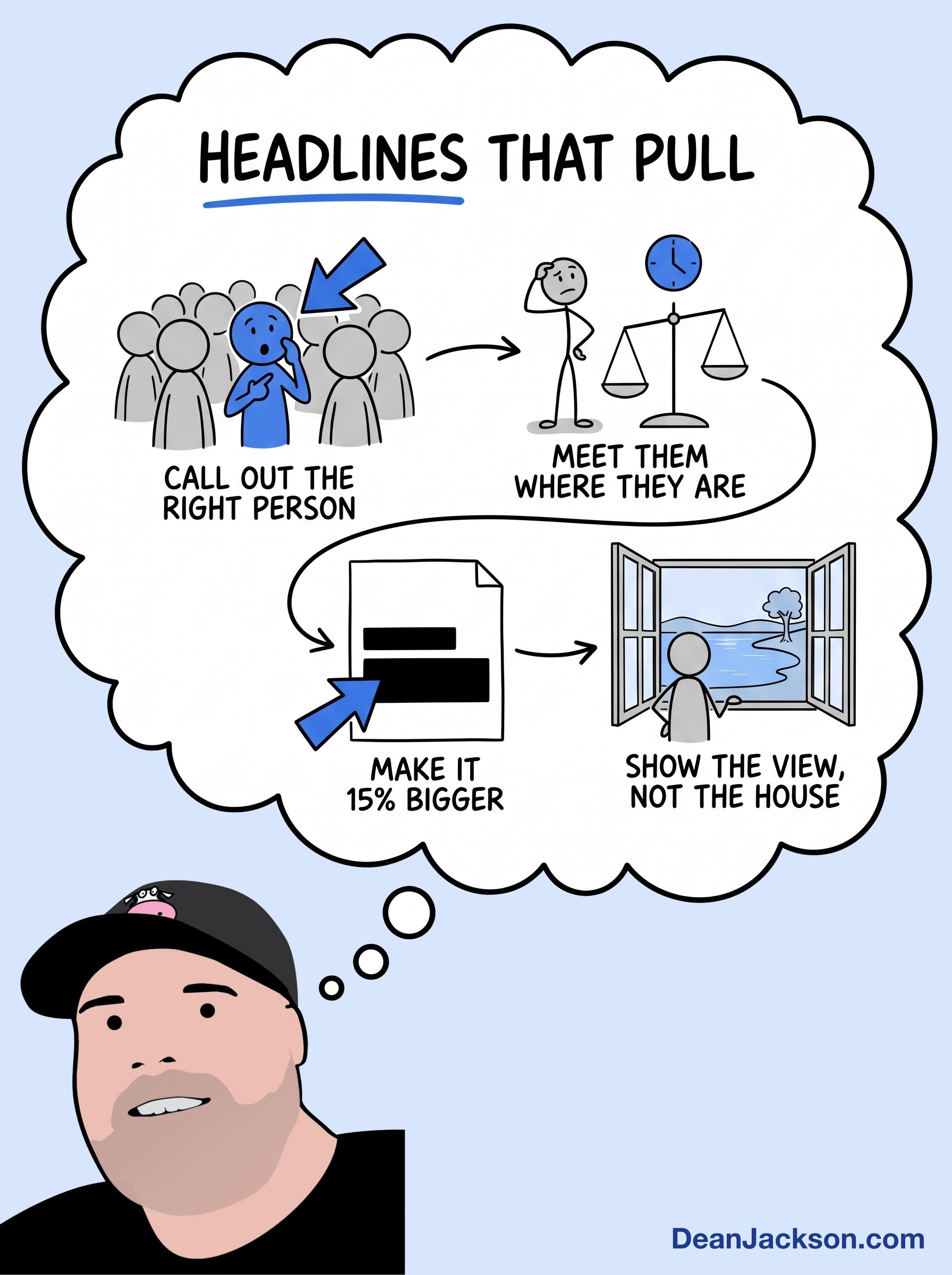
Three headline lessons from Tony Antin's Great Print Advertising: call out your exact prospect, make it 15% bigger, and show the benefit itself.
Good morning.
Day 110 without rain, and today it rained. So I'm in the car.
I want to talk about the thing that's been the biggest key to every ad, postcard and letter that's worked for me.
The headline.
I was looking through journal number seven, from 1997, and I found something I learned back then that I still use every day.
It came from a great book called Great Print Advertising, by Tony Antin. He ran creative at Reader's Digest, and they blended an editorial approach into their advertising that made everything crystal clear.
The first thing... the best headlines meet people where they are.
I'm not trying to impose my will on anybody. I'm trying to get the attention of the right person.
One of the most reliable ways I know is a headline that starts with "if you."
We've run this one for over 30 years: "If you plan on selling your house in the next 6 to 12 months, what you do right now can make a difference of thousands of dollars."
A realtor client asked a lady what caught her attention. She didn't even hesitate. "I'm selling my house next year, and I saw there were things I should be doing now."
That's it. It called out exactly the right person.
Same chassis. "If you're looking for an amazing lakefront house in Winter Haven, read this."
There's something about "if" and then "read this" that's magnetic.
And sometimes meeting people where they are means letting them sit in their uncertainty.
When mortgage rates kept dropping, everybody was shouting "refinance now." Even Dave Ramsey went on a rant about it.
But most people didn't know what their rate was, or whether lowering it would make a difference.
So for Churchill Mortgage we wrote "How to know when it makes sense to refinance."
We're not telling you to do it. We're telling you there's a time... and you'll want to know when it is.
The second thing is about the space around the headline.
Tony said to make the headline as big as you think it comfortably should be... and then make it 15% larger.
I tried it, and it pops. It's like your pupils dilate a little.
That's been a signature for us ever since.
The third thing is visual cues that support the benefit.
Think of David Ogilvy's Rolls-Royce ad. Half the page is the car.
If you're selling a lakefront home, don't show a picture of a house on a lake. Show the view from the house to the lake.
That's what they want.
And if you're offering a book, show the book. Our best Facebook ads have been the headline, a picture of the book, and the word download.
Put it all together and you've got a headline people can't resist, because you're speaking to exactly your ideal prospect.
The more specific you get, the more responsive they'll be.
You can't broaden your way into a magnetic headline.
Join me live on the next free 50-Minute Profit Finder call, Friday, October 9 at 1:00pm ET. Save your spot →
Transcript
Auto-generated transcript, provided as supporting material. It may contain errors, and speaker labels are occasionally mis-attributed.
Good morning. Okay, we made it 110 days in a row without rain, and today we got the rain. So I have to do in the car here, but here's something that I want to talk about that has been, I think, the biggest key to the success that I've had with ads, with postcards, with letters, with all of it. And it is the headlines of. Of all of these pieces, the headline is the most important part, of course, of any ad. But I was looking through 1997 journal number seven, and I recognized something that I learned that to this day, I still use. It changed the way that I approach, I'll say the.
The packaging of a headline in combination to the psychology of it, the visual cues of it, and what to do. So let me just go through a couple of the things. This is influenced by a great book that I read called Great Print Advertising. And it was written in the 90s by Tony Antin, who was the advertising director for the Reader's Digest. And there's quite an amazing story about how they blended editorial approach to advertising that made things crystal clear. So for me, the first thing that I. That I really kind of solidified here was the best headlines. Meet people where they are. So you immediately know that this is for you.
So rather than trying to impose my will on somebody, I'm looking to get the attention of the right person. And one of the things that I've used a lot is headlines that start with if you. And that is a. That's a reliable way to call out your exact prospect. So I've shown you one of the ads that we've used now for over 30 years is that if you plan on selling your house in the next six to 12 months, what you do right now can make a difference of thousands of dollars. So that is a kind of directive. It gets people that. That they know what this is about, and they know that there's going to be some payoff for them in that there's maybe some things that they should be doing.
As a matter of fact, we had a realtor client who was running that ad, and he would ask people, when he called to follow up with them about the book, he asked this lady, you know, I sent you the how to sell your house for top dollar fast. I was curious, what was it about the ad that caught your attention? And she, without even hesitating, she said, well, I'm going to be selling my house next year. And I saw there were some things that I should be doing now, and I wanted to know what they were so it works to call out exactly the right people.
I've used that same chassis by saying things like, if you or someone you know has been bitten by a mosquito in the last 30 days, read this. Or if you're looking for an amazing lakefront house in Winter Haven, read this. If you're looking for an amazing oceanfront condo in south beach, read this. And there's something about if. And then the directive of read this. That is magnetic to people, especially if you. They are doing the things that you are calling out in the headline. So I look at that as a. As a great one. And then the idea of meeting people where they are is sometimes you have to go back a step or just allow them to sit in their uncertainty.
So years ago, there was, you know, interest rates for mortgages were dropping. They were really low. And everybody was shouting, refinance now. Rates have never been lower. These are the lowest rates in history. And then, of course, next month, the rates were even lower. And everybody was shouting louder and louder, now's the time to refinance. And. And even Dave Ramsey was the radio host, author of Financial Peace. He went on a rant on the radio. And I had a client, Churchill Mortgage, who's a longtime client, friend of mine, Mike Hardwick is the founder, and he and Dave have been good friends. But I was saying to Mike that part of the reason that people aren't immediately going to refinance is they don't know what.
They don't even know what their interest rate is or how lowering their interest rate would make a difference. So to meet people where they are, we created a headline that said, how to know when it makes sense to refinance? Because that's the place that people were. How to know when it makes sense. Now, we're not saying you should. We're not directing or imploring you to do it. We're saying there's some calculations that you can see. And by knowing these things, you'll know if it makes sense and when it makes sense. So that implies that there is a time. And of course you want to know.
I'm not trying to get you in that thing. I've used this for Social Security result. If you or your spouse plan on collecting Social Security after whatever the date that we put was, we put a date six months after their 62nd birthday. Read this. And it was a really interesting thing because you're tapping into the mindset that people have. If they were planning on collecting Social Security after they. This certain date, then that implies there's Something changing or something could be happening there. So we've used it to draw in the right people. So the words that you say, the words that you say can call out specifically to the people.
And we've talked a lot about headlines, and there's a lot that's been written about headlines. But this is something specifically that I got from. From this book, and it has to do with the layout of the environment that you're presenting this headline. So if you're doing a postcard or a print ad or anything like that. One of the things that I learned from. From Tony was the idea of making your headlines large and bold. And I never, you know, we always look at it that you take the newspaper as a. As a clue or editorial content. It has a headline that tells you what this is about.
Looks like news. It looks editorial. But one of the things that he said as a guideline for, like, actually magnetizing attention is to make the headline as big as you think it should comfortably, appropriately be in the context of what the space is that you're doing it, and then make it 15% larger than that. And I thought, oh, that's really interesting, because I tried it and it does pop. It's almost like your pupils dilate a little bit more or it's like locked into place because it's just that little bit bigger. And that's kind of been a. A signature. And then the third thing around the environment of these headlines is using visual cues to support the benefit, to support what you're.
What you're saying there. So when we're doing, you know, if you're looking for an amazing lakefront house in Winter Haven, one of the things I modeled this after, the very famous David Ogilvy ad for the Rolls-Royce with a picture on almost half the page of the Rolls-Royce. And then the headline, you know, at 60 miles per hour, the loudest sound in the new Rolls-Royce is the sound of the electric clock. Well, looking at these. Looking at these headlines for. If you're looking for an amazing lakefront home, the picture, the visual cue of that is. Is the view that the person who wants to buy that lakefront home is going to be seeing.
What's the benefit that they're getting? Not a picture of a house on a lake, the picture from the house to the lake. That's what people want. So when you cue that all up, it all creates a visual environment. If you're offering a book, one of the best things, especially on meta ads or on postcards or even print ads, is if you're offering a book, use an image of a book that gives people a cue that this is something that you can download. I look at the, you know, the the best Facebook ads that we've done have been the headline, a picture of the book, and then just the visual cues download.
So that whole thing is a headline that people can't resist because you're speaking exactly to your ideal prospect, even as specific as you want to be. You know, the more specific that you can get, the more responsive those people are going to be. You can't broaden your way into a headline that's going to be magnetic. So that's some great tips on headlines from great print advertising. And tune in. Stay. I'll tell you a little more tomorrow.
Every idea that I've had, every dollar that I've made over the last 30 years has gone through my brain, through my pen, onto a piece of paper in my journal before it went out into the real world. And if I can turn people onto that activity as a driver for what to do, what to think about, what to ask yourself to draw out, what the next most valuable action is for you and how to find the most profitable things that you can install in your business, I'm all for it.
So this Friday at 1pm, I'm going to do for the first time a 50 minute profit finder workshop. And you're going to join me live on Zoom. And we're going to go through a 50 minute exercise. Bring your pen, bring a notebook or piece of paper and I'm going to guide you through a thinking process that will help you identify where the lowest hanging fruit is in your business and maybe some fruit that you didn't even know was there.
But I'm going to show you where to look for it. So it's free. It's for you. It's Friday. At 1pm this Friday. Just watch.
Just go to 50minuteprofitfinder.com and I'll get you all the details and hopefully you can join us then. Friday 1:00pm.
Get BreakthroughDNA Free
Discover the 8 Profit Activators that can transform your business. Get the complete framework, free.