How I use my journal when “things” are on my mind
Watch
Listen
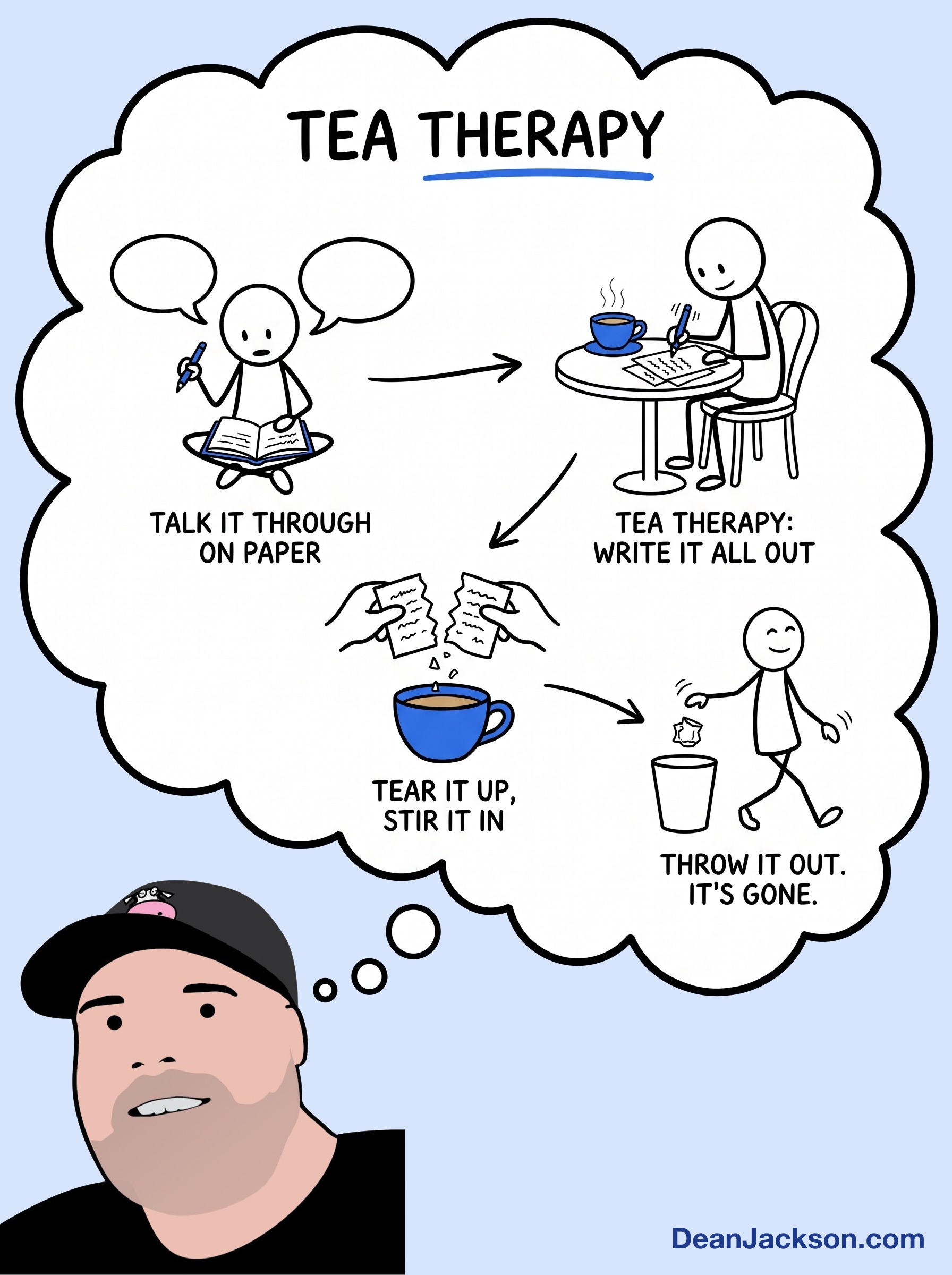
When something's on his mind, Dean writes it out: a conversation with himself in his journal, or 50 minutes of tea therapy he tears up and throws away.
Good morning.
It's a cloudy morning. Looks like it's been raining.
Somebody asked in the comments... do you ever write negative things in your journal?
Great question. Because I do.
And I've got some very specific ways I use writing when things are on my mind.
Disappointments. Troubles. Negative emotions. Whatever's getting in my head.
Most of the time I use my journal to have conversations with myself.
That's something I was doing a lot back in 1997, figuring out my way and where I was headed.
I'd walk through a decision and play both sides of it. I still do that a lot.
Asking myself questions about a specific situation is a very helpful thing.
But there are some things I don't want in my journal.
A conflict with another person. A situation that's really gotten under my skin.
For those, I do something I call tea therapy.
Here's how it works.
I go to a cafe and get a cup of hot tea. I take some loose sheets of paper... printer paper, or a yellow pad.
Then I write a letter in super small print, and I get everything out of my mind.
If I need to have a difficult conversation with someone, I have it right there on the page. Or I write the letter that unloads what I really want to say.
It's cathartic. There's something about saying the things you'd normally hold back and getting it all out on the page.
I spend 50 minutes, maximum.
At the end of the 50 minutes, I tear the pages into little pieces.
There's usually a little tea left at the bottom of the cup. I put the pieces in, stir them up... and let them go.
When I throw out the cup, it's gone.
That's the symbolic ending to that particular issue. And it's very reliable.
I don't do it that often. I have a pretty happy life, and I stay away from conflict and from people who bring me down.
But there are still times when you're in something that needs thinking through.
And this is a very helpful way to do it.
If you've got something on your mind, give it 50 minutes and a cup of tea.
Then let it go.
Join me live on the next free 50-Minute Profit Finder call, Friday, October 23 at 1:00pm ET. Save your spot →
Transcript
Auto-generated transcript, provided as supporting material. It may contain errors, and speaker labels are occasionally mis-attributed.
Good morning. Okay, it is a cloudy. Looks like it's been raining morning. And I wanted to talk about something today because somebody asked in the comments, do you ever write negative feelings or negative things in your journal? And I thought that was a great question because I do. And I've got some very specific ways that I, you know, use my journal and more importantly, writing when, let's just say when things are on my mind. And that could be, you know, disappointments, it could be. It could be troubles, it could be, you know, negative emotions, whatever is going on, something could, you know, be, you know, getting in my head or dealing with my emotions.
And so I will use my journal to have conversations with myself. I think I've talked a little bit about that because it's certainly one of the, the common things that I was doing back in. In 97, kind of figuring out my, my way and where I'm. Where I'm headed. And so having those kind of conversations to help me walk through decisions and play both sides of something was a very helpful. Was a very helpful exercise. And I still do that a lot. But asking myself questions about specific situation is, Is a very helpful thing. But sometimes there's some things that I don't want to be in my journal.
Like sometimes, you know, there are things that I really, you know, in a conflict with another person or with something, a situation that has really kind of gotten under my skin or, you know, whatever the case may be. I do something that I call tea therapy. And here's how it works. I'll go to a cafe or I'll go somewhere and I will get a. A cup of hot tea and I will take loose sheets of paper, just like printer paper, you know, like, or a yellow pad or something like that. And then I will write a letter in super small print. Like, I just write small and, and I'll get everything out of my, out of my mind.
Like, I'll have. I'll have. If I need to have a difficult conversation with someone, I'll have the conversation in my journal or in. On these sheets or I will write, you know, a letter to really just kind of unload what I really want to say. And it's cathartic. You know, there's something about the. Just releasing that, saying the things that, you know, going unleashed when you say the things that you would. Would normally or want to maybe say to write them down and get it all out on the page and, you know, maybe think through your thoughts. And I may spend 50 minutes maximum on this process and at the end of that 50 minutes, I take the pieces of paper and I, you know, tear them into little pieces, and then I put them in the room.
Maybe there's this much tea at the bottom of the. The cup. I put the pages in the water, stir them up, and it kind of just metaphorically, symbolically, kind of letting them go. And when I throw out the. The cup, if I get the, you know, the cardboard to go cup or whatever, when I throw that out, it's gone. And I use that now as a symbolic ending to that particular issue. And it's very reliable. I don't do it that often. I have a pretty happy life, and I have, you know, I try and stay away from conflict, and I stay away from, you know, people in relationships that kind of bring me down or whatever.
But there were times, you know, when I. And still are, when you're involved in something that, you know, just requires you to think things through. And that's a very, very helpful mechanism for doing it. So I appreciate Reinhart asking the question, and that's the answer. And I hope that if you've got things on your mind, that this is a useful and helpful way for you to use journaling to access your brain, access your feelings, and work it out.
Every idea that I've had, every dollar that I've made over the last 30 years has gone through my brain, through my pen, onto a piece of paper in my journal before it went out into the real world. And if I can turn people onto that activity as a driver for what to do, what to think about, what to ask yourself to draw out, what the next most valuable action is for you and how to find the most profitable things that you can install in your business, I'm all for it.
So this Friday at 1pm, I'm going to do for the first time a 50 minute profit finder workshop. And you're going to join me live on Zoom. And we're going to go through a 50 minute exercise. Bring your pen, bring a notebook or piece of paper and I'm going to guide you through a thinking process that will help you identify where the lowest hanging fruit is in your business and maybe some fruit that you didn't even know was there.
But I'm going to show you where to look for it. So it's free. It's for you. It's Friday. At 1pm this Friday. Just watch.
Just go to 50minuteprofitfinder.com and I'll get you all the details and hopefully you can join us then. Friday 1:00pm.
Get BreakthroughDNA Free
Discover the 8 Profit Activators that can transform your business. Get the complete framework, free.