“Imagine if you applied your SELF…” (Here’s how)
Watch
Listen
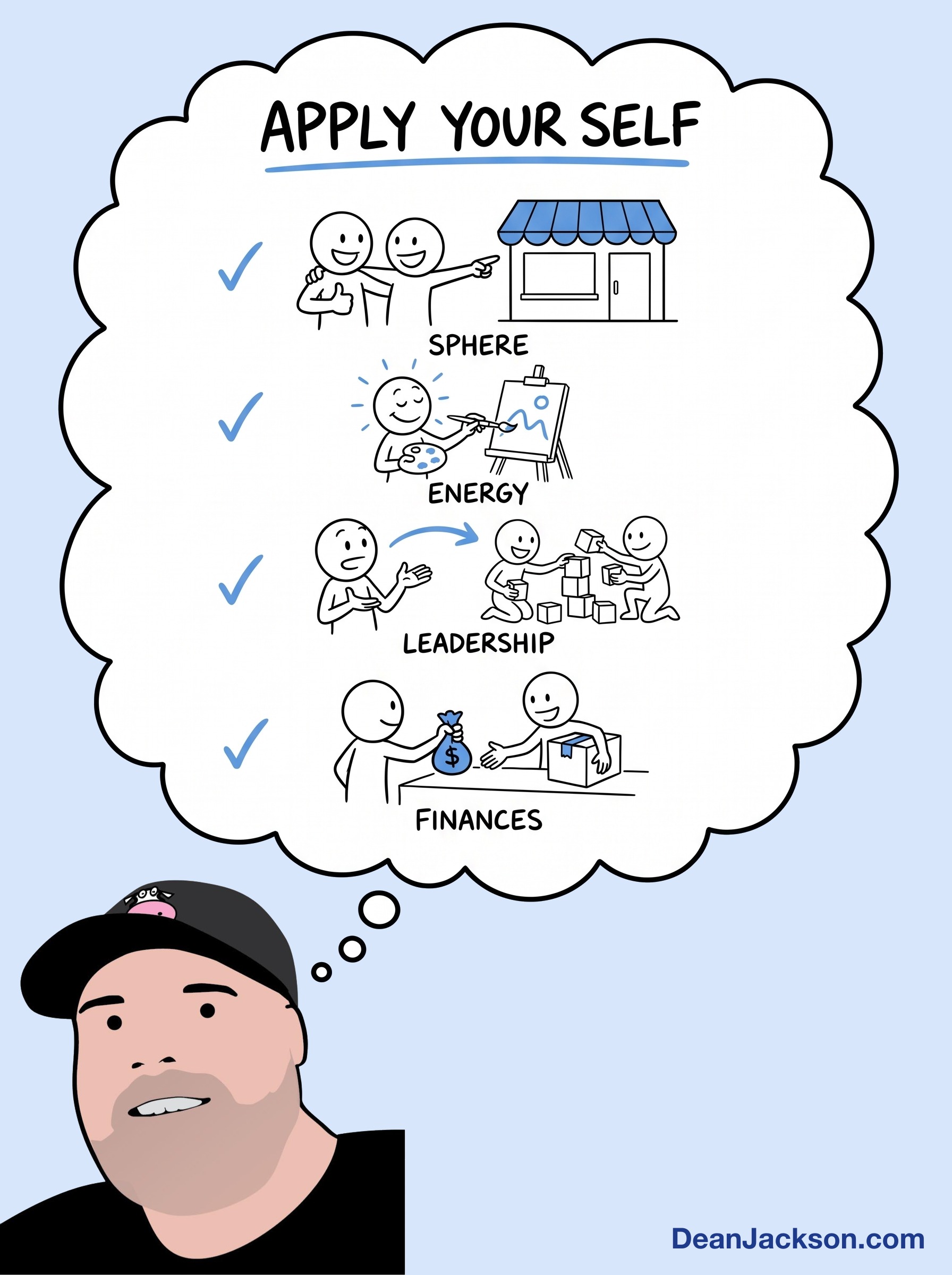
“Imagine if he applied himself,” said Dean's third-grade report card. Split yourself into your SELF: sphere, energy, leadership and finances.
Good morning.
I'm reading journal number eight. The end of 1997.
And one of the most common themes I keep seeing is how to get myself to do the things I want to do.
When my mother passed in 2013, I found a red box with every report card from my whole school career.
And there was one comment that summed up all the others.
"Dean is able to achieve excellent results with what seems like little effort. Imagine if he applied himself."
I can still see Mrs. Jefferson writing that on my third-grade report card.
Those words have been sitting in my brain ever since.
I knew stuff. Anything I had to figure out on the fly in class, I was really good at.
But homework... that was a real burden.
And there I was at 31, still struggling with the same thing.
It's only in the last few years that I've really started embracing my ADHD. Not as a character flaw.
Russell Barkley calls it a disability. You can know everything, and you just don't do it.
That's not something you fix with willpower, or thinking differently, or affirmations.
Acknowledging it lets you build scaffolding. Support.
So I started breaking down those words. Because the clues are in the words.
The words are the formula.
Imagine.
As kids, anything's possible. As adults, we temper it. "That's not realistic."
But imagination is a big part of this. What would you really want, if you could count on you to make it real?
If.
If what you imagined were going to be real, what would have to happen?
That's the beginning of Dan Sullivan's Strategy Circle... your brain comes up with the obstacles, and you turn each one into an action.
You.
This is where things get blocked. It's the boundary between the imaginary world and the applied world.
And for me, what's in the way always comes down to one of three problems.
A logic problem. It doesn't make sense.
A logistics problem. You know what to do, you just can't get the action taken.
Or a limbic problem. The internal game. For me that shows up as indecision... way too many options.
As visionaries, we can draw the blueprints. We just can't swing the hammer.
Applied means making something real. In the real world, in real time, with something you can point to.
And here's the part that changed everything for me.
We hear "yourself" as one word, and it feels like a finger pointed at you.
What if you separated your and self?
Your SELF is something you have.
S is your sphere. Someone you know, or a service that's available, that can do the thing.
E is your energy. The things only you can do.
L is leadership. Is there someone you can just tell what you want, and they make it happen? That's the beginning of Who Not How.
F is finances. Can you just buy the outcome?
That's what has changed my productivity. I describe what I want, and my team creates it.
Like I said about Quentin Tarantino yesterday... it's not your job to know how to do all of those things.
So if you've heard "imagine if you applied yourself" and used it to blame yourself, it's probably because you're reading yourself as one word.
Dream it. Imagine it. Think through what would have to take place.
Then decide what to do first... by applying your sphere, your energy, your leadership, or your finances.
Join me live on the next free 50-Minute Profit Finder call, Friday, October 23 at 1:00pm ET. Save your spot →
Transcript
Auto-generated transcript, provided as supporting material. It may contain errors, and speaker labels are occasionally mis-attributed.
Good morning. Okay, journal number eight, end of 1997. And I'm realizing that one of the most common themes that I keep seeing in my journals that I'm working out is how to get myself to do the things that I want to do. And it reminded me of, you know, where I am right now is I have struggled with productivity, let's say self motivated productivity. And it wasn't until I really learned about ADHD and learning that that is has its own challenges. Not a character defect. It's, it's a real thing. And I remember the embedding. I was reminded of this when my mother unfortunately passed in 2013.
And I found a red box with all of my report cards from my entire, from my entire school career. And looking through those, I was reminded of these things that were, you know, kind of planted in my, in my brain. And the most common refrain I found one comment that was absolutely the perfect summation of all of the comments that I got was, Dean is able to achieve excellent results with what seems like little effort. Imagine if he applied himself. And those words have been kind of subconsciously in my brain since third grade. And I, you know, as soon as I remember seeing Mrs. Jefferson writing that exact comment on my report card.
And of course, as a kid, you want to, you want to please people. I knew I understood stuff. I knew that in any situation in class where I had to know stuff or calculate stuff on the fly, I was really good at that. But doing anything, any amount of homework was a real burden for me. And so I see this again even into adulthood. Right? Here we are, I'm 31 years old in 1997, and I'm still struggling with this idea of getting myself to do the things that I know to do. And 30 years later, maybe in the last couple of years, I've really come to the understanding and really started examining it and embracing my ADHD, not as a, you know, not as a character flaw, but as what Russell Barkley refers to as a, a disability.
And you know, I don't say that he, he says that, that nobody wants to admit any kind of disability. But. And it's not saying anything character wise, it's saying that there's technically something you can know everything, but you just don't do it. And that's not anything that can be changed with willpower or thinking differently or, you know, or making any sort of affirmations to yourself or any of that stuff. It's something that requires a, a different approach and treating it as a disability, acknowledging it as a disability allows you to create scaffolding, to create support for that. So I've, that's something that I'm much better in my life at, you know, in this stage now, 30 years later.
So I wanted to kind of talk about the, the progression here because it wasn't until just a few years ago that this really, this really materialized for me. And so I looked at it, I started imagining and breaking down those words because the clues, the solution is in the words. The words are the formula. And so I made a formula out of this, of parsing out each word as a step in the process. So imagine that's the things where we are as a 8 to 10 year old. We can imagine anything because anything's possible, right? We're, we're used to our imaginations and we let our imaginations run wild.
As we mature into adulthood, we get to a point where we kind of temper our imagination because we are tending to think more grounded in reality. Right. That's not realistic. But the imagination is a big part of this. It's still, it's possible to get anything you can imagine. And the next step in the process is if, imagine. If. So if you take this imagination unfettered from, unfiltered from your belief in your ability to actually get it, can you imagine what you would do if you could do it, if you could count on you to do it, or if you could make it real in the world, what would you really want?
And I'll talk a little bit more about limiting beliefs because that, I see some evidence of that coming in my early journals here. But if you. Is really the next part of the equation here is if this, that what you imagined is going to be real, what would have to happen in order for that to take place? You're seeing now the, the germ of the. The beginning of what I talked about a couple of days ago with Dan Sullivan's strategy circle of taking something that you want and our brain immediately coming up with the obstacles, and then immediately now giving yourself the opportunity to find, to transform it into an action that could be done.
This is what would have to be done in order for these things to, for your imagination to take place. Then the next is you. So imagine if you. And this is where things get blocked. This is where many times, this is the boundary between you, between the imaginary world and the applied world. Where because what does it actually mean to apply yourself? You know, I started parsing out those, the words and if you look at applied it means making something real. It's tangible in the real, in the real world. And it happens in real time. And there's usually an artifact of this. That there's something that goes on the permanent record, or you've created something that you can point to that shows that you applied yourself, that you did this, this thing.
But you. The big things that have to be overcome are anything that you're not doing. This is what I've realized for myself, is that it comes down to one of three problems. It's either a logic problem, meaning the thing I'm trying to do is not logical. It doesn't make sense, that it's an impossibility to be able to do it. It's a logistics problem, meaning you know what to do. You know that that would create the action. You just can't get either yourself to take the action or cause the action to be taken to get those things in place. So that's the second L is the logic problem.
Or it's a limbic problem. And limbic meaning inside, it's an internal game. It's the things. You can't get the right mindset to do this. You can't wrap your mind around actually doing it, or something is blocking you. And for me, that often shows up in indecision, that that's really a thing that in order to, you know, you dream about something, you can design something, then you have to decide. And that's the big thing for me. I have got way too many options. And I can imagine options. And as a visionary, we have the ability to imagine something complete. We can see exactly what would have to happen.
We can make. We can do the conceptual drawings, we can make the blueprints of it, but we can't swing a hammer. It can't get ourselves to take the action to do it. So when making that decision is. Is part of the thing. And then getting into the applied side of it is where we actually dispatch the things that need to be done or do the things that need to be done. And so I took the self. You know, when. When you hear the words, imagine if you applied yourself, most of the time we interpret that as one word, yourself. And we're pointing the finger at us as somebody you're to blame.
Right? Imagine if you applied yourself. There's an element of individual responsibility around that. And so I looked at it and I said, what if we separated your and self? And we made self something that you are in possession of, that you are in possession of a self, S E L, F. And I've made a little Acronym for those. So imagine if you applied yourself and self being your sphere, meaning something that you know exists, somebody that you know that you have a relationship with, a service that is available that can do the thing that it is you want to do. If there's a service that can do it, fantastic.
That's a application of the S of self. The second thing that we can apply is our energy. That's the things that only we can do. And being able to identify what are the things that only you can do in this element that are going to require your specific energy that goes a long way. L is leadership. Who can. Is there somebody else that you could just give them, tell them what you want, and they can make that happen? This is where. This is the very beginning of the who not how mindset of not learn. You know, if there is there anybody else that could do this for me and then F is for finances.
Can you just solve it with money? Can you buy the outcome that you're looking for? And many times that's a real advantage if you have the money and the leadership skill to be able to say to somebody, do this. This gets outcome. It's amazing. And that's one of the things that has really like, improved my. My productivity. I was joking. You know, you have. I have a team of people that I can describe what I want, I can show it to them, and they can create that from. All I have to do is just express what I want. Like I was talking about with Quentin Tarantino yesterday, that it's not your job to know how to do all of those things.
You just need to be able to describe what your vision is. And that little framework there has been a game changer for me. There's. There's a lot more to say about that, but I wanted to throw it out there because if you're someone who's heard or said, you know, heard those words, imagine if you applied yourself, and you've always used that by blaming yourself, it's typically because you're treating the yourself as one word. And I hope that this can help you think differently, that you can think about embracing your visionary capability, the dreaming, the imagining of this, and then really just think through what if I was going to have that, what would have to take place.
And then you get to decide which ones you want to do first by applying your sphere, your energy, your leadership, or your finances. This has been a big unlock for me and I've got a lot more to say about it, but let me know in the comments if that's something that applies to you as well.
Every idea that I've had, every dollar that I've made over the last 30 years has gone through my brain, through my pen, onto a piece of paper in my journal before it went out into the real world. And if I can turn people onto that activity as a driver for what to do, what to think about, what to ask yourself to draw out, what the next most valuable action is for you and how to find the most profitable things that you can install in your business, I'm all for it.
So this Friday at 1pm, I'm going to do for the first time a 50 minute profit finder workshop. And you're going to join me live on Zoom. And we're going to go through a 50 minute exercise. Bring your pen, bring a notebook or piece of paper and I'm going to guide you through a thinking process that will help you identify where the lowest hanging fruit is in your business and maybe some fruit that you didn't even know was there.
But I'm going to show you where to look for it. So it's free. It's for you. It's Friday. At 1pm this Friday. Just watch.
Just go to 50minuteprofitfinder.com and I'll get you all the details and hopefully you can join us then. Friday 1:00pm.
Get BreakthroughDNA Free
Discover the 8 Profit Activators that can transform your business. Get the complete framework, free.