“That’s not your job.” Just do this…
Watch
Listen
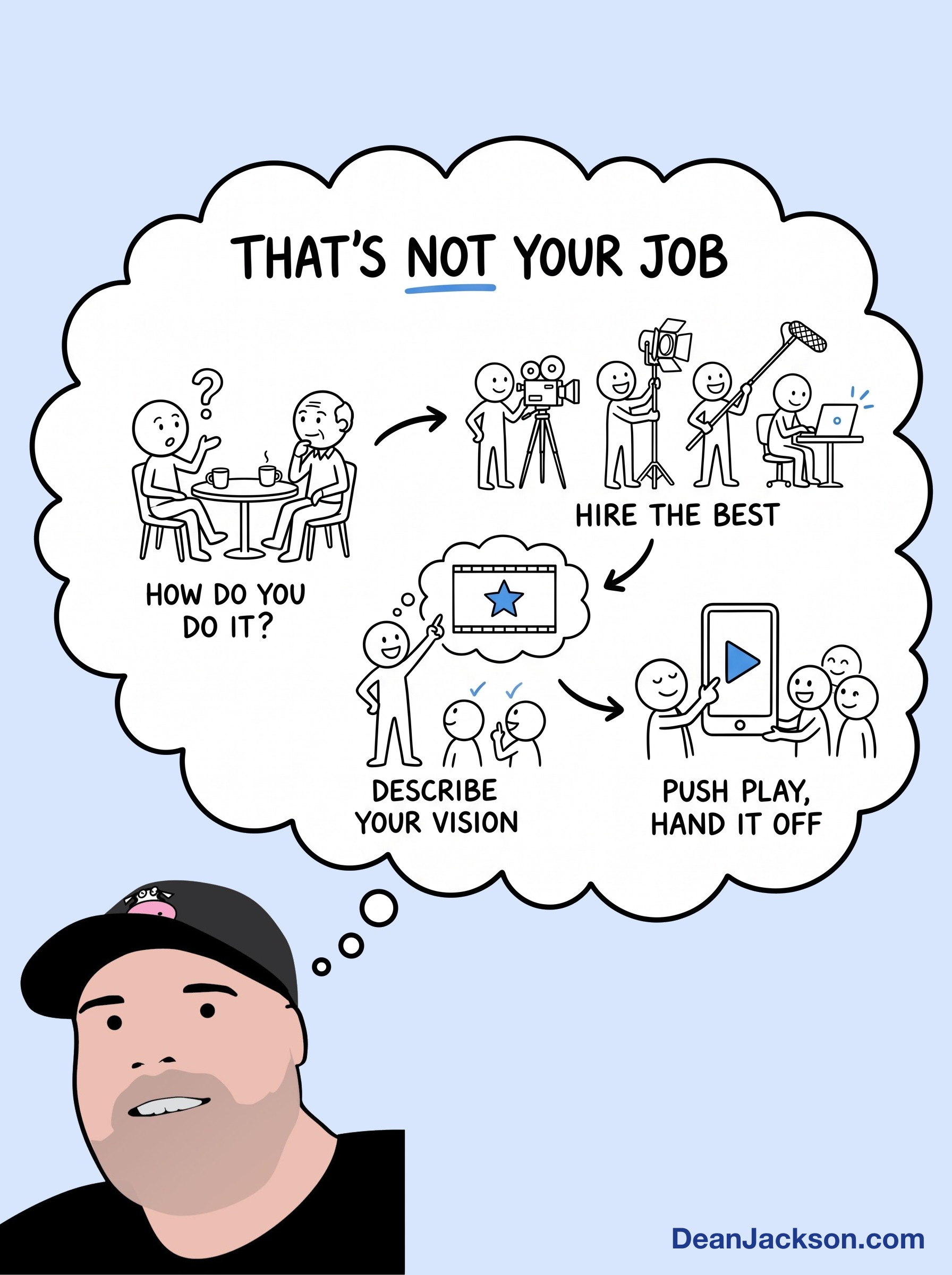
Terry Gilliam told a young Quentin Tarantino the technical side wasn't his job. Your only job is to describe your vision, then let great people do the rest.
Good morning.
We've been talking about overcoming obstacles.
And I love Dan Sullivan's first question... "Is there any way I could get this without doing anything?"
It reminded me of an interview I saw with Quentin Tarantino on the Charlie Rose show.
He was describing a lunch with one of his hero directors, Terry Gilliam.
Quentin was a new filmmaker, just getting started. He was at Sundance.
And he asked Terry Gilliam, "How do you get your vision up on the screen?"
He was asking about the technical things. Maybe there was some secret.
And Terry Gilliam said, "First of all, that's not your job."
As soon as I heard that, I thought... that's really interesting.
You can hire the very best cinematographers. Lighting directors who know how to get the lighting just right.
The best sound people. Costume and set decorators to make everything work out for you.
Your number one job, your only job, is to describe your vision.
As entrepreneurs, sometimes the biggest thing that gets in our way is the feeling that we have to do everything.
Back in 1997, when I was writing in my journal, we had email and the telephone. That was really it.
Fast forward to right now, and there's never been a better time to actually do nothing.
If you're a visionary, if you know what you want, your access to people who can do the things you need done is unprecedented.
And with what's coming with AI... any technical thing, any research, anything that requires opposable thumbs is available to us.
So your number one job is being able to describe what it is you want.
That's where the Strategy Circle comes in.
What is it that I want? What would have to happen for those things to take place?
And then... is there any way I could get this part done without doing anything?
Take these videos. Back then there'd be no way to get them out into the world. You'd be duplicating VHS tapes.
Now the only thing I need to do is push play, talk like this, and share the video with my team. They take it the rest of the way.
It's not my job. And it's not your job to do every step in something.
When all you do are the things you love and the things you're really good at, they feel effortless. And your output goes way up.
And if you're not the visionary... if you love the technical things, it's the same.
It's not your job to come up with the vision. Your job is to find people with the vision, make yourself available to them, and collaborate.
It's a great time to be alive.
Do your job, let everybody else do theirs... and anything is possible.
Join me live on the next free 50-Minute Profit Finder call, Friday, October 23 at 1:00pm ET. Save your spot →
Transcript
Auto-generated transcript, provided as supporting material. It may contain errors, and speaker labels are occasionally mis-attributed.
Good morning. Okay, let's drive to get some coffee. We've been talking about the idea of overcoming obstacles. And, you know, I loved Dan Sullivan's approach of is there any way I could get this without doing anything? As the first question. And that reminded me of a video that I saw with an interview with Quentin Tarantino. Quentin Tarantino was on the Charlie Rose show, and he was describing to Charlie Rose a lunch encounter that he had with one of his hero directors, Terry Gilliam. And Quentin was a new filmmaker. He was kind of just kind of getting started. He was at Sundance. And the question that he asked to Terry Gilliam was, how do you get your vision up on the screen?
How do you. You have a really beautiful way of making, you know, beautiful movies. And Quentin was kind of asking him the. The technical things, or maybe there was some secret to the way that he got his vision on the screen. And the advice that Terry Gilliam gave him was he said, first of all, that's not your job. And it was very like, as soon as he said that, I was like, that's really interesting. So he said, that's not your job. You can hire the very best cinematographers, director of photography, you can hire lighting directors who know how to get the lighting just right. You can hire the best sound people to do.
Who know how to capture the sound. You can hire the costume and set decorators to make the. The. To. To make everything work out for you. Your number one job, your only job is to describe your vision. And I thought, man, that. That's really interesting because as entrepreneurs, sometimes the biggest thing that gets in our way is having this feeling that we have to do everything. Now we are in a. I was thinking about this because in, you know, 1997, when I'm writing in my journal, I was thinking about the landscape then about how little, you know, we actually had access to. I mean, we had email.
That was really the technology thing, and we had the telephone. So to communicate and be connected to other people was quite a thing. But now, if you fast forward to right now, there's never been a better time to actually do nothing. I mean, in terms of if you are a visionary, if you know what you want, your access to people to who can do all of the things that you need to get done is unprecedented. I mean, I. I'm still amazed, I think, about what the. You know, the reality of what we have with what's coming with AI right now. I mean, the fact that any technical thing that needs to be done, any research that needs to be done.
Anything that requires opposable thumbs is available to us. And, you know, so the good news is, if you are a visionary, your number one thing is just being able to describe what it is you want. And that's where that strategy circle that I mentioned yesterday comes in. That if you just think about what is it that I want to do and then what would have to happen in order for those things to take place, and then asking that question, is there any way I can get this element of this done without doing anything? And I look at it, you know, I think about these videos as a.
As a great example. Like, first of all, in 1997, there would be no way to distribute these. There'd be no way to get these out into the world, you know, in a super easy way. You would have to duplicate, you know, cassette or, you know, VHS tapes so people could watch them on their. On their VCRs. But when you think about what goes into. If I have a vision for creating a daily video like this, the only thing that I need to do is push play, talk like this, and then just share the video with my team, who takes the rest of the way. It's not my job.
It's not your job to do every step in something. And so I think what you'll find is that when you really get going like this, that you'll love, you know, the things that you love to do and the things that you're really good at are kind of effortless things for you. And I think that you would have a much more productive output if all you had to do was the things that you actually are good at and the things that you enjoy. So I look at that as a really nice parallel to everything that we've been talking about up to here. But bringing it up to date, there's no excuse to not be in collaboration with people who can do all of the elements of things, aside from you being the visionary and deciding what you do.
And by the way, if you're not a visionary, but you're a director of photography or you are a. You love to do the technical things. That's the same thing. It's not your job to necessarily have to come up with the vision. Your job is to find people with the vision, make yourself available to them, and collaborate to make sure that all of the technical things get done. It's a great time to be alive right now. And if we just focus on doing your job and let everybody else do their job and collaboratively, anything is possible.
Every idea that I've had, every dollar that I've made over the last 30 years has gone through my brain, through my pen, onto a piece of paper in my journal before it went out into the real world. And if I can turn people onto that activity as a driver for what to do, what to think about, what to ask yourself to draw out, what the next most valuable action is for you and how to find the most profitable things that you can install in your business, I'm all for it.
So this Friday at 1pm, I'm going to do for the first time a 50 minute profit finder workshop. And you're going to join me live on Zoom. And we're going to go through a 50 minute exercise. Bring your pen, bring a notebook or piece of paper and I'm going to guide you through a thinking process that will help you identify where the lowest hanging fruit is in your business and maybe some fruit that you didn't even know was there.
But I'm going to show you where to look for it. So it's free. It's for you. It's Friday. At 1pm this Friday. Just watch.
Just go to 50minuteprofitfinder.com and I'll get you all the details and hopefully you can join us then. Friday 1:00pm.
Get BreakthroughDNA Free
Discover the 8 Profit Activators that can transform your business. Get the complete framework, free.