How to be prolific
Watch
Listen
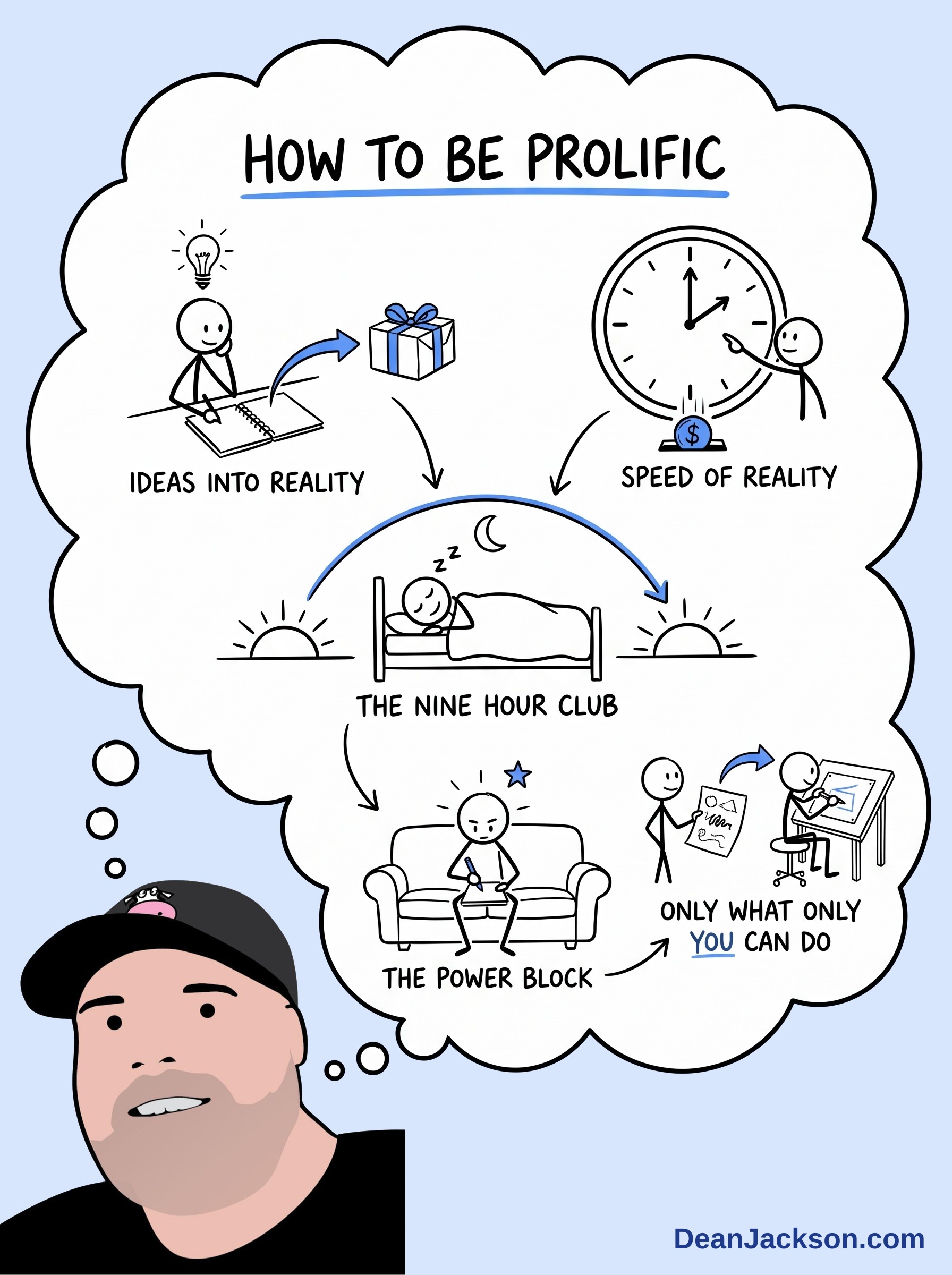
A question I asked back in 1997: how do I set up my life to be prolific? The zones, the Nine Hour Club, and doing only the things that only I can do.
Good morning. Coming to you live from Celebration, Florida.
Look at that sun. Breaking through an otherwise overcast day.
I'm here to start one of my three day Breakthrough Blueprints. So I've got a little time to talk.
And I've got my journal with me.
Page 82, journal number eight. We're in November 1997.
And I laughed, because the question I wrote on that page was... how can I set up my life to be prolific?
It made me smile. Because that's really the game.
If you're a creative. If you're an entrepreneur. If you're playing anything that asks you to turn ideas into reality.
Part of it is just getting yourself to do the things that take something from an idea in your head out into the real world.
For me that path runs through my journal, and then out into the world.
And the currency you trade to turn ideas into reality is units of time.
That's it. That's what it is.
Here's what struck me, flipping through these pages.
This is the SAME issue you're going to have 30 years from now.
So much of what I was writing back then was about optimizing my days. Managing my energy. Guarding the creative flow.
Putting myself in a position to be productive.
And the more productive you are, that's what leads to being prolific.
That word choice got me. If you're going to be productive, you might as well be prolific.
It's the kind of thing that lets you make a daily video for 122 days in a row.
Because here's the simple, profound part.
You can't spend more than today's allocation of time... today.
Time moves at what I call the speed of reality. There's no way around it.
Back in November 1997, time moved at 60 minutes per hour.
And here we are, nearly 30 years later. Guess what.
Still 60 minutes per hour.
We can only do one thing at a time.
And part of being productive is that there's an output for the time you spent. Some artifact. Some thing you actually got done.
So here's what I've learned over the whole 30 years.
Find the zone approach that works for YOU.
Mine? In bed at 11. Up at 7. Mornings uninterrupted and guarded for the creative work. That's my most creative stretch.
Afternoons for people. Delegation, meetings, Zooms.
Evenings for rejuvenation. Fun. Movies.
I was at dinner last night with a gentleman here at the event. He's up at 5am every morning. That's his zone, and he's done it for years.
But the trade off? He's in bed at 9.
And here's the thing. There's no nobility in waking up early.
You don't have to wake up at 5 to be a more worthy, productive person.
Robin Sharma wrote The 5am Club. I had breakfast with him once.
And I told him I think most people would do better aiming for the Nine Hour Club.
A nine hour envelope dedicated to sleep and recovery. The on ramp into perfect sleep, and the off ramp of starting your day.
Allocate those nine hours, whenever they fall, and you're better off.
So the zone is still the primary decider of how prolific you're going to be.
Now here's what I still struggle with.
Deciding what to do inside those blocks.
I've got perfect attendance at the gates now. Lights out at 11, ninety nine percent of the time. Out the door at 8. Mornings cleared, all the way to noon.
Clear for takeoff.
But I arrive at that power block, pen in hand, notebook in hand, in what I call the evil scheming position... and sometimes I'm undecided.
Multiple things converging, all carrying equal weight.
Being the dispatcher of my own time is still a work in progress.
And part of getting better is doing only the things that only I can do.
I can design things. I learned PageMaker in 1997. But lots of people can do that.
So instead I draw what I want. A postcard. A book cover. Where everything goes.
Takes me minutes. And Glenn turns it into something amazing in hours.
That's the whole game.
Set up the zones. Decide what you're going to be prolific in. And strip out the friction by doing only the things that only you can do.
Stick with that. And one day you'll look back at a prolific life track history.
Join me live on the next free 50-Minute Profit Finder call, Friday, October 23 at 1:00pm ET. Save your spot →
Transcript
Auto-generated transcript, provided as supporting material. It may contain errors, and speaker labels are occasionally mis-attributed.
Good morning. Okay, we're coming live from Celebration, Florida. And today. Oh, look at the sun. Otherwise overcast day. But here we are, I'm at Celebration and we're about to start one of my three day breakthrough blueprints. So I've got some time here to talk and get our, our video done for today. So I'm in my journal back here and I laughed because on page 82 of journal number eight, we're in, you know, November 1997 right now. The question that I asked is how can I set up my life to be prolific now? It was, it's very kind of made me smile because that's really the game.
If you are a creative, if you're an entrepreneur, if you're playing a game that requires you to turn ideas into reality or to be productive, you know that part of it is getting yourself to do the things that need to be done to take something from an idea in your head. For me, that path is going through my journal and then out into the real world, trading. The currency that you have to turn your ideas into reality is units of time. That's what it is. Now I've, what I've been really struck by here is looking through my journals. This is the same, this is the same issue that you're going to have 30 years from now.
As I look at it now, it's like so much of the conversations were really about optimizing and setting up my days to manage the energy and the creative flow and do things that put me in a position where I'm able to be productive, which, the more you would be productive, that's what leads to being prolific. And I thought that was a funny word choice because if you're going to be productive, you might as well want to be prolific. It's the kind of thing that goes into how do you create a daily video for 122 days in a row? This is the kind of thing is realizing that you can't spend more than today's allocation of time today.
And it seems so like, I don't know when I, the more that I say it and think about it, you realize that it's such a simple and profound thought that time moves at what I've been calling the speed of reality. There's no way around it. In 1997, in November, time was moving at a rate of 60 minutes per hour. And here we are in 2026, in October. October, nearly, you know, 30, almost 30 years later, 29 years later, and guess what? Time is still moving at 60 minutes per hour. We can only do one thing. When I'm. When you realize that part of being productive is that there is an output for the time that you've spent.
There's some artifact or some check off your list of things that you want to do that you actually got something done. So for me, what I've recognized now over the whole 30 years is finding the zone approach that works for you because I describe it to people. You know, my perfect zone is to be in bed at 11, to wake up at 7, spend the morning uninterrupted, doing things that are productive, guarding that creative time. That's my most creative period of time. And then the afternoons talking to people or doing things that require involvement with other people, delegation, meetings, zooms, all of that stuff. And then the evenings for, for me, for rejuvenation, for doing things fun or socializing or watching.
I love watching movies and Netflix and stuff like that. So for me that's the perfect thing. I was having dinner last night. One of the gentlemen that's here at the event is a guy. He wakes up at 5am every morning and that's his zone. He's done it for years. But the trade off is he's in bed at 9 o'. Clock. And that, you know, it's so funny. There's no nobility in waking up early. You don't have to wake up early to be a more nobly productive person. You know, I was. Robin Sharma, who wrote the. The 5:00am Club, you know, very notedly is an advocate of waking up at 5am and I had breakfast with him one day and said, you know, I think people would be.
It would be a better aspiration for most people if they joined the Nine Hour Club. And the Nine Hour Club would be having a period of nine hour envelope advocated to sleep and recovery, including the on ramp to getting perfect sleep and the off ramp of getting your day started. If somebody would just allocate that nine hours, they would be better off no matter what time of day those nine hours are. So I look at it that, you know, still going 30 years later, it's still the primary thing that is the decider of how productive or prolific you're going to be. Now the thing that I struggle with the most is deciding what to do in those things.
I am, I have perfect attendance in the zones of. I've really made it over the last year a very concerted effort to hit the gates of the things. I kind of add precision to things. Lights are out at 11, 99% of the time I'm hitting that mark, 8am I am in the car, out the door and 99% of the time we're hitting that exact mark. The mornings are, are cleared for productivity. I'm going to move this over here so we don't get the sun in the way in, you know, and all the way till noon. Clear for takeoff. Now where I do struggle sometimes is deciding what specifically to do in that power block.
From 10am to till noon I, my day is, I'm on lock in terms of we go and I have breakfast and then I shoot the video and all of that is done and then I am in position. I call it in the evil scheming position. I'm in the. I'm either at Concord, on the couch, pen in hand, notebook in hand, ready to focus, turning all the world off. But what I find is that sometimes I approach or arrive at that moment and I'm undecided on specifically what I'm going to work or there may be multiple things that feel like they're converging all at once that need to be, that all carry equal weight.
So being a decider, a dispatcher of my own time is a, that's still a work in progress. I'm better at it. And part of that is no way limiting the things that I actually do and organizing my life so that I only do the things that only I can do. I was joking. Like I, I can technically I can lay out and design things because I learned that skill in 1997 to be self sufficient. I know how to use page maker and you know, all of the, the design tools. But there are many people who can do that. And so I get to the speediest way, way to be prolific is I have a designer who now knows exactly how I want things to be laid out.
I can send them. I, I don't really touch any technology other than my pen and a piece of paper. I can draw a postcard or I can draw a cover of a book or a design. I can just draw what I'm looking for, put the positions of where things were going to go so that Glenn knows what I'm looking for. And it's amazing what he's able to turn out. Now that may take hours to do that, but it takes me minutes to outline or to draw and convey the message of what I'm looking to, to do. So that pursuit of setting up the zones for yourself on how or when you're going to be productive, deciding what you're going to be prolific in what you're going to, what your output is going to be, and then removing all the friction by doing only the things that only you can do.
That's my reflection from page 82 of journal number eight in 1997. Thirty years later, in 2026, and I imagine it'll be the same thing in 2056. We'll be having the same conversation, but I'll have stuck with that and have a prolific life track history.
Get BreakthroughDNA Free
Discover the 8 Profit Activators that can transform your business. Get the complete framework, free.