How to have a business that works without you
Watch
Listen
A double spread from journal number eight on the book that changed everything for me, and how to build a business that runs without you.
Good morning.
We've got a lovely double spread today in journal number eight. From 1997.
And I think way back in video number one or two, I mentioned the book that was the turning point for me.
Michael Gerber's The E-Myth.
That's where I learned the concept of working ON your business, not IN it.
The subtitle is something like... why most small businesses don't work and what to do about it.
When I first read it, back in '89, I was an individual realtor in Georgetown, just outside Toronto.
Making a hundred cold calls a day. Doing all of the work myself.
And I was already bumping into the ceiling.
Because I couldn't be two places at once.
I couldn't do the cold calling to drum up the business AND be available to actually do the business.
Gerber calls it the ceiling of complexity.
So the mindset he installed in me was this... separate your business from yourself.
And it sounds odd the first time you hear it.
But here's the thing. There are 32 million businesses in the US, and the overwhelming majority are one person doing all the work.
Which is very limiting.
Now, AI is a great advancement here. It can take a lot off your plate. That may be the first place you start.
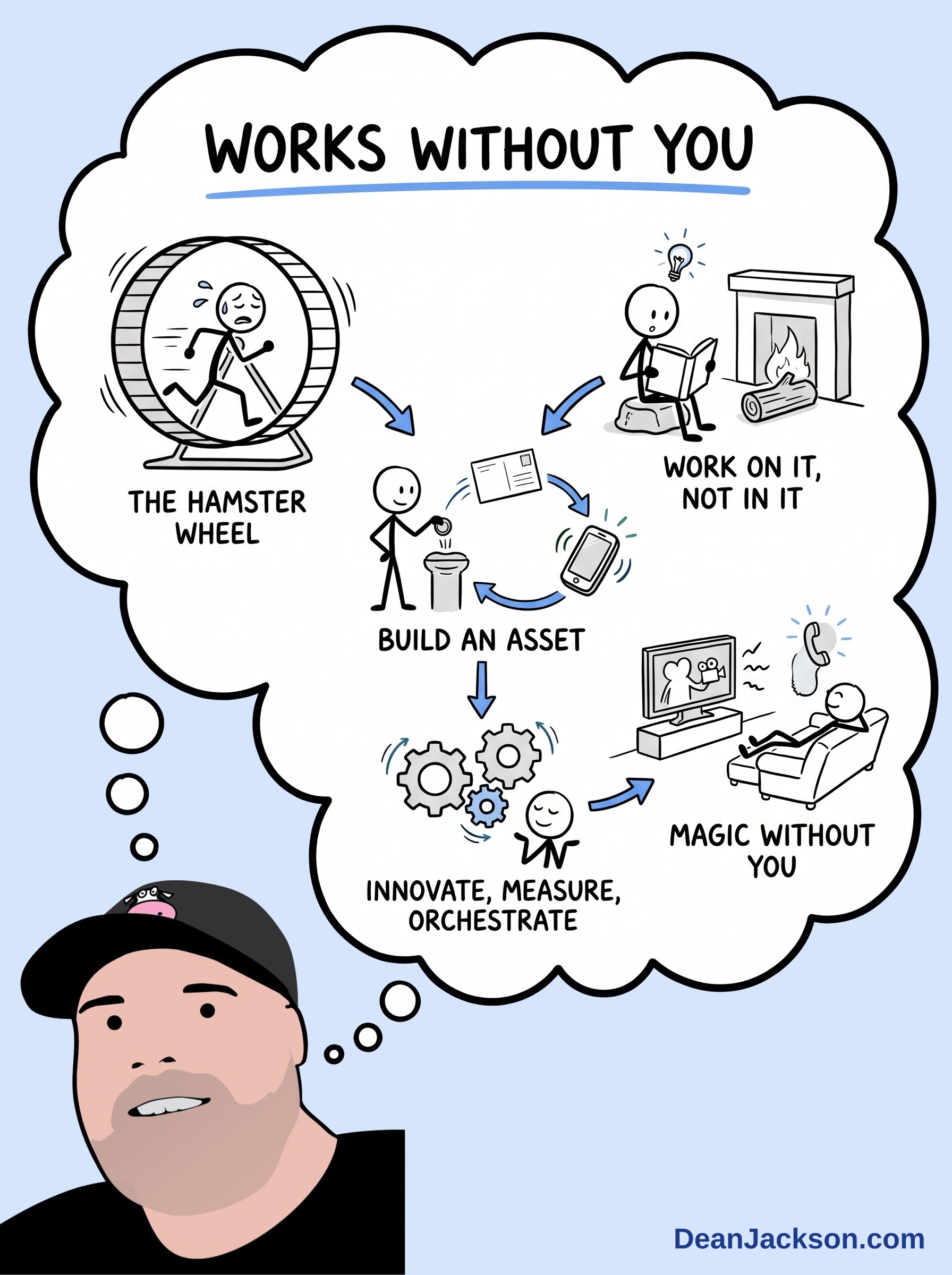
But I still remember reading that book. Sitting by the fireplace at the Delta Hotel in Mississauga.
One of those moments where something lands on a deep level.
I started thinking about my business as its own thing.
Instead of a hamster wheel.
Because the cold calling worked while I was doing it. Step away, and nothing's working anymore.
So I asked... what could work WITHOUT me?
I'd just discovered direct response at the same time.
And I saw it. If I took the time to create a postcard that got people to call me, instead of me making the cold calls... that was leverage.
How could I use some of my money to work for me?
That led to the Guide to Halton Hills, which is still the foundation of everything today. The Home Buyer Workshop. The Six Steps to Home Ownership book.
IP assets. Intellectual property assets. I didn't know to call them that yet.
All of them from one goal. Setting up things that can work without me.
So here in journal number eight I've got a little summary of what I learned from Michael.
Most small businesses don't work. The people who own them do.
That was exactly where I was in 1990.
And your problems in your business are not the people. Unless you're the only one. Then it IS you.
Your business is a perfect reflection of you.
Because if the things that make it run depend on you doing them, you'll reach a point where you're not as energetic or reliable as you'd like to be.
An entrepreneur is a visionary.
And that's the biggest key. Create the vision of what you want.
What does it look like?
I loved the idea of assets. Ads, postcards, recorded messages.
I had phone lines down in the basement. And I'd hear them clicking and whirring in the background while we watched a movie we rented from Blockbuster.
No on demand back then.
So I'm sitting there, and I can hear my system working. People calling, listening, leaving messages for me.
The first time you see your business working without you... that's a core memory.
So two words Michael gave me. Intention and attention.
Your job as the visionary is to set your intention. See what you want.
It starts with an image. How could this work without me?
Operate on the FUNCTIONS of the business. Not the tasks you have to fulfill in it.
And there are three key processes.
First, innovation. What you do. The core thing. You run ads, send postcards, use recorded messages, VSLs.
Second, quantification. How it works. Measuring, so you know predictably what to expect.
I've mentioned Deming before. Without that measuring, you don't know whether something's actually working.
Third, orchestration. Setting up the systems. The elimination of choice at the operating level.
This is how we do it here. This is how we recruit and train to do it here. This is how we manage it, and how we change it here.
You're constantly working on the business. Not in it.
So people always ask... how do you set up a business that runs without you?
This is the beginning. It's simple.
And it's a life pursuit. I'm still working on this same model 35 years later.
It's the first place I look when I work with entrepreneurs now.
So here's my wish for you.
That you get that first time where something wonderful happens in a way that happened without you.
Magic.
Join me live on the next free 50-Minute Profit Finder call, Friday, November 6 at 1:00pm ET. Save your spot →
Transcript
Auto-generated transcript, provided as supporting material. It may contain errors, and speaker labels are occasionally mis-attributed.
Good morning. Okay, we've got a lovely double spread today in journal number eight from 1997. And I think in maybe even journal number one or journal number or video number one or video number two, I mentioned a book that was the turning point for me. And that book was Michael Gerber's the E. Myth. And that's where I learned the concept of working on your business and not in it. And it's, I think the subtitle of the book is why Most Small Businesses Don't Work and what to Do About It. And you know, in 1990 89, when I first was exposed, exposed to this book, you know, I was an individual realtor in Georgetown, just outside of Toronto, and I was making 100 cold calls a day, and I was doing all of the work myself.
And I was already seeing that I was limited by my ability to be two places at once to do, to continue to do the cold calling, to drum up the business and be available to actually do the business. It became a, you know, what he calls a ceiling of complexity. And so in installing that mindset of working on your business, and it sounds like, odd when you first say it if you're not first familiar with what it is, but what he's saying is to separate your business from yourself. That it most small businesses, let's face it, there's 32 million businesses in the United States and by far the overwhelming majority of them are non employer entities, which means they're one person doing all the the work, which is very limiting.
Now, AI is certainly a great advancement here that many people can bypass a lot of the stuff that can take things off their plate. And it's a wonderful leverage tool. And that may be the first place that you start here. But I still remember when I was reading that book, I was sitting at the Delta Hotel in Mississauga by the fireplace. And that was like one of those moments that really got something on a deep level. And I started thinking about my business as its own thing, that how could I create instead of a hamster wheel where, you know, the hamster wheel of cold calling worked while I was doing it, but as soon as I step away, it's not working anymore.
And so that idea of working on things that could work without me, I interpreted that and started putting that in place by creating IP assets, intellectual property assets. I didn't know to call them that at the time, but I thought to myself, because I discovered direct response, at the same time that I was hearing these things, I started seeing that if I could create Take the time to create a postcard that could be sent and get people to call me instead of me having to make the cold calls. That. That was a very leveraged thing to do. And it all came on the point where I was thinking, how can I use some of my money to leverage to work for me?
And that was a great thing to. To deploy. And that led to me creating the guide to Halton Hills that we still is the foundation of everything today, creating the Home Buyer Workshop and the Six Steps to Home Ownership Book. So all of those things have come from a goal of setting up things that can work without me. So I found this nice little summary here in journal number eight. That's kind of some of the things that. That I learned from Michael Gerber. And at that point, we would have Michael come to the main events, and so we would share his. His process here. And I was just taking notes one of these these days.
And some of the things that stand out is. Is, you know, most small businesses don't work. The people who own them do. And I think that was really the point that I was at in 1989 or 90 when I first read it. And your problems in your business are not the people, unless you're the only one, then it is. You're the problem. Your business is a perfect reflection of you. And, you know, I think if you're in a situation where the, you know, the things that make your business run depend on you doing them, you're going to reach a point where, you know, you see that you are not as energetic or enthusiastic or reliable as you could be in those things.
And setting up a system for it and is the best thing that you could do. An entrepreneur is a visionary, and that is really the biggest key is to create this vision of what it is that you want for your business. What does it look like? At the time, I loved the idea of having assets that are, you know, ads and postcards and recorded messages. I used to love. I'd have these separate voice or, you know, phone lines in my house in the basement that I could listen to the voice to the voicemails clicking and whirring and playing in the background while I'm. I'm, you know, we're watching a movie that we had to rent from Blockbuster, by the way.
No, On Demand. So we're sitting there watching a movie, and I can hear while I'm doing that, my system was working for me. People were calling and listening to the recorded messages and leaving messages for me. And that's a Wonderful thing. The first time you see your business working without you, it's, it's one of the, you know, core memories that you'll have in your business, in your business growth. So two critical words I wrote down that Michael advocates here is intention and attention. That if you look at it that your job as a visionary is to set your intention by seeing what, what it is that you want.
It's got to start with an image of how could this business work without me? What if I was setting this up as a separate thing and operating on the functions of the business, not on the tasks that I'm going to have to fulfill in the business? So there's three key processes that you want to work on is. Number one is innovation. What you do. This is how you, you know the things that you, that your business does. You run ads, you send postcards, you use recorded messages, use VSLs, you do whatever it is your innovation, setting up what that core thing looks like. Number two is quantification.
How it works. You know, I mentioned Deming as a, you know, as a great way of looking at the system of your business and understanding how all of the pieces are working, measuring so that you know predictably what to expect. Without that kind of quantification, you don't know whether something is actually working or not. And then number three is orchestration. And that is setting up the systems for the elimination of choice at the operating level. And that's a pretty amazing thing when you get down to, you know, basically this is how we do it here. This is how we recruit and train people to do it here.
This is how we manage the people to make sure that how and what we do is being done and how we change it here. You're constantly working on the business, not in it. You're working on the system and all of the components that are, that are going to create the result that you're intending for it to create. Create. So people always ask that, how do you set up a business so it runs without you? This is the way, this is the beginning. It's pretty, it's simple, and it's a life pursuit. I'm still working on this model. You know, this would be 35 years later, 36 years later, still working on this same model.
And it's the first place I look for, you know, installing this type of thing in the businesses and entrepreneurs that I work with now. So I hope you enjoy that and I wish for you that experience of the first time something wonderful happens in a way that happened without you. Magic.
Get BreakthroughDNA Free
Discover the 8 Profit Activators that can transform your business. Get the complete framework, free.