How to choose a market with the biggest ROI
Watch
Listen

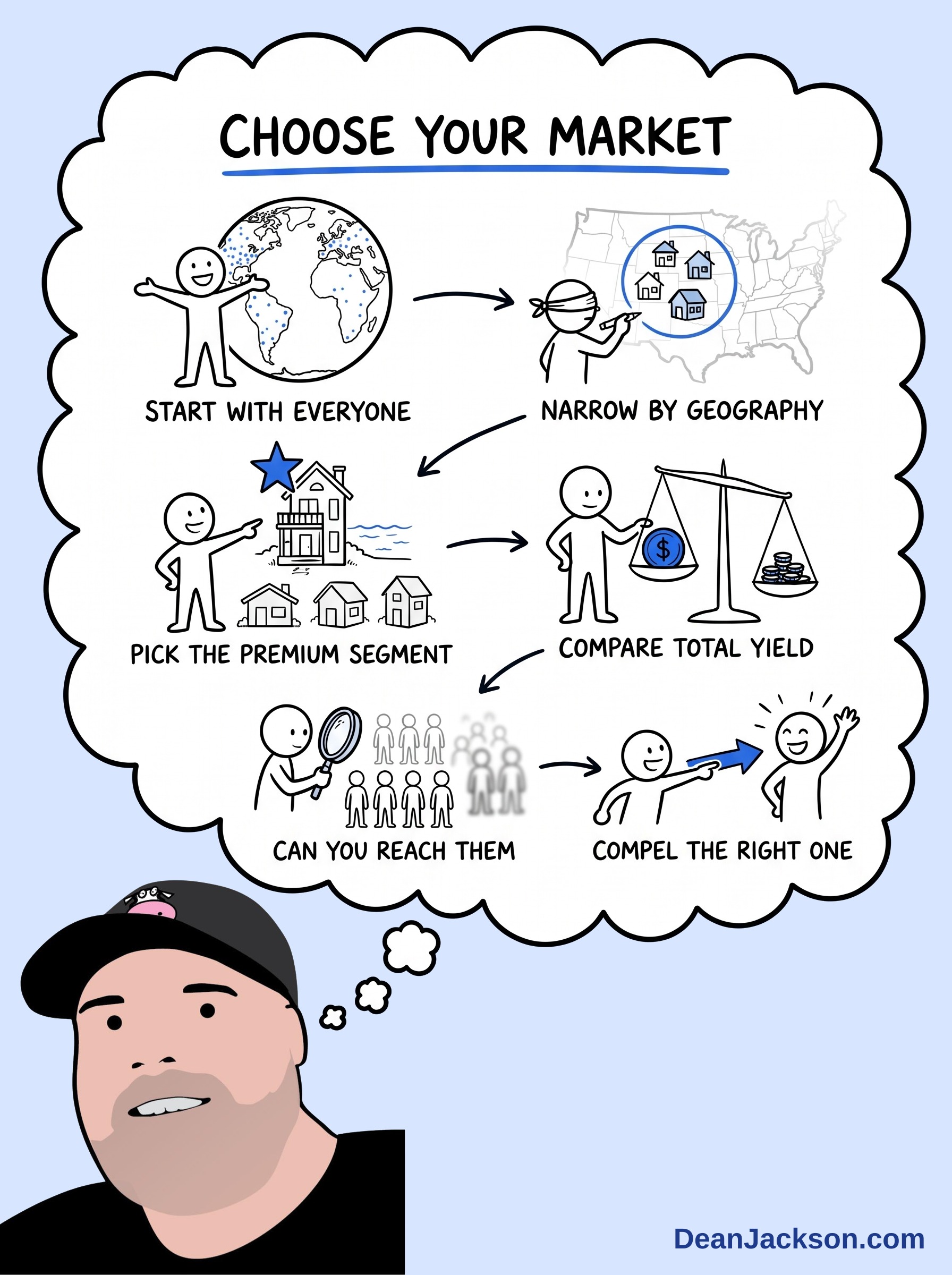
A page from November 1997 on target market selection. How to find the one premium audience you can help most, and why it makes everything downstream more profitable.
Good morning.
Just had breakfast, read through journal number eight. November of 1997.
And I was working out some thoughts on target market selection.
Here's the frame I had back then, and I still love it.
Nothing is as valuable as finding the super premium, highest value, highest probability audience that can most benefit from a collaboration with you.
Not who can we sell to. A collaboration.
How can you create an outcome for people?
Because the price you can charge depends on the outcome you can create. And the confidence people have that you can create it.
Now, most of the time when I take someone into a new target audience, I have to get them to close their eyes to who they've always served.
And look instead at their best capabilities. Who is the very best person for them to serve?
Sometimes it's a completely different person than the one they've got in front of them today.
And since we're in the Before Unit here, talking about people who don't know you yet... we may as well pick the ones that are the most profitable. The ones you can help the most.
So I'll take a whole session just to go through this.
And it starts with everyone.
Let's begin with the broadest possible audience of people you could help.
Then we narrow.
Geography first. If you're a local business, put a bubble around the town. Winter Haven, Florida. A 15 mile radius.
If you're a gym or a boot camp, maybe a 5 mile radius is all you need.
Blinders on everything else.
Because it starts with eliminating people.
This is an elimination and a sorting process. We're not committing to anything yet.
We're just finding the possibilities so we can evaluate them.
And here's a thing worth sitting with. Even if you've got national potential, artificially constraining yourself to one market lets you crack the code.
Figure it out in a test market. Then roll it out.
We learned that from Claude Hopkins.
So once we've got a geographic bubble, I ask people to exhaustively list every segment they could serve.
All the different types of people you could help.
Then... which one is the most profitable?
Which person, if you helped them, gives you the best outcome?
In real estate I always look for the highest, most desirable thing.
In Winter Haven that's lakefront homes. Somewhere else it's oceanfront, or golf course homes, or horse farms.
All valid. All valuable.
And then you compare them. On the numbers.
I always want an estimated total yield for the market.
Say Winter Haven has just over 2,000 lakefront homes. A 5% turnover rate. That's roughly 100 transactions a year.
At an average commission of 15 or 18 thousand dollars each.
That's a much higher total yield than a pile of condos turning over fast at a 7 thousand dollar commission.
High turnover isn't the same as high yield. Do the math.
Then the next question. How are we going to reach them?
Are there lists? Are these visible prospects, where you can get a list and point right at them?
Or are they invisible prospects, walking around where you can't tell who's who?
And often it's both at once.
If you're targeting chiropractors, those are visible. You can buy that list.
But if you ARE a chiropractor, your prospects are invisible. You can't see who twisted their back in the shower this morning.
So you ask... what do they read? What organizations do they belong to? Where do they hang out?
Are they actively looking for what you do?
And what would the first step be?
That's the whole evaluation. And it ends at one question. What do we do to compel these people to raise their hand?
Here's what I'd argue for you.
There's an ideal market you can help. The one where you make the biggest impact.
Narrow your focus to that one.
And everything downstream gets more profitable.
Join me live on the next free 50-Minute Profit Finder call, Friday, November 6 at 1:00pm ET. Save your spot →
Transcript
Auto-generated transcript, provided as supporting material. It may contain errors, and speaker labels are occasionally mis-attributed.
Good morning. Okay, we are just had breakfast, read through journal number eight in November 1997 and one of the things that I was going through here was some thoughts on target market selection. And as I was thinking about it, there's nothing as valuable as going through the process of identifying the super premium, highest value, highest probability, highest likelihood audience that can most benefit from a collaboration with you. That's the way I was thinking about it is as a collaboration, not who can we sell something to. How can you create an outcome for people? Because definitely your compensation, your, the price that you can charge is going to depend on the outcome that you can create and the confidence that people have in your ability to create it.
So often, you know, part of when I look at going into a new target audience, what I have to do with people most of the time is just close their eyes to who they've always served or the kind of clients that they're currently serving and focus more on what are their current best capabilities, who could be the very best person for them to serve. Because sometimes it's a very different thing. And since we're focused in this case on the before unit, we're going to people that don't know you yet, people that are not doing business with you, then we may as well pick the ones that are the, the most profitable for you, the ones that you can help the most.
And there's some great things, things that go into this selection process so often I'll take a complete session where we'll just go through this mindset of let's start with everyone, right? Let's start with the broadest target audience of people that you could, that you could help. And then if there are any geographic constraints or any geographic considerations, let's narrow that down first. So if you're saying if you're a local business and you're serving a local market, let's just put a bubble around Winter Haven, Florida, that that's your market. If we say within a 15 mile radius or if you're a gym or I'm just noticing some boot camp people going out here.
If you're an inherently local business, then maybe you only need a 5 mile radius of people that you serve and putting on blinders, all the other stuff. It starts with eliminating people. I would say, you know, if we are building your prospect vending machine, the two things that we need to figure out, the, the calculations on that are we need to know how much is the person that you are looking to help. But what, how much, what's the lifetime value and the transactional value of that person so that we can determine how much you would cheerfully pay to get engaged with one of those. And then on the other end of the equation, we look at how, who are the audience?
Who is the audience for this? And, you know, we know for certain that there are 8.1 billion people on the planet right now. So if we could get a message to 8 billion people, your ideal target audience is a subset of that 8.1 billion. But that's unfeasible. We can't reach everybody. So we have to narrow the focus to the most relevant, reach the highest probability target that we can, that we can find. So we start with, let's. This is an elimination process and a sorting process. We're not committing to anything yet. We're. What we're doing is we're finding the possibilities so that we can evaluate them.
So we start broad. We narrow it geographically. If we've got a, you know, something that is local, and even if it's got national potential, some of the, the best thing you can do is artificially constra yourself to a specific market so that you can crack the code. You can figure out in a, in a test market, things that you could roll out to the rest of the, the country. We learned that from Claude Hopkins. So if we have everybody, then I always ask people to exhaustively list out all the possible segments that you could choose. Who, who are all of the people, the different types of people that you could, that you could help.
And then narrowing it down, what is the most profitable segment? Like, what is the one that if you could help this person, you would have a, the best outcome? So within real estate, I always look at what's the highest, most desirable thing. So in Winter Haven, that's lakefront homes in some areas might be oceanfront homes, or it might be golf course homes or horse farms, Whatever it is, those are all valuable and valid target audiences. And so narrowing yourself kind of listing what those are will give you a good chance to see how you can point your marketing at a very specific audience. Then we want to get to a sense when you're evaluating and comparing them is how many are there?
Like, if you. One of the things that I always want to calculate is an estimated total yield for the market. So if we're comparing one market to another, we may say that in Winter Haven, there's just over 2,000 lakefront homes with a 5% turnover rate. So there's roughly plus or minus 100 transactions that are going to happen there. And let's say that they might have an average, you know, market an average commission value of 15 or $18,000 for each of those homes. So that is going to be much higher total yield than the higher turnover rate of the condos that may only have a $7,000 commission.
So you look at your audience and say, who are the ones that are the most profitable for you? And then one of the things that you want to kind of take into consideration when you're selecting a target market is how are we going to reach them? Like, are there, are there lists available? Do you have visible prospects where you can get a list and say, these are the people? Or do you have invisible prospects where people are walking around and you don't know who's who? Because in some markets, like you have both. If you're targeting chiropractors, those are visible prospects. You can get a list of chiropractors.
But if you are a chiropractor, your prospects are invisible prospects. You can't see who has back pain today or who twisted their back in the shower. So when you look at it and you kind of evaluate, are they easy to reach or how can we get to them? Then you start thinking, if I wanted to get in front of them, what do they read? What organizations do they belong to? Where do they hang out, where are they? Are they actively looking for the kind of service that I provide? What would be the first step in that? Those are all things that are this evaluation process to come to the best, best target audience that you can focus on, and then you can get to the point of what do we do to compel those people to raise their hand?
I would argue for you that there's an ideal market that you can help. And by focusing or narrowing your focus on that premium market, the one that you can have the biggest impact on, it's going to make everything downstream much more profitable for you.
Get BreakthroughDNA Free
Discover the 8 Profit Activators that can transform your business. Get the complete framework, free.