Lead Conversion Maxxing: Start here.
Watch
Listen
The biggest mistake in lead conversion is treating every lead as guilty until proven ready. Flip it. Treat each one like a five star prospect.
Okay, let's keep going with maxxing week.
I've been traveling and I kind of lost track. I think it's Thursday night.
Today it's lead conversion maxxing.
And before we touch any tactics, we have to fix the thing that runs underneath all of it.
What you believe about your leads.
Because if you did the lead maxxing right, you got them early. You got them exclusively.
You steered them off to your own tributary and now you're the single voice educating them.
So here's the first mistake I see everywhere.
People think the only good leads are the ones ready to buy right now.
And they miss almost everything.
Someone who raises their hand is about five times more likely to do something more than 90 days out than inside the first 90.
Now I'm not saying sacrifice the first 90 days. Or the first nine.
If somebody wants to go right now, wonderful. That's the whole point.
But whatever you do in that first hundred days, you'll do three to five times more over the next hundred weeks.
That sounds like blasphemy to a CMO who only looks at ROAS in the first 30 days.
What's the earnings per click. Did we convert before the credit card bill came due.
That's an expense mindset.
Take a capital investment approach instead.
The best thing you can do is find all the leads sooner than anyone else, get them in relationship with you, and get them exclusively.
So when it's time, you're the first thought they have.
Here's a number that settles it.
Just over 50% of the people who inquire about anything will do that thing within the next hundred weeks.
So objectively, the people inquiring are going to do something.
It's not about the quality of the lead.
It's whether they do it with you.
Which brings me to the whole language around lead conversion.
Are they scrubbed. Are they qualified. Run them through the gauntlet.
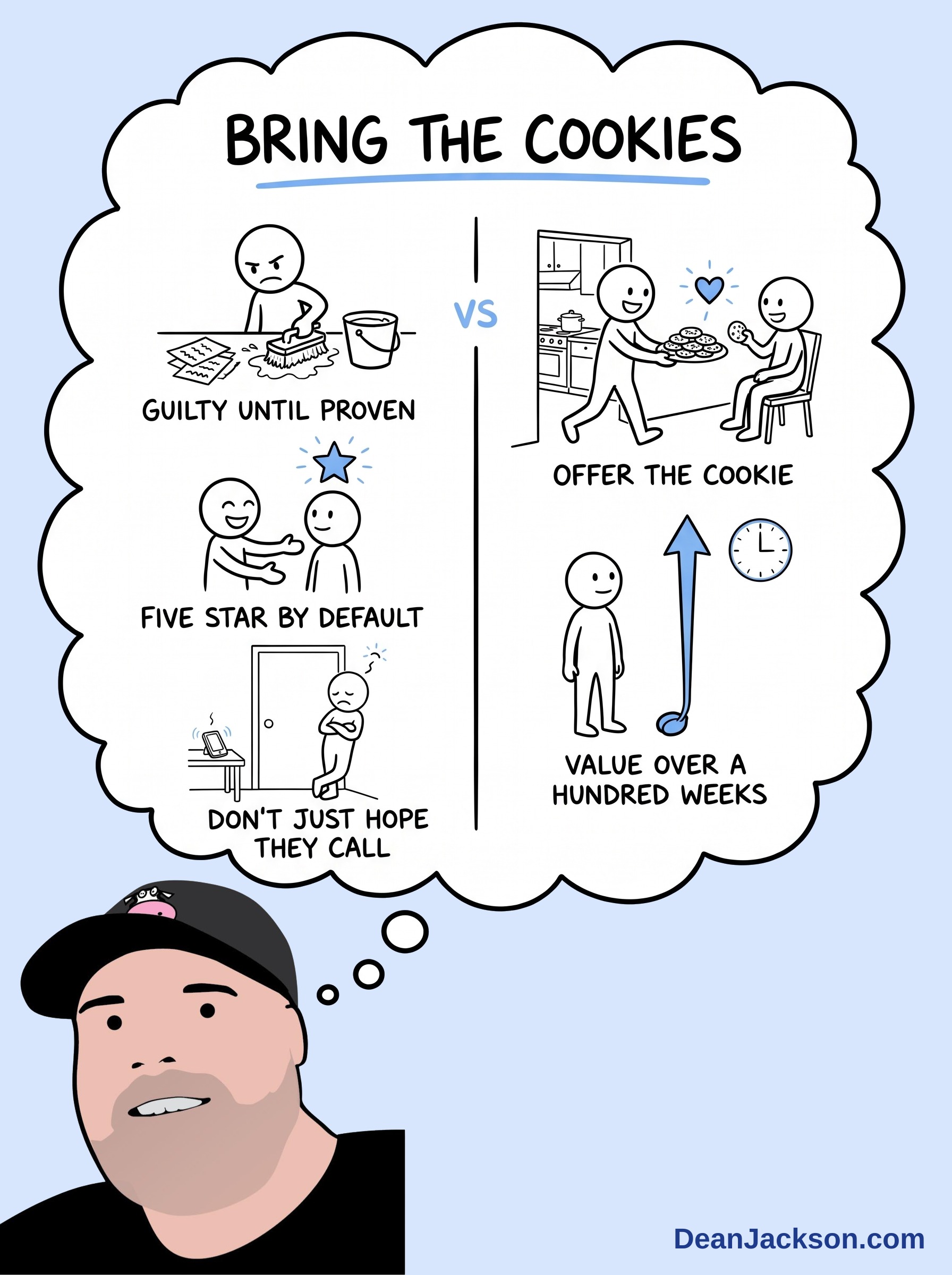
As if the leads are dirty and guilty until proven innocent.
Flip it.
Treat every single one like a five star prospect until they prove they aren't.
Not the other way around.
A five star prospect is willing to engage, friendly and cooperative, knows what they want, knows when they want it, and would like your help.
All five have to be true.
Not everyone is willing to engage right now. That doesn't make them a bad prospect.
So in the first hundred hours, you're hunting for the ones ready to go.
And if they're not ready, that's fine.
They move into follow up, where you keep adding value and educating until they are.
But here's the other big mistake.
Sitting back and hoping they call.
Even the language gives it away. If there's anything I can do, feel free to reach out.
That's passive. That's handing your leadership role back to them.
You're saying, you request something first, so I can react without risking rejection.
Let me give you the kitchen analogy.
Say I bring you into my house and sit you in the living room.
And I say, help yourself, there's lots in the fridge.
You're not going to go rummage through my fridge. Not a chance.
But if I walk out of the kitchen with a plate of fresh cookies and say, would you like one...
It's harder to say no than to just take one.
You take the cookie.
Because I anticipated what you'd want and brought it to you. Now you're not imposing.
Think about how we work.
If I ask, would you like a cup of tea, you might say, only if you're having one, don't boil the kettle for me.
We don't want people going out of their way.
You'd never say, you know what, bake me some cookies. It's not going to happen.
But we love when things are offered.
It's hospitality.
So figure out what the cookies are for your five star prospects.
What can you anticipate they want, and how do you wrap it so it feels like a gift, not an imposition.
There's so much here we're going to need two parts. We're only in the first hundred hours.
So for tonight, just change the one belief.
Five star until proven otherwise.
Join me live on the next free 50-Minute Profit Finder call, Friday, November 6 at 1:00pm ET. Save your spot →
Transcript
Auto-generated transcript, provided as supporting material. It may contain errors, and speaker labels are occasionally mis-attributed.
Okay, let's jump right in. I've been traveling and I kind of lost track. I think it's Thursday, Thursday night. So let's continue maxing week and we'll talk about lead conversion maxing now, if you are going to get the most of lead conversion, the thing that we need to focus on more than anything is the thought process that we have about these leads, what we believe about them. If we're lead maxing, we're getting all the leads, we're getting them early. We've got the best opportunity to communicate with those people and exclusively because we're not at the base of the river where everybody's coming and we're competing with everybody.
We've, you know, we've steered them off to a tributary where we're alone with them and we get to be the single voice that is, that's educating them. And when it comes time that they're ready, that they'll be able to work with us. So the first thing that we want to do is realize the value objectively of what these leads are most of the time. The biggest mistake that I see people make in lead conversion is they think about only the leads that are ready right now are the good leads. And they miss out on so much because we've seen it again and again that whatever happens in the first hundred days, and by the way, for most people, 100 days, that's their super long term follow up.
If you've got a mindset that these, these leads, if you identify somebody who raises their hand that they're interested in something, there's a five times more, the five times higher likelihood that they're going to do something more than 90 days from now than there is that they're going to do it in the first 90 days. So it's worth it to do that Now. I'm not saying in any way that you should sacrifice the first 90 days or even the first nine days. I'm perfectly happy if somebody wants to do something right now. Of course, that's the whole point of this. We're trying to find the people who are ready to do something right now.
But we also realize that, that whatever we do in that first 90 or 100 days, we're going to be able to do three or five times more over the next 100 weeks. And that sounds blasphemous to some CMOs that are focused only on ROAS in the first 30 days. What are the earnings per click? But when you take this approach that we talked about in lead maxing, that you're realizing that there's value in these, in being an explorer, in getting people before they're ready and there's a equity value that you're doing. It's like taking, it's flipping the switch and going from being expense based and looking only at, we ran the ads, how many did we convert before the credit card bill was due?
And that is how we're judging the success of it. If you take a capital investment approach, you realize that the best thing you can do is find all the leads sooner than anybody else and get them all in relationship with you and exclusively so that when it's time for them to do something, you're the first thought that they have. So I look at this, that we kind of break it into zones. I mentioned the hundred, you know, cohort of a hundred leads. If we take that, if we are, if we get somebody who downloads a book called how to sell your house for top dollar fast on a, the strength of an ad that's saying if you're going to sell your house in the next six to 12 months, what you do right now could make a difference of thousands of dollars.
There's a really good chance that that person is going to sell their house in the next six to 12 months and certainly an even higher chance that they're going to sell it in the next 24 months or 100 weeks. So of course we want to find the people who are ready to go right now, but we're completely okay if it's a little bit longer. And so the first goal of course is to find the people who are ready right now. So as soon as the lead comes in, the first and only thing that makes sense to do is to treat each individual like they are a five star prospect and they want to do something right now with you.
So we look at that and you know, our five star prospects are people who are willing to engage, friendly and cooperative. They know what they want, they know when they want it and they'd like us to help them. All five of those have to be true. Now, not everybody is going to be willing to engage right now, but that doesn't mean that they're not a good prospect. I've based all of this and we, I've shown studies that 50%, just over 50% of the people that inquire about anything are going to do whatever they've inquired about within the next hundred weeks. And so that, you know, lets you know that objectively the people that are inquiring about things are actually going to do something where that's, it's not a matter of the subjective quality of the leads.
Objectively they're going to do something, it's just are they going to do something with you? And are you willing to give them the benefit of the doubt? Are you willing to treat them like their five star prospects until they prove that they aren't versus treating them like they're not five star prospects until they prove that they are. And that's where, you know, the whole language, everything around the way that lead conversion is talked about in marketing is that the default is that the leads are bad, that they're, you know, they, people ask are they scrubbed leads, are they qualified leads? You have to put them through a gauntlet series or we've got to scrub them or qualify them as if they're dirty somehow.
Right. But if you take the approach of treating everybody like they're a five star prospect and not imposing your timeline on them, but offering service and offering things that are going to give them a chance to indicate to you what their timeline is, that's where all the magic is. If you look at getting the most out of that bundle of 100 leads that you're looking at, so we take the first hundred hours is really about that is finding the five star prospects, finding people who are ready to go right now and if they're not, it's okay. We now move them into our, our follow up process where we continue to add value to them and we continue to, to educate them and motivate them until they're ready.
Now we don't just sit back and hope that they're going to call. That's another big mistake that I see people make is they treat people like they're, we're expecting them to take the initiative and we use language even in the way that you follow up. You say to people, if there's any, anything I can do for you, please feel free to reach out to me. We're more than happy to help. And all those things are just kind of passive things that are not really taking a leadership role. You're kind of pushing off your role as a leader and putting it on them and you're saying to them, you request something of me so that I can spring into action and react to you rather than risk being rejected by offering something to somebody.
So it's a funny way of thinking about it, but I often use an analogy. I'm in my kitchen, right? If I were to bring you into my house, sit you in the living room and I just said to you, hey, I'm really happy you're here. If you're thirsty or hungry, there's lots of stuff in the fridge, go ahead and help yourself. I doubt that many of you would feel comfortable enough to go and get something from my fridge, but if I came out from the kitchen with a plate of freshly baked cookies and I said to you, hey, would you like a cookie? And I've got the cookies right in front of you, it would be more difficult for you to reject the cookies than it would be to take one.
You'd probably take the cookie and it's because I anticipate what you might want and I bring that out to you and offer it to you. That way you don't have to feel like you're imposing on me. Right? It's. Society is such a weird thing, but it's. We've been acting like this since we started banding together and playing the cooperation game. That's where all these societal norms came, right? And so if we don't usually want people to go out of their way for us, and if I were to say to you, would you like a cup of tea? You might say, well, if you're having one, I'll have one, but don't boil the kettle for me.
Like, we don't want people to go out of their way for us. Just like if I said, if there's anything that you'd like, if you're hungry or thirsty, you would never say to me, you know, it'd be great, would you bake me some cookies? It's not going to happen. We're not wired that way. But we do like when things are offered to us and we're appreciative of that, it's really about taking a hospitality approach to it. And so that kind of thing of figuring out what would be the cookies that you could anticipate that your five star prospects are going to want and how could you wrap it up so it doesn't feel like they're imposing on you, but it's something that they really want.
That's an exciting thing. I think we're going to have to do two parts about lead conversion maxing because there's just so much. And we're only in the first hundred hours of this here, so let's do that. I'll. I'll continue with lead conversion maxing tomorrow.
Get BreakthroughDNA Free
Discover the 8 Profit Activators that can transform your business. Get the complete framework, free.