These 3 things are 90% of winning ads - just do this
Watch
Listen
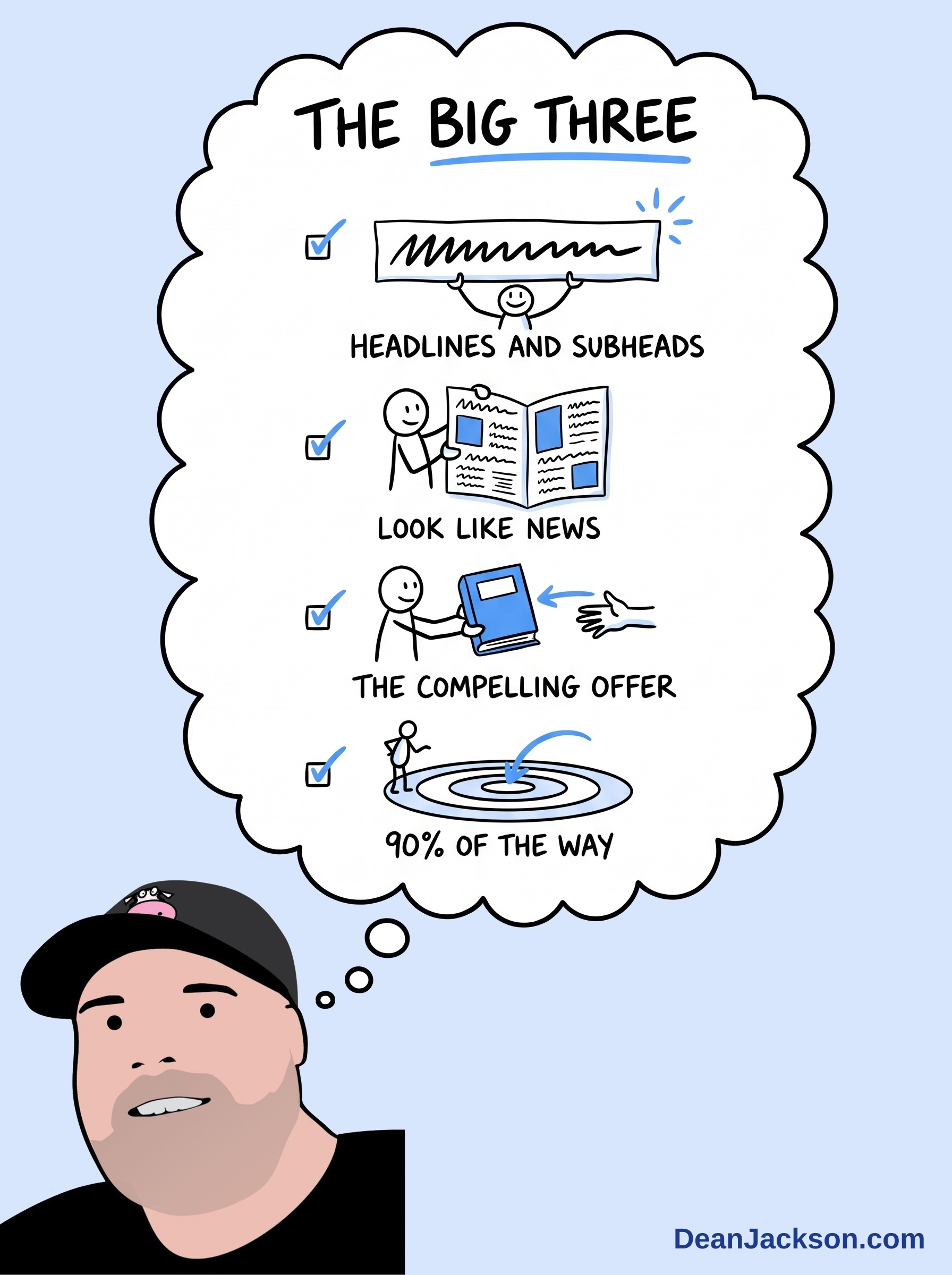
After studying every great copywriter, I boiled it down to three things. Get your headline, your layout and your offer right and you're 90% there.
Good morning.
We're in journal number nine now. Start of 1998.
And this is a milestone. Ten years since I started in business, back in my real estate career.
A lot has happened in ten years.
I left the real estate business behind. Now I'm in marketing, helping other agents grow, marching all across the country.
And I'm settling into who I am now.
Because here's what I'm realizing. The most valuable thing I know is how to put words on paper that get people to take action.
To come to me. Instead of me having to go out to them.
So I became a student of the game.
Dan Kennedy. Gary Halbert. Jay Abraham. Jeffrey Lant. All the way back to Claude Hopkins and Eugene Schwartz.
But not just book knowledge. I was applying it. Developing my own wisdom.
And wisdom isn't a fancy word. It's just what you've learned from experience. You do something, you see the impact, you debrief why it worked or why it didn't. Now you have wisdom.
So in journal nine, I made a list. My skills to develop as a copywriter.
Ten or twelve things.
It's like tennis. You break it down into the forehand, the backhand, the volley, the serve, the return. All of it adds up to your game.
People say the 80-20 rule. But I bet these three get you 90% of the way.
First. Headlines and subheads.
Ten or twelve words, plus a little amplification underneath.
Get a winning message that grabs attention and frames how somebody receives what comes next. And you're 80% there.
Eugene Schwartz said it in Breakthrough Advertising.
All that research. All that figuring out whether people are problem aware or solution aware. Hours and hours of it.
And it comes down to ten or twelve words.
Get them right and you can launch an entire industry.
Get them wrong and it does not matter what you say after. Because nobody's paying attention anymore.
Somewhere in these woods I'm going to find a Cosmo magazine. They're so hard to find now, have you noticed?
I want to show you the process Eben Pagan and I would go through every time a new one came out. Adopting those headlines to your situation.
Second. Layout templates.
I used to spend so much time on formats. Making my message look like valuable information instead of looking like an ad.
And that's the whole distinction.
If something looks like an ad, your brain reads it one way. If it looks like news, like information, your brain reads it completely differently.
We know and trust things that look editorial. Things that look like articles.
Coming up in journal nine, one of the most epic ads I ever wrote. A full page in the ReMax Times. A real broadsheet, the size of the Wall Street Journal.
We had to argue tooth and nail to run it. Because it looked like editorial.
I've got the actual ad. I'll show you.
You can do this with postcards, magazine ads, newspaper ads, letters.
And the very best frame of all is a personal letter. That's what Gary Halbert taught us.
Look through the Halbert swipe file. So many of them were just letters. A great headline, framed as information, one person to one person.
And once you're in it, you read all the way to the end.
Third. And this is the most important one.
The offer.
What is the most compelling thing you can offer that makes it easy for somebody to start the process of working with you?
Gary Halbert used to say what you're saying matters more than how you say it.
His example. If you have to interrupt a meeting because somebody's wife is at the hospital delivering triplets, there's no bad way to say that. The news is the thing.
So it's not the words. It's what you're saying.
And Jeffrey Lant gives you the four most important words. You get benefit now.
Get everything to fit squarely under those and you're on your way.
So how do I use this now, thirty years later?
Think about separating the compelling from the convincing.
I use meta lead ads more than anything. And the most valuable thing you can do isn't try to convince people to buy.
It's where the headline, the layout and the offer merge into the most compelling reason for someone to raise their hand.
That's why a book works so well.
Somebody's scrolling the news feed and they see an ad for a book. Big headline. Stop Your Panic Attacks. Stop Your Divorce.
The words say exactly what they were looking for.
And the visual is a book cover. Your brain knows instantly, oh, this is a book. Something I can get.
Free download. You don't need to say much more than the headline.
The more you say, the less response you get.
So I just gather the people I want to have a conversation with. Start in the outermost ring of their interest. And pull them into the vortex, toward the bullseye of letting us help them.
Headlines. Layout. Offer.
Get those three right... and you're more than 90% of the way to a relationship with someone.
Join me live on the next free 50-Minute Profit Finder call, Friday, November 20 at 1:00pm ET. Save your spot →
Transcript
Auto-generated transcript, provided as supporting material. It may contain errors, and speaker labels are occasionally mis-attributed.
Good morning. Okay, we are now in journal number nine. It's the start of 1998. So this is the year. This marks 10 years since I started in business, my real estate career. And I mean, a lot's happened in that 10 years. But as I'm settling into Florida, I'm settling into my role now. We. I left my real estate business behind. We've gone into marketing and helping other real estate agents grow their business, and we're marching all across the country doing those. I'm realizing that the most valuable thing that I know, the thing that I have invested my time and my effort and my energy into is, is understanding how to put words on paper that get people to take action, to come to me instead of me having to go out to them.
And that meant, you know, really studying copywriting, understanding marketing. And I was making a list. I was really like a student of the game. And I was studying, of course, you know, Dan Kennedy and Gary Halbert and Jay Abraham and Jeffrey Lant and going all the way back to Claude Hopkins and Eugene Schwartz and all of the greatest copywriters to really, like, get my solid foundation. And more importantly, than just having a book knowledge understanding of marketing, I was applying these things. I was developing my own wisdom. And I don't say wisdom in a aggrandizing way. I mean, wisdom is just factually something that you have learned from experience, that if you've done something and you've seen the impact of the change or you understand after debriefing why something didn't work, you have wisdom.
Now you have something that. That you've got your own experimenting. So I was making this list in journal number nine of my skills to develop as a copywriter. And I. You know, there's about 10 or 12 things that I've got listed down here, kind of breaking down the way that you would take the individual components of anything that you're studying, like tennis, they would take, you know, you've got your forehand and your backhand and volleys and serving and returns and approach shots, and all of those little collectively make up your. Your skill as a tennis player. And there are some big ticket items in copywriting, in marketing, that get you, you know, you say the 80, 20 rule, but I bet that these probably get you 90% of the way.
The. The top three things that I had here is your headlines and subheads that if you can articulate in 10 or 12 words, plus a little amplification with a subhead, if you can articulate a winning message or a message that gets somebody's attention and gets them thinking and framed into receiving your message in a certain way. You are 80% of the way there with that. I look at Eugene Schwartz in Breakthrough Advertising, said this whole thing about research and preparing and, you know, getting your. Getting all of your understanding of what are the dynamics involved in what you're trying to convey to people. And there's a funny part in Breakthrough, I don't remember the exact quote, but he was essentially saying, after all that research, after understanding what level of awareness your people have, what level of whether they're problem aware or solution aware, what the research is, what your approach is going to be, what your offer, all of that comes down to at the end of it, 10 or 12 words after all of those hours and hours of research.
And they're so pivotal that you can't underestimate the importance of them. Because he says if you get those 10 to 12 words right, you can launch an entire industry. If you get them wrong, it does not matter what you say after those 10 or 12 words because you didn't get them engaged and paying attention. So I spend so much time, and you can see it in my journals. I'm determined I'm gonna find a Cosmo magazine. Somewhere in the woods are so hard to find magazines now. I don't know if you guys have noticed that, but I'm gonna find a Cosmo magazine and show you the process that Eben Pagan and I would delightfully go through every time a new Cosmo magazine came out to adopt headlines to your.
To your situation. So those things, headlines and subheads, that's 80% of it. You can get that across. Another thing that is super important and valuable are layout templates that you can. I used to spend a lot of time getting the formats of things and trying to make my message look like it's valuable information instead of making it look like an ad. And that's an important thing to. That's an important distinction here, that when we did the checklist on how to evaluate your ad, one of the things was, does it look like news or does it look like an ad? And if something looks like an ad, your brain perceives it completely differently than it does when it's reading information.
So there are certain formats mats that have an advantage when you are laying things out. We know and trust things that are editorial, things that look like articles, things that, you know, we would spend so much time making things look like a page in an actual editorial page in the magazine. And it's funny because Coming up here, maybe one of the greatest ads, certainly the most epic ad that I had ever written up to this point was a full page ad in the REMAX times, the big ReMax newspaper. It's the size of the Wall Street Journal, like a real broadsheet thing. It did a full page ad in there.
And we had to argue tooth and nail to be able to run this ad because it looked like editorial. And this is going to be a great story coming up here from Journal 9. And I've got the actual ad, so I'll show you how that works. But you can see the headline and the layout format brings people in with your message and it gets them in the right light because they're looking at this as news. Now you can do that with postcards, you can do it with magazine ads, newspaper ads and letters. The very best, like frame of layout is a personal letter. That's what Gary Halbert taught us.
And looking through the Gary Halbert swipe file, you see so many of the things were just letters that had a great headline framed as information from one person to one person. And once you're in it, you start reading all the way to the end. And then the third thing that I think is the most important of this entire list is your offer. If you've got, you always think through what is it that we're offering? What is the most compelling thing that we could, that we can offer for people that makes it super easy and compelling for them to take advantage or start the process of working with you towards getting the outcome that they want.
So of those, you know, I was just to laugh because Gary Halbert used to talk about messaging and your offer or how what you're saying is far more important than how you say it. If you, you know, we, he used the example if you had to go in and interrupt somebody in a meeting because you just got a message that their wife is at the hospital and delivering triplets, there's no bad way you could go in and say that. That wouldn't be exciting to somebody. There's so many different words you could use to say it. So it's not the words, but it's what you're saying.
And when you get down to that core, you know, we talked about Jeffrey Lance approach of the four most important, you know, throughput words of you get benefit. Now if everything fits squarely under one of those four, those four directional things, you are on your way. But it's the offer that's going to get something. So how we make this, how I use this now, 30 years later is when you think about the most successful ads. We're able to separate the compelling from the convincing by using. I use meta lead ads more than anything else. And the most valuable thing that you can do with meta ads is rather than try and convince people to buy your stuff, this is where the headline and the layout and the offer can merge to create the most compelling opportunity for people to raise their hand.
So that's where things like a book is a fantastic thing. Now, the visual that goes with the book is a book cover. That's why when somebody sees an ad, they were scrolling through their news feed and they see an ad for a book with a big headline on the book that says stop your panic attacks or stop your divorce. That's why stop your divorce was so successful is the words spoke exactly what somebody was looking for. So those words, the, the, the offer or the headline of stop your panic attacks and the visual layout of having the iconography of a book that your brain knows immediately, oh, this is a book.
So it's looking at this as something that I can potentially get with the offer download, and it's a free book. You don't need to say much more than the headline, and more you say, the less the response that you're going to get. So I always look at, I want to just start by gathering the people that I know I want to have this conversation with in the outermost ring of where their interest would be to get in that vortex of moving towards the bullseye of letting us collaborate with them to help get rid of their panic attacks. So that's the, that's the big thing, the big three headlines and subheads, the layout contextually of what you're trying to do and the offer.
If you get those three things right, I believe you're more than 90% of the way to getting a relationship with someone.
Get BreakthroughDNA Free
Discover the 8 Profit Activators that can transform your business. Get the complete framework, free.