Headline Hunting: where to swipe the very best ideas
Watch
Listen
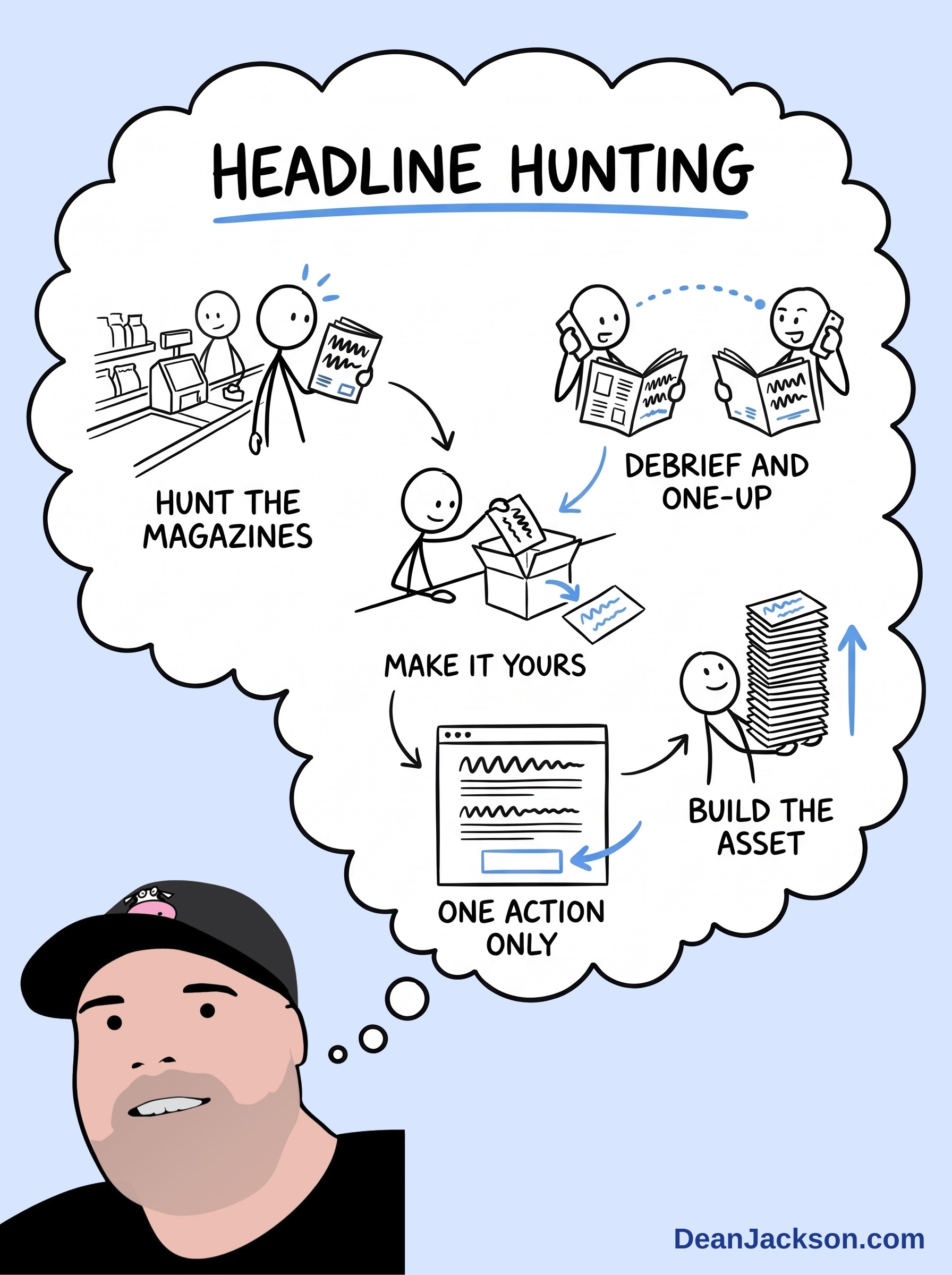
How Eben and I used to race through each new Cosmo for headlines, and how that habit built the squeeze page and a list-building machine.
Good morning.
Journal number nine. And today I want to give you a dramatic reading.
Page 16. February 4, 1998. I was at the Eagle Ridge Mall, sitting in the food court, journaling.
Here's what was on my mind that day.
I tested two things. I turned the phone ringer off, and it was great to not have that distraction so I could focus.
And then I proceeded to not focus on what I was doing.
That's the deep thought. That's journal nine.
But it made me laugh. Because back then the only distraction of a phone was that it might ring.
Now my phone's on silent all the time. Someone said the least used app on my phone is the phone app. True.
Anyway. One of the things I did at that food court was take great delight in what I called headline hunting.
Eben Pagan and I had a ritual. Every time a new Cosmo came out, we'd each get it, separately, and go through it.
Then we'd get on the phone and debrief. One-upping each other with the best headlines we'd found in the wild.
Almost thirty years later, here's my first observation. It is hard to find a magazine now.
They used to be everywhere. I still haven't found a Cosmo. But I found Women's World, and that'll do.
Cosmo. Women's World. Money. The retiree magazines. Those are the best for usable, templated headlines.
And here's the good news. The people who write these are some of the highest paid copywriters in the world.
Because this is all they've got. They have to grab you in line at the grocery store, right there by the register.
In the time it takes you to walk past, they have to catch you and make you curious enough to look inside.
And you know the move. See page 38.
That's the whole game. They get you invested. You start the article, you're a little bit in, it's your turn at the register, and now you have to buy the magazine to finish it.
You can't not continue.
So here's what I learned from that. And I carried it straight onto the Internet.
My first website came through Jeffrey Lant. He had a company called World Profit back in the mid-90s, teaching people how to get online.
A gentleman near Toronto, David Ledoux, got me set up. Shout out to David if he's still around.
Back then you couldn't just make a website. You needed a server, a package, the whole thing.
Jeffrey also ran postcard decks. Like a Val-Pak for business opportunities. A cellophane-wrapped deck, and you'd buy one card in it.
So I wrote a postcard. And I built the headline from the magazines.
In Women's World I saw one. Turn boxes into cash.
That's a lovely formula. This into that. A transformation.
So mine became, turn a free email address and a few hours a week into an extra monthly income.
Cobbled together from Cosmo, from Reader's Digest, from whatever I'd been hunting.
The card sent people to a site called Money Making Websites.
What a domain. Does what it says on the tin.
Now here's the thing everybody else was doing. They'd pile the page full. Articles, sections, links to click off to everywhere.
A little box up top. Join our newsletter. And a hundred other distractions around it.
And I realized the most valuable thing I could do was capture a name and an email address.
Because then I had a way to talk to them after they left. An asset.
So I thought, what if that's the only thing you can do on the page?
What if I optimize it so the one action available is leaving your name and email?
I'd get more names per hundred visitors than any method where people could scratch the itch and wander off.
So I borrowed the Cosmo trick. See page 38.
When I built the Living in Winter Haven site for Julie Matthews, I wrote the whole page like that.
Search 1,100 homes online. Find out how to buy a home with zero down. More inside.
Find out how to sell your house for top dollar, fast. See inside.
All these headlines going down the page. And instead of click here, everything led to one form at the bottom.
Free instant access. Just your name and your email.
That was the magic. In the early days we'd get 40 or 50% of visitors to leave their name and email.
Building the list. Building the asset.
And the moment they signed up, they landed on a welcome page. Same page, exactly. Except now everything said click here.
Same stuff. Unlocked.
Some of it led to Market Watch, where they'd tell us what they were looking for and get every new listing in their range.
Remember, no Zillow in 1998. No realtor.com. The only way in was through an agent with the MLS.
So. I say all that to nudge your curiosity.
Look through the magazines. Even the National Enquirer has some of the most compelling language you'll ever see.
And here's a tip. If you see the same ad month after month, you know it's a winner.
Magazine ads cost a fortune compared to meta ads. Nobody keeps running a loser.
So learn from the people still buying print. Those have to be winning ads.
Take the appeal, run it through your own processing center, apply it to your situation.
And there you go. A fresh idea, custom made for you.
Whatever you do, turn your phone off so you don't get distracted.
Join me live on the next free 50-Minute Profit Finder call, Friday, November 20 at 1:00pm ET. Save your spot →
Transcript
Auto-generated transcript, provided as supporting material. It may contain errors, and speaker labels are occasionally mis-attributed.
Okay, good morning. Here we are, journal number nine. And I'm going to start out today's episode with a dramatic reading of a page in my journal, page 16 of journal number nine. I was at the Eagle Ridge Mall, which, if you watch the very first of these videos, I went back to the Eagle Ridge Mall, where we often go to the movies here. But I would go there and. And I would sit in the food court and I would journal and. And think. So today, here's what was on my mind. February 4, 1998, journal number nine. I tested two things today. I turned the phone ringer off, and it was great to not have that distraction so I could focus on what I was doing.
And then I proceeded to not focus on what I was doing. There you go. That is a deep thought from journal number nine. But I found it funny because the, you know, the funny thing was the only distraction of the phone in 1998 was that it might ring. And, you know, now it's like so funny that the phone ring. I have it on silent at all times, and I never answered the phone at all. The least somebody said this, that the least used app on my phone is the phone app. I hardly ever talk to anybody. But anyway, one of the things that I would do in my, in my journals and at the Eagle Ridge Mall was take great delight in what I would call headline hunting.
And Eben Pagan and I used to take great delight when the new issue of Cosmo magazine came out. We would independently get the Cosmo magazine and we would go through and we'll come up with ideas, and then we would get on the phone and we would debrief and we would one up each other with headlines that we had discovered in the wild. And, you know, here we are 20, 26, almost 30 years later, and my first observation is how difficult it is to find magazines. You wouldn't believe it. I mean, it used to be magazines were everywhere. We had to go all over town. I still haven't found a Cosmo, but I found Women's World, and that'll do for the, for the exercise here.
But if you look at Cosmo magazine, Women's World magazine, Money magazine, any of the retiree magazines, those ones are the best for really usable, practical, kind of templated headlines that you can use and adapt for your own purposes. And the good news is that the people who write these headlines are some of the highest paid copywriting jobs in the world, because this is all they have to use to sell this magazine. They have to catch somebody's Attention while they're in line at the grocery store or at Walmart is where I found this. And it's right there by the cash register. And in the time that it takes for somebody to walk right by, they have to capture your attention and get you to be curious enough to want to look inside.
And you know how they always put the. See page 38. The whole thing is how they get you invested in the magazine. And then meanwhile, you're reading page 38 and you're only a little bit in and it's your turn. And now you got to buy the magazine to finish the article because you can't not continue. So something that I learned, and we're going to get here because this is the year that the Internet became a big thing. And we talk about the idea that. I don't know if anybody's keeping official records of this kind of stuff, but there's some speculation and debate among who invented the squeeze Page, what it's called now.
And I'll say it comes down to me and Jonathan Meiselle and Jonathan wonderfully named it the Squeeze Page. And I'm not sure, you know, there's. I think what we should do is we should have a Wayback Machine off. Go back and look at. I can point to the first time I used the squeeze page and we could go back and see. I may have the first recordable use of the squeeze page. But here's what I learned from magazines like this and headlines that I used in a website that I created for Julie Matthews here in Winter Haven, the Living in Winter Haven website. And before that, I think the very first website that I created was one called Money Making Websites.
And there's a couple of good lessons there that Jeffrey Lant had a company called World Profit back in. Back in the mid-90s, and he was kind of action central for teaching people how to use the Internet. And so that's how I really kind of got to know Jeffrey. After I'd already been studying his. His copywriting things. The next logical progression was getting online and actually bought the first website like the. You know, people were kind of selling websites like, you know, it was kind of a package. You had to have a server and you had to have. It was not as easy as today to set up a website.
So he was helping people with that. And so I. My first website was through Jeffrey. There was a gentleman who lived pretty close to me in Toronto. I think his name was David Ledoux. And I wonder if he's still around. Shout out to David Ledoux if he is, he's the guy that got me into my first website. So as I set it up, Jeffrey had these postcard deck. And if you, you know, that may sound crazy, but it's kind of like a Val pack for. For business opportunity see or for, you know, small businesses. And you would get a cellophane wrapped little deck of postcards and you could buy one of the postcards in that deck.
And it was much less expensive, of course, than sending an individual postcard to somebody. But I got a idea from a Cosmo magazine and I saw in this Women's World magazine there was something very similar to it in the pages here. Let me see if I can find it. Because it was, it reminded me of, of the headline that I used for my postcard. So I create here was one Turn boxes into cash. That was. And that's kind of a nice headline formula of this into this or this or this a transformation. So my headline that I did for the postcard was turn a free email address and a few hours a week into an extra monthly income.
And that headline was something that I had cobbled together, created by inspiration of seeing things in the Cosmo magazine and other magazines. Reader's Digest, another good example of where to look for these kinds of headlines. And when you would go to money making websites, that's where I would send people. They could call and listen to a recorded message or you could go to money making websites. How great a domain name was that? Like that, it does what it says on the tin. But when you go there, instead of what most people were doing with their websites is they would have all kinds of things and you could link onto all these other pages.
They would have articles or they would have sections on the web page. And I learned very quickly that the most valuable thing that you could do is to capture a name and an email address for somebody. Because now you had a way to communicate with them even after they left your website. You had an asset now that you could direct communications to them. So I put a very high priority on attracting names and email addresses. And most people, what they were doing, everybody was using list servers is what they were called then. And people would have a little, you know, form up in the top of their page that said join our newsletter or something like that, where you could put in your, your email.
Email address. And then there were lots of other things for people to click on. And I realized, I bet if I just made that the only thing that you could do on the page, if I optimized the page so that the only thing you could do was leave your name and email address. That I would get more names and email addresses per 100 visitors than I would get using any other method where people could scratch the itch that they had or get other kind of information or get distracted and go off somewhere else. So I borrowed from Cosmo magazine this idea of see page 13 or page 30.
See, it's already on here, page 38. There's teasing you with a promise and then telling you you have to go to page 38 to solve this mystery. And so what I did was I would, when we were doing this for Julie, I would say, you know, search 1100 homes online and then see inside and find out how to buy lovely homes in Winter Haven with zero down payment. More inside. And I would go through the whole things, find out how to sell your house for top dollar fast, see inside. So you'd go down and there would be all these headlines, and instead of saying click here, like most of them would do, we would just lead to one form at the bottom of the page that said free instant access.
And it was just leave your name and your email address and, you know, get all of this, all this information. And that was the magic formula that got the most people. Sometimes in the beginning, we would get 40 or 50% of the people who came to a website to leave their name and their email address, and we would build this asset of a list. Now, as soon as people put in their name and their email address, they. They went to a welcome page where it was the exact same thing as the homepage, except now all of the things said click here. So you could see the exact same stuff, but you'd essentially unlocked those things.
And some of those would lead to a form where you could get updates of all the homes that come on the market in any price range and area you choose, which was still a novelty in 1998. There was no Zillow. There was no realtor.com. the only access to information was through a Realtor who had access to the mls. So we would get quite a few people to sign up for Market Watch, where they would fill out a form and tell people what they were looking for. And so all of that, I say all of that to encourage you to, you know, out of this kind of curiosity week, in a way I told you about stop your divorce of coming through looking in USA Today and found that.
But looking through magazines, even the National Enquirer has some of the most compelling language that you see and some of the advertisers that you're exposed to on these pages. And by the way, if you see an ad in a magazine, you know, month after month, you know that that is a winning ad, because the magazine cpms like cost per thousand to run an ad is so much, you know, greater than the what you could do on on meta ads now. But you get a very specific audience. So there's a lot to learn from the people who are still doing print ads today, because those have to be winning ads.
And you can take those appeals, put them through your processing center, apply them to your situation, and there you go, you've got a fresh idea, custom made for your specific situation. So this has been fun to to go through them. Whatever you do, turn your phone off so you don't get distracted.
Get BreakthroughDNA Free
Discover the 8 Profit Activators that can transform your business. Get the complete framework, free.