Guessing, Betting, and the AI Attention Economy
Listen
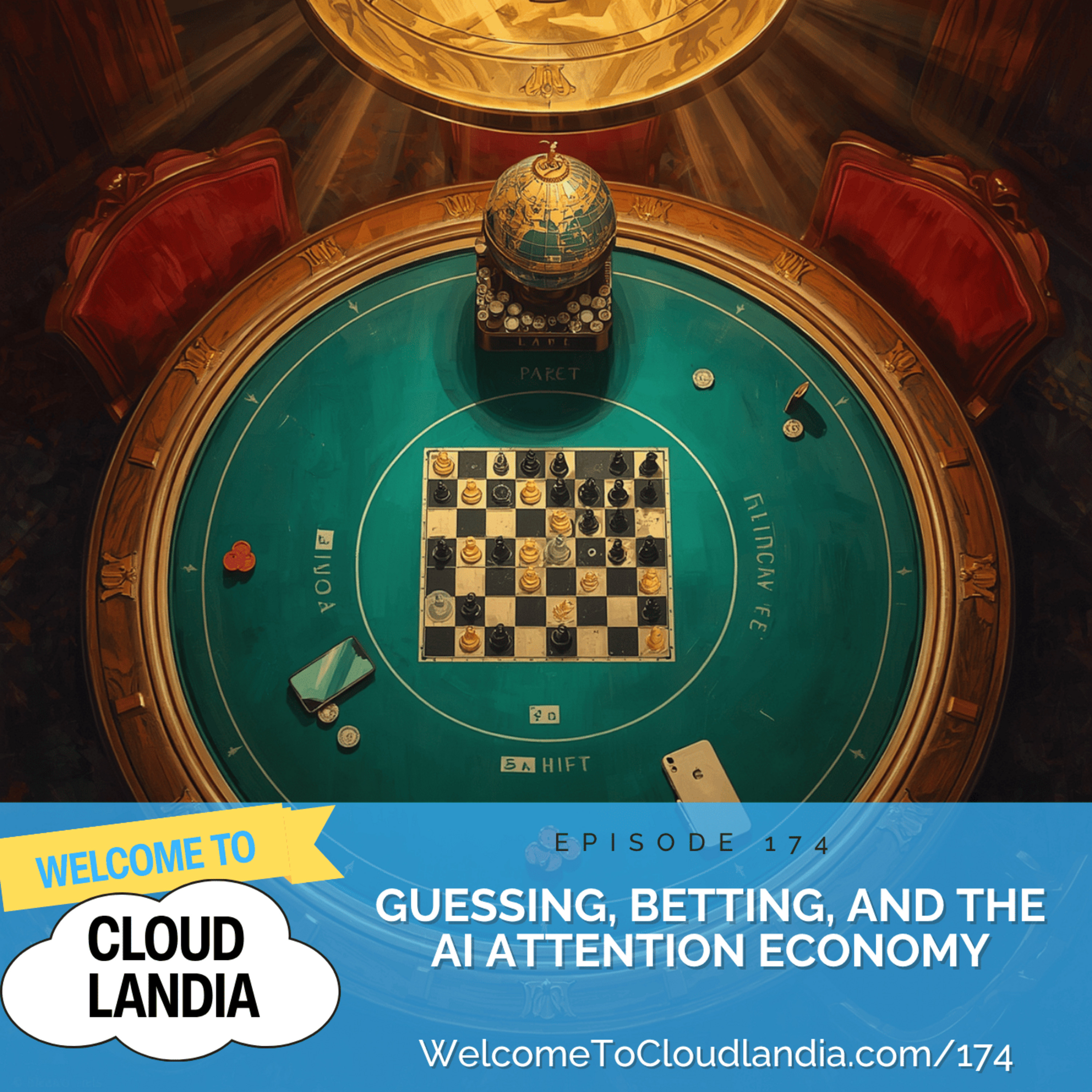
The most valuable currency in an AI-saturated world isn't data or content, it's the 1,000 minutes of attention each person has available every single day.
In this episode of Welcome to Cloudlandia, Dan shares a new thinking tool he's been developing with entrepreneurs: Intentional Times Accidental, a framework for distinguishing between results you planned for and opportunities you simply recognized and seized. The conversation connects naturally to a powerful quote Dean encountered, "You don't get what you want, you get what you are", and how that idea links to Dan's work on creating a better past. We also hear how Angus Fletcher trains elite special forces operators not by scripting their responses, but by deepening their personal story so they can make sound decisions in chaotic, unpredictable situations.
From there, Dan and Dean trace the same pattern into global affairs, examining how recent moves in the Straits of Hormuz reflect high-stakes guessing and betting under pressure. The conversation shifts to AI's financial sustainability problem, the gap between what AI companies are spending on infrastructure and what the market will realistically pay, and why Dean believes AI-generated content faces a fundamental ceiling in a world where human attention is fixed and finite. Dan observes a cultural blowback already forming, with young people pushing back against AI predictions that threaten their futures, and a surprising surge in religious interest as a counter-reaction to tech-driven culture.
This episode finds Dan and Dean at their most candid, trading observations about Perplexity's flattery, Dean's 40 Hz brain-stimulating Beacon light, a dog-calming gadget called PetGentle, and a Henry Kissinger story that perfectly captures what's happening on LinkedIn right now. Listen in for a conversation that moves fast, thinks wide, and lands on ideas you'll be turning over for days.
Show highlights
- The global attention budget is fixed: 8 billion people × 1,000 minutes daily, AI-generated content must compete within that hard ceiling.
- Dan's new Intentional Times Accidental tool helps entrepreneurs separate planned breakthroughs from lucky ones they simply recognized and seized.
- Elite special forces operators are trained not with scripts but by deepening their personal story so they can decide well in chaotic, unplanned situations.
- Dan believes OpenAI cannot legally convert from nonprofit to for-profit mid-streamand predicts the dispute will reach the US Supreme Court.
- A fake AI-generated scientist published 13 bestselling books over the past year and doesn't exist, Dan's verdict: only dangerous if you believe it.
- Young people are opting out of AI adoption and turning toward religion in growing numbers, a cultural blowback Dan says is entirely predictable and already underway.
Links
Transcript
Auto-generated transcript, provided as supporting material. It may contain errors, and speaker labels are occasionally mis-attributed.
Dean: Welcome to Cloudlandia. Mr. Sullivan.
Dan: Hello there, Mr. Jackson.
Dean: There he is. Are you in Chicago or Toronto today?
Dan: Toronto.
Dean: Okay.
Dan: Well, it's very cold. It's very cold.
Dean: Somebody told me that they've had their ninth false spring and it's coming into back to winter.
Dan: Yeah. It's overcast. It's gray. It's damp. It's cold.
Dean: Oh boy. Oh boy. Oh boy. Well, it seems like you have- Welcome to Cloudlandia. Welcome to Cloudlandia. Are you in Chicago or Toronto today? Okay.
Dan: Well, it's very cold. It's very cold.
Dean: Somebody told me that they've had their ninth false spring. Back to winter.
Dan: Yeah. It's overcast. It's gray. It's damp. It's cold.
Dean: Oh boy. Well, it seems like you had a great week in Chicago talking to Chad.
Dan: You've been talking to Spice.
Dean: I've been talking to Spies. I got my men on the inside. Yeah. So good times?
Dan: Yeah. I had a really good time. I created a new tool which is called Intentional Times Accidental. And I just have the entrepreneurs in the room take a look at what results they got, breakthrough results,
Dan: Where it
Dan: Was intentional. They intended to get that breakthrough. They put a plan in place and they got the result and compared to things that just happened to them and they took advantage of it.
Dean: That's an interesting distinction. I just had a great quote that I heard just this morning and I thought, what a perfect timing. The quote was, let me get it right because it's ... Oh yeah, you don't get what you want. You get what you are. That totally fits with our creating a better past because you are what you did. And what you did is created a better past.
Dan: Or a better you, maybe.
Dean: A
Dan: Better
Dean: You. Yeah. But that context of everything we've been talking about that really fit well, you don't get what you want, you get what you are and you are, I'm adding this, but what you are is the collection of what you've done.
Dan: Did, what you did. Oh, what you did,
Dean: Yeah.
Dan: Yeah. Yeah. Yeah. And that requires a totally different approach.
Dean: Yeah. It's like it's the inverse of what people ... There's a difference in what you're going to do and intending to do and what you did because that's the only thing. Yeah. What you did is what makes you what you are. Yeah.
Dan: Yeah. Angus Fletcher who's coming to talk to us in Orlando. First week of June, he talks about the special forces, the Delta Force, Navy SEALs, Green Berets. There's a lot of these different kind of special operators, they're called special operators. And he said that what they train them is how not to ... They don't tell them how to handle situations. They constantly work with them to tell their story. When you were in this situation, what did you do? When you were in this situation, what did you do? How did you handle this? And because they're put into situations that are chaotic,
Dan: Sort
Dan: Of chaotic situations, all guesses and bets and they don't have a lot of information being in the chaotic situation, but they have to make good decisions and how do you do that? And he said, "It all depends on the story that you tell yourself. What's the story? What's the story? How have you handled this? How have you handled that? " It's a lot of experienced transformers, to use the coach term. "You did this, this part of it worked, this part of it didn't work, and because of what you know worked and didn't work, how do you handle this similar situation going forward?
Dean: "So you're saying like his whole thing is activating the part that so that you ... Well, how do they use that? To what end is that? How do they train people?
Dan: Well, they put them into all sorts of practice situations and that you can't prepare for. So they have these vast bases, a lot of them in North Carolina and they put them ... Usually it's dark and something happens, they're given an objective. They have to go and do something and then they're presented with all sorts of unpredictable situations and how do they actually achieve the mission where they have to make it up on the spot.
Dean: And
Dan: They do this over and over and over again. And the big thing is they have to know what their story is because they can't know what the conditions are because that's not available to them. So they have to fall back on previous successful and unsuccessful experiences. They have to go back and say," How did I do this before? Okay, this is what I have to do. "Yeah,
Dean: Whatever you don't do this.
Dan: They have to go back to what they are. They have to go back to link this idea up with the idea of great quote. That's a really great quote.
Dean: And I think that then once you've had an experience of something when it comes up, if you know what the right thing to do is, that helps. I find that even in our marketing things, that's one of the progression that we talk about in the VCR formula, vision plus capability multiplied by reach is the vision thing starts as a proposition, moves to proof that once you say ... And imagine it's the same kind of thing there, right? That you look at a situation that a soldier might be put in, they have a proposition based on, well, this is similar to this or whatever, but the next level is proof that this worked and then it moves to be a protocol that now when you reliably have proven that in this situation, if you do this, that this is the outcome and then that becomes property and that
Dan: Becomes-
Dean: That's an interesting
Dan: Thing. It doesn't always work. It doesn't always work.
Dean: That's the whole-
Dan: There's a recent example in world affairs on 28th of 28th of March,
Dean: 20th,
Dan: I forget when they bombed Iran. I think it's the 25th of- February. February. February. Yeah. And the Ayatollah, the head guy said," We're going to have a meeting on a Saturday morning and that's safe because it's the Sabbath for the Jews so the Israelis won't do anything on Saturday and the Americans only do things at night. So you can feel safe. Say they all gathered at one spot and the Israelis decided to do something on the Sabbath and the Americans decided to do something in the daycare.
Dean: During the day.
Dan: During the day and they lost 47, 48, 49, I forget the number. They lost 49 of their top leaders in about the first five minutes of the bombing career and they're making a whole series of really bad guesses and bets. On the one hand, we'll cut off all the shipping that comes out of the straight format. We just locked down and the Americans said, "Well, we'll be just outside and nothing can go to Iran or come to Iran during that time." And now they ... I don't know what's going to happen. I don't think they want to do anything willingly. I don't think their hearts and souls are in coming to an agreement, but their economy depends upon shipping through the straits of hormones. America's economy doesn't depend on any of that.
Dean: Right, exactly. And that's an interesting thing, right? When they don't the unintended thing, nobody expects that if we can't pass through there, nobody's going to pass through there. That seems unpredictable, right? No, they wouldn't do that.
Dan: So the only thing that can't pass through is anything bound for Iran or from Iran. All the other stuff from the United Arab Emirates, that can pass through because they've got the US Navy protecting them and everything like that. I think it's your VCR formula, I think that what the president of the United States has a real handle on his leverage. He knows how to leverage situations. We got the greatest Navy in the history of the world and we're just five miles outside of the Straits Hormuz. We're just going to take an interest in any tanker that comes by and we say, "Where are you going? Who do you blonde to? " If you're going to Iran, no, you have to go someplace else. We're not going to take your oil or anything. We're just going to send you someplace else, but you can't go there. Something comes from Iran, they say, "No, you have to go back or you have to go back. You can't come out.
Dean: " Yeah.
Dan: You wonder if they thought that through
Dean: I don't think so. Yeah. I wonder though now that what'll be the work around like where you headed? We're definitely not
Dan: Going to rant. Yeah. I think Cuba, next week Cuba will start. They're going to say, "We want to get the casinos back into Havana. How about let's get the casinos back in Havana?" Are you a betting person?
Dean: Yeah, right, exactly.
Dan: Yeah. Now let's talk about your electricity because right now you don't have any.
Dean: Oh man, do you miss it? Yeah.
Dan: Yeah. I
Dean: Think that's funny.
Dan: But the thing about guessing and betting, you really see that with the AI world. Boy, there's some really big bets being made that it's going to turn out a certain way.What's
Dean: The latest
Dan: Picture? I don't think this is ... Well, one of the predictions is that OpenAI with Sam Altman started off as a nonprofit organization and now he says, "But don't pay any attention to that. Now we're going to be a profit making corporation." And Elon Musk says, "No, I don't think you can switch like that because what about all the people that you promised things to and now you're going back on your promises?" I don't think you can just like that. I gave you 10 million or 20 million. I forget what he is. He said, "I don't care about my money, but I don't think you can just switch like that. " Well, it's going to be a Supreme Court case. You know right now it's going to go right to the US Supreme Court, but I think he's dead in the water. I think OpenAI is dead in the water.
Dean: Oh, wow.You wonder like
Dan: That- I don't mean that technology is dead in the water.
Dean: No.
Dan: But his corporation can't become a profit making organization. He can't start off as a nonprofit and then in the middle say, "Oh, but we're actually for
Dean: Profit." I just heard on a podcast, I don't remember the exact details, but the general idea was that the infrastructure spend and the cost of providing this AI, all the demand and everybody using it, that right now it would be almost impossible to charge enough that the market would be outpriced to actually pay for what it's costing. I think they're spending $600 billion or something on the infrastructure, like the servers and the stuff which really will be obsolete in three or four years that require even that investment again to keep up with it and the energy and the whole stuff that where does the model, how does the monetary model of that work out, like being able to charge you like most people are using it for free or the $20 a month plan, which is not anywhere near what needs to be done. So do you end up ... Yeah, you wonder like it's got to be advertising to be embedded in, which is going to
Dan: Change. Well, and then they have the problem of data centers to have these huge data centers.
Dean: That's what I was saying was the data centers are, that's what I think that infrastructure they spent $600 billion or something on the data center, which is only going to be viable for three or four years and then requires to be upgraded. It's not like building a nuclear power plant that's going to last for 50 years or whatever.
Dan: Yeah. It seems to me that there's a lot of selling of fairy dust in the whole thing. And what's the interesting thing, I think that consumers are actually getting a really good deal right now. I don't know what it costs me. It costs me 200 a month. Because I got the super max. I don't have the computer yet. I haven't started working with the computer, which will do work while I'm sleeping and not sure I need that. I'm not sure that I actually ... I'm not going to just get it so that I can have the experience. There's got to be a reason for it, but yeah. Well, this morning I just knocked off two chapters of the book with Perplexity. Yeah,
Dean: What kind of book is this?
Dan: Yesterday creates tomorrow.
Dean: Oh, okay. Right. That's the one.
Dan: That's the next book. That's the next book. Yeah. Yeah. And so here's what I'm thinking. This is really good for consumers. I don't think it's so good for investors. Well, it's good for investors if they're first in because there's a lot of other money piling in like a Ponzi scheme. The early investors get paid off, but I'm not seeing the lawn game here with any of them.
Dean: I don't either. I just wonder ... Yeah, the question I've been asking is always I just push the accelerator pedal on it and I'm kind of asking people to what end? That's the question I'm asking, right? So when you look at it that, well, look at, you'll be able to create videos with just a single prompt and your cloud can do your whole year's worth of emails and your content. It can create your whole years worth of content while you're sleeping, but then you go again to what end, right? We know when content is AI, it's not the same. It's got that thin clank of the counterfeit and it's going into an environment where our limited attention, everybody's attention, it's almost like universal basic income. Our universal basic attention budget is 1,000 minutes maximum per person. And that's a fixed thing. The global attention budget, the gross domestic attention of the world is 1,000 minutes times eight billion daily. That's the maximum-
Dan: And you have no control over what people are doing.
Dean: That's exactly right, but they can only spend that much attention, right? If you take out the daily things like what you're really competing for on AI front is for the content stuff, you're really competing for about 400 or 450 minutes a day of available attention unit, but you're competing against everything else. You're competing against people doing original work, which is, I don't know, it's going to be a fascinating thing to watch this unfold because as our capacity to create content is reaching infinity.
Dan: It's certainly beyond where anybody thought there were limits.
Dean: Yeah, exactly.
Dan: Yeah. My sense is that it's really interesting because everybody's saying everything's speeding up, but my feeling is that everything's going to be slowing down. And for example, there's been easily 15 articles in my YouTube last week and this isn't stuff that pops up for me. This is stuff that I go looking for. Anyway, it's all about how AI is going to be one of the really hot election issues. I thought it was going to be in 2028. It's actually going to be in 2026 and that young people are opting out of AI. Young people don't want to ... And the reason is because all the predictions are they won't have jobs. They won't have jobs. So why should I get involved with something that ... And everything ... Not saying they're correct. I don't think they're correct. I don't think they've really thought it through deeply because they don't have enough experience yet to think things through deeply. But I think that there's all sorts of blow back that's starting to happen with AI right now that ... Well, first of all, that Mark Zuckerberg is now the second most hated person on the planet. He's the first. Yeah. And these are not heroes anymore. These people are not heroes and there's sort of a cultural ... It's not a social blow back, it's sort of a cultural...One of the things they're noticing that young men are turning to religion a lot more than young women are. There's statistics now. The Catholic church especially is getting an enormous number of converts. I saw something about
Dean: That, that Bible sails among young people is way
Dan: Up. The
Dean: Bible's
Dan: Back, I think was one of the
Dean: Advices.
Dan: Yeah. And I think the reason is anything that adults are for, we're not for. So adults have gone atheistic, so we're going to go to religion and I think it's just a cultural ... Whatever the people older than us are for, we're against, whatever they're against, we're for. And that's not predictable.
Dean: I met Shep Gordon who was Alice Cooper's manager and- Still is. Still is, right? Yes, that's right. And that's what he said was that he realized he didn't have to convince people that Alice was good. He just had to be the ones that ... You have to convince the kids that Alice was good. He had to convince the parents that Alice was bad for kids. And that's pretty funny. Whatever the parents were against, that was the best thing.
Dan: And I think that just seeing more and more signs of pushback on AI, the more extreme the predictions of AI, the more extreme the pushback is. And must be nervous being the head of one of these companies.
Dean: Yeah. I mean, when you see now the ... I was just with somebody the other day, they were showing me their infrastructure for all these agents that they're creating and just the sheer number of ... When they're kind of creating them as thinking of them as employees, right? The sheer number of agents you can have employed on single tasks or whatever, twenty four seven. It's pretty amazing, but it's really interesting to see how platforms like LinkedIn have become bots posting content where other bots are commenting on the content and nobody's actually really connecting. It's just so funny to me. That's why I say to what end, like, is this really ...
Dan: Yeah, it's really interesting. There's a story about Henry Kissinger, secretary, I think the National Defense and Secretary of State, I
Dan: Think he
Dan: Had a couple positions, but at the same time he was at Harvard. He was a special professor at Harvard and he said, "Well, it's just going to be a lot of time and it's very young students." So what he would do is he would record his lectures and an assistant would take the tape recorder into the lecture room and make sure it was working and make sure people could hear it. And so instead of Henry Kissinger being in the lecture room, tape recorder was his broadcast tape recorder was in there. And then after a month or so, Henry Kissinger said, "Gee, I wonder how the students are reacting to the broadcast tape recorder." So he Asked another assistant is to go and he went in, he said there was nobody there. There was nobody there. He said, no, there was a tape recorder on every desk.
Dean: Right.
Dan: Tape recorder.
Dean: They
Dan: Said they're tape recorders. We're recording the tape recorders.
Dean: Oh
Dan: Man.That's kind of what's happening.
Dean: That is exactly what's happening. And that's I think the thing. I always go back to these, you've said it too, what's going to be true in 25 years, what's the things that ... It's not going to change that we have a thousand minutes of available attention. I've really been looking at how is this going to affect the economy in a way, like your personal economy. And I realized how much of our personal family spending is local within a five mile radius of where you are. And so much of it is local economy stuff. Everything about your house is consumed locally, all your food, all of that stuff is all local economy stuff and that makes up ... I forget what the actual percentage, but it's less than 10% of people's budgets are kind of like discretionary spending on things outside of the big things. House and your car and your health and your kids and your food. It's the me category of what you're spending money on would be that those are all the personal preference things, right? Consumer spending, I guess, is what you would
Dan: Call
Dean: That on entertainment, on clothes and things. Yeah.
Dan: And if you travel somewhere, it's local wherever you travel to, then it's local to that market. That's always local. That's exactly
Dean: Right. Yeah.
Dan: Yeah.
Dean: Well,
Dan: There's
Dean: The thing is
Dan: You have all this- I actually brought this up in the free zone last Tuesday. And I said, "All of your reality is actually local reality." I said, "Nobody has global realities. You just have local..." I mean, you say, "Well, I go to England, that's global." And I said, "Yeah, but when you're in England, it's local."
Dean: Yeah.
Dan: You've just moved your local spending to a different place on the planet, but it's so local.
Dean: Yeah, you're just landing into that bubble.
Dan: Yeah.
Dean: That's a really
Dan: Interesting- And that really goes for your relationships too, your relationships. I mean, Zoom has made a big difference, but I just consider that when I have one of my two hour sessions, I might have 45 people on it, but they're all local to the experience of being on Zoom together. I think global is an abstraction. There's no reality to it.
Dean: Yeah. I mean, it was so very interesting. As I think about from my first kind of realization of this was in the '80s when I was ... We used to fly all the time to Florida because my dad worked for Air Canada, so I would always fly and get there. But when I went to high school, I left my senior year and drove down to Florida and then drove back in the summer. After the school year there, so I was making a couple of trips a year up and down Highway 75. I realized as you're driving down that way, you go through Detroit and you go through Dayton, Ohio, and then you get to Lexington, Kentucky, and then you go to Knoxville and Chattanooga. And I started realizing all these places, they've got their own ... You'd stop at Cracker Barrel, but the newspaper was the local newspaper and if you spent the night, the TV channels were the local things and you realize you don't ... USA Today was the kind of unifying thing that you could get like the national newspaper kind of thing wherever you are, but that was as global as we had access to in a way until CNN came along. But when I was growing up in the '80s, '70s and '80s, that's the ... I realize now on reflection that my whole world was filtered through this lens of being in the GTA, right? In Toronto and in Canada and then North America, but very little information or access to whatever's going on in the world. Back in 1972 when the Canada Russia series was like ... They may as well have been from Mars because we had no clue as to what is Russia, you know what I mean? The Iron Curtain, it's like you have no glimpse of what life is only rumors and readings, but now it's like
Dan: Everybody- The only thing I've known about Russia my whole life is that I hope I never go there.
Dean: Right. Then Sting had this great song called Russians. And it was the ... I hope the Russians love their children too as a thing because in the Cold War, that was the big all the rhetoric around the thing. He's saying, I think the Russians love their children too. And that's very like that message of hope kind of thing. But you never
Dan: Knew
Dean: What they were thinking or what was going on because there was no access to all of it and there was nobody incentivized or trying to steer your thinking around it. And now that we've got AI to even add on top of that, up until just a few years ago, we had reached peak where everybody was a messenger and there was lots of misinformation or specific information, agenda driven information that people are posting out on everybody how to voice.
Dan: Well, the only thing I know of a little bit more than two years with
Dean: Complexity
Dan: Is that it approves of my biases.
Dean: Yeah, of course. You're right on track, Dan.
Dan: That's a brilliant ... Dan-
Dean: Yeah, that's a
Dan: Brilliant ... You've done it again. You've done it
Dean: Again.
Dan: Yeah. And I always thank it at the end of the session. I always say, Perplexity, thanks a lot. You were a great help. And then it comes back out and says, "You're a joy to work with, Dan."
Dean: Yeah. I mean, it was so funny,
Dan: The thing- I mean, how many people in your life have you ever gotten that treatment from?
Dean: Oh boy, I had perplexity. I mean, Charlotte knows who I am and knows everything about it, but I was in conversation with perplexity the other day and something I was researching something, getting some opinion on something, but I came up as one of the things. It was some email marketing thing or whatever and simplicity and conversation, all the things it was like suggesting for me that, well, Dean Jackson says blah, blah, blah, whatever. And I said the perplexity, "Well, I'm Dean Jackson." They go, "Oh, what an honor to be in.
Dan: " It
Dean: Was just, "Oh, mind blown."
Dan: Yeah, I said, "You know, the way you feel about me, that's the way I feel about me. " That's the
Dean: Way I feel.
Dan: Yeah.
Dean: I think that is so funny though. You're absolutely right. And that's become memeable how friendly it is.
Dan: I mean, the amount of compliments I get on my searches and they said, "Boy, that is a really brilliant, clever search that you've just done. Let me take over here. I can really do a lot with this. "
Dean: Yeah, exactly. I've noticed the seeding and salting for next steps. That is brilliant, Dan, because of this, this, and this. You know what would be great? I could show you this and this with one little shift or whatever. I'm like, "Yes, please."
Dan: But I'm getting better. Do you find yourself getting better?
Dean: In what way? Measure
Dan: That. Well, just I would say sort of in a structural way that my prompts really ... If I just compare a year ago, I'm so far ahead with my prompts. Yeah,
Dean: Me
Dan: Too. Yeah. And one of the things that I find really works, I said, "Now perplexity, this is going to be a 40 page document, and I want to make sure there's a sales hook in every paragraph over 40 pages."
Dean: Okay.
Dan: Yeah, do it. And sure enough, all the sales hooks are right there and I wouldn't have even thought about that a year ago.
Dean: So this will be interesting. This will be the first one. Is this going to be one of your quarterly books or is this something separate?
Dan: This is a quarterly, yeah. It'll be a 2027 Hay House book, I think. I'm starting to get a feel for what they're looking for. Well, I've never had one turned down and they're big sellers for them. They like the work. Yeah. So this I have the Greater Game, which comes out in May 26th, that's with John Bowen and then I have casting that hiring with Jeff Madoff. So about as soon as the greater game is out, so starting in June, I'm going to start sending myself, I got an idea for next year. I've got another one and I'll send them always more ambitious. That's a good one.
Dan: Send
Dan: Them that one. And then I say, "But I've got a second one." Because the ideal cycle is you sell one in May and you sell one in November. Those are the two perfect seasons for books. May and November are the really great ... Yeah, so two a year.
Dean: Okay. John Grisham. There we go. Yeah.
Dan: Yeah. John Grisham's not the only writer out there who's got a factory going for him outside.
Dean: I was actually thinking of James Patterson. He's
Dan: Got
Dean: The-
Dan: Yeah, he's in the 200 or he's way above 200. Yeah.
Dean: Yeah.
Dan: He's
Dean: Got
Dan: The
Dean: Real factory going. Yeah. I wonder what happened with his bookshots. Did you ever see his thing of that? He thought he was creating short fiction books, like episodic books. Imagine one book as an episode of something kind of a thing. I don't know whether it took off or whether it's ... I don't read fiction.
Dan: There's a lot of them out there that are doing at least two books a year.
Dean: Yeah. Well, I got my first quarterly collection is being laid out right now. I've mentioned I've been writing the emails- These
Dan: Would be like essays, right? It'd be like
Dean: A book of editing. That's exactly what it is. Yeah. I'm treating it. I thought about it like rather they're not because they're not like a single topic book the way you're doing your quarterly books, these are episodes, more like a collection of poems or whatever. So my great thing, if I'm thinking of the 10 year collection of these is using the same size, same format, the way you've stuck with the thing, you definitely know that your quarterly books are part of a series and using Bedica as the timeless font using the same size and format of the 350 word thoughts collected. And I was wondering about the titles, but I came up with the idea of using the most popular subject line, because I send them all as emails, the one that got the most open rates as the title of that collection. So the winning one for this one was High Status Chimps is the one of the High Status Chips and having a simple bold, Halvetica bold, those words on the thing and just a black line drawing of a ... I'll send you the cover. It's very funny to see. And then the color scheme being the Pantone color of the year. So for 2026, it'll be all in the Cloud Atlas Color palette and then whatever the 2027 color of the year is, that'll be the
Dan: Pallet for it. Well, there was a scandal about the Pantone.
Dean: I didn't know that.
Dan: Did you know that?
Dean: No, tell me.
Dan: It's white.
Dean: Yeah, that's exactly Cloud Atlas is white, yes.
Dan: I mean, that's a political word.
Dean: It's not white. White, white. It's cloud. It's cloud white band. I don't care.
Dan: It's white.
Dean: Yes.
Dan: It's white.
Dean: But I'm never
Dan: Going to
Dean: Mention, aside from telling you that's the pattern, that's going to be kind of my deep track Easter egg for 10 years from now when you look at the spines of the box set of all of these books, the color rainbow of the color of the year sequentially from left to right.
Dan: Yeah. We have about five colors for books. We have an orange, we have a red, we have a maroon, we have a
Dean: Teal.
Dan: Nice. Yeah. We have sort of like a teal kind of blue. We have a deep blue and we have a green. We have a green. And we have a purple, so there's seven. And we make the choice, my artist who does all the cover work, she'll just send me four or five to choose from and I'll just say, we'll go with this one. And we never repeat from quarter to quarter. We make sure that we don't repeat.
Dean: Right. You rotate through.
Dan: Yeah. You
Dean: Know what's funny?
Dan: But it's an interesting thing and I think there's going to be a lot of this. I think with AI, actually there was ... I have a site that I go to every day. It's called Arts and Letters Daily and it's sort of a ... Do you go to that? No, I do not. Yeah. Well, it's interesting. It's kind of academic, sort of academic. It's mostly articles, essays and book reviews and things like that. And they were talking that there's an incredible scientist who's coming up with incredible breakthroughs over the last year and he's written 13 books over the last year, but he doesn't exist, but he doesn't exist. Oh
Dean: Boy, that's how they get you. You see? You see?
Dan: But he's the bestselling scientist because he's making up the craziest discoveries you've ever ...
Dean: Oh my goodness.
Dan: Yeah.
Dean: See, that's the thing of where that's the danger of all of this,
Dan: Right? No, that's where the entertainment, that's where the entertainment is. Oh,
Dean: I got it. Okay.
Dan: No, it's only dangerous if you believe it.
Dean: Otherwise,
Dan: It's just entertaining.
Dean: It's this ...
Dan: No, it's not parity. I mean, but you have to have a certain mindset to know that it isn't real, but it's entertaining.
Dean: Oh, that's so funny. I like things like that.
Dan: Well, you know, PT Barnum had it right. There's a sucker born every minute.
Dean: That's true. Yeah. That would say one out of three people. So look to your left and your right. It's not them. It's not them. There's three of them. Guess what? Guess what? Exactly.
Dan: Yeah. I was looking at the Elon Musk predictions, which did not come true last night. There's about 25 of them.
Dean: What is that?
Dan: Usually they're ... Huh?
Dean: What recent predictions, you mean?
Dan: Yeah. There'll be things like I think in 2024 he said by 2026, 90% of all cars will be self-driving.
Dean: By 2026, yeah. But I'll tell you this much that I very rarely touched the steering wheel now. I literally get in the car and I speak where I'm going and I push one button and I get there and that's it. And it's so good. You see very clearly where it's going that there's with any rate of improvement, Chad and I were just talking about that, that the next thing now Florida is actually leading the way and going to be the first commercial testing ground for the drone, human transportation drone. So they're opening up literally 13 minutes from my house in Auburndale, Florida is this ... It's right in the center of the I- 4 corridor, which joins Orlando and Tampa. And the idea is that you'll be able to hop in like a six-seater drone like van or whatever and it will take you to Orlando or take you to Tampa in minutes instead of an hour or whatever, like cut down on all the traffic. It's very ... I don't know. It's a real thing now.
Dan: I'll tell you something. In
Dan: 1918,
Dan: More than a hundred years ago in the state of Ohio there was what's called the interurban and these were electric street cars, electric streetcars. And you could get from almost one town to any other town in Ohio, they had that much track laid and it lasted for about 30 years and then it all disappeared. Well, even Toronto had that,
Dean: Right? Toronto had that, the
Dan: Trolleys
Dean: Or whatever.
Dan: Oh, well, they had the trolleys. They still have the trolleys, but this was from every small town to ... Every small town was on it. You could literally get to anywhere from anywhere and then it all went away. It all went away. But the big thing is I thought of a book cover that somebody is not everybody. And what I mean by that is there will be certain individuals that just can't get enough of the latest technological breakthroughs, but it isn't everybody.
Dan: Right.
Dan: It's not 90%, like 90% are not going to go for it. It's like that. But his predictions are always, within two years, 90% of people will be in self-driving. I mean, it's some fraction of 1%
Dean: Didn't take you ... You've been autonomous driving since 1997 or whenever you started with your limo service. Oh yeah. Yeah. So
Dan: You've had the benefit of that. We went to our next door neighbor, our next door neighbor here in the beaches, she's written a really great musical that was at the Italian Cultural Center, which is on Lawrence, kind of Lawrence and Warden, not too far, Lawrence and the Don Bella, the Allen Expressway, so Lawrence right up there. So we just called an Uber, picked us up at six o'clock and drove us there and then we got finished and we called an Uber and the first wait was 10 minutes and the second wave was eight minutes, great escalates, really nice escalators and everything else. Okay. The thing is that everybody who wants to get a custom design technological breakthrough for some part of their life activity can get it, but it doesn't mean everybody's going to do that. Yeah. But the big thing, everybody wants that there's going to be complete change over to a new technology. There never is.
Dean: Right. Yeah. There's always ... Yeah, exactly. There's always holdouts. I think it's going to be amazing times. It's great to be alive right now.
Dan: If you're interested in new things, there's always going to be new things to be interested in.
Dean: But if you're not interested- I mean, the things you're doing, you think about all the things that we weren't able to change or improve, you're doing a whole
Dan: System
Dean: Reboot.
Dan: It's really interesting because I was in Chicago the whole last week and a lot of people know that I'm very interested and I was telling them about Buenos Aires. We've made about
Dean: 13
Dan: Trips. I think it's 13 trips now. And they said," Well, what's that cost? "And I said," The cost is that you won't do it.
Dean: "Oh, that's
Dan: Exactly right.You're asking the wrong question. I said," If you ask the cost, it's not for you. I can tell you it's not for you.
Dean: "Right, exactly. Yeah, that's exactly right regardless of the treatment, just do the math on the trips themselves and.
Dan: They give me a number and I said," Will you believe me if I say I don't know?
Dean: "Yeah, right, exactly. I think that's the best. It's fully
Dan: Sold for you. I do not know how much this is costing.
Dean: Yeah. And it doesn't matter because it's less than you have. So that's the greatest thing, right?
Dan: Yes. Yeah.
Dean: Yes. It Exactly. So it does not matter. The funny thing I was sharing with Chad, do you wear an aura ring, Dan? Or do you have your ... You do.
Dan: I have an aura.
Dean: Okay. So I was sharing with Chad. I've been using this 40 Hertz light that I have from Beacon 40 and I don't know whether you've heard about 40 Hertz light waves, how they affect brain support, memory focus, all of that stuff, your brain, gamma waves. And I had been using it for three weeks and my HRV has gone up by 40%, which is really like it's pretty interesting to me because there's
Dan: No- Is it a wearable? Is it a wearable?
Dean: No, it's a little beacon, little lamp that I sit on the shelf beside my TV. So when I'm just watching TV it's on and let's say the TV is at noon, the beacon is at about 10 o'clock or whatever. So it's in my peripheral vision and it's strobing these 40 hertz lights, but imperceptible.
Dan: It
Dean: Doesn't take away. So if you're reading for instance, or you're in your living room reading if the beacon is on the table or shuffles in your peripheral vision, it's getting in. It's getting into your eyes. But it's fascinating.
Dan: It's fascinating. Makes you smarter. Does it make you smarter?
Dean: It makes your brain does good things for your brain. That's what it does.
Dan: Good.
Dean: Tickles your brain.
Dan: Yeah. I'm going to start buying a little device called Pet Gentle. Look it up if you want to see it. They have great commercials. So it's Pet, capital P, capital G, but it's put together. The two words are put together, pet gentle. And it's imperceptible, but if you have a dog that kind of goes crazy, you just press it and the dog immediately looks a little bit stunned, but just walks around quietly after you press.
Dean: Okay. Ah, number one pet trainer for humans and effortless dog training. That's
Dan: Funny.
Dean: Easily train. Hardheaded
Dan: Dogs. It's
Dean: Just one click of a button.
Dan: Yeah. And they show really great videos of the dog going crazy and somebody just presses the button and then they just stop and then they look very confused. They look very confused because they don't know what happened. And apparently- I wonder if this will
Dean: Work for humans. It's for entrepreneurs.
Dan: Well, that's what I wanted.
Dean: In the workshop. Yeah.
Dan: That's exactly what I wanted to know. It breaks. It breaks. You just press it.
Dean: Come on back. And everybody's
Dan: Like- Come on back. Everybody just comes back and says- Oh, so funny. But apparently it only works on dogs, but it does something to their adrenaline system. And he said the trainer who created it, he said they're not really bothered by something. What they're experiencing is an adrenaline overload, adrenaline overload. And what the sensor does, the little device that you press and the signal goes up, it just changes their adrenaline flow and they immediately calm down. Wow.
Dean: The video, this is amazing.
Dan: That's
Dean: Funny.
Dan: I think Trump has one of those that drives his enemies crazy. He's got a little beamer. He's even got the poke hooked.
Dean: Oh man, what a great website this is too.
Dan: Yeah. But the videos, the commercials are really great.
Dean: How did you find out about
Dan: It? No, it was on a YouTube. I was watching a YouTube- Right. YouTube and the commercial came on and you see the ... I mean, it could be AI for all I know and everything, but it's just interesting. I mean, how many times have you been around a dog that's going crazy? I wish I'd get him to just calm down.
Dean: Yeah, that's wild.
Dan: Yeah.
Dean: I love it. I love it.
Dan: Look, we're doing free advertising.
Dean: There we go. Today's podcast brought to you by the wonderful folks at tripetgentle.com and beacon40.com. There you go. Sound wherever internet is provided.
Dan: Yeah. Okay, Dean. Talk to you next week.
Dean: All right. Thanks, Dan.
Dan: Bye.
Get BreakthroughDNA Free
Discover the 8 Profit Activators that can transform your business. Get the complete framework, free.