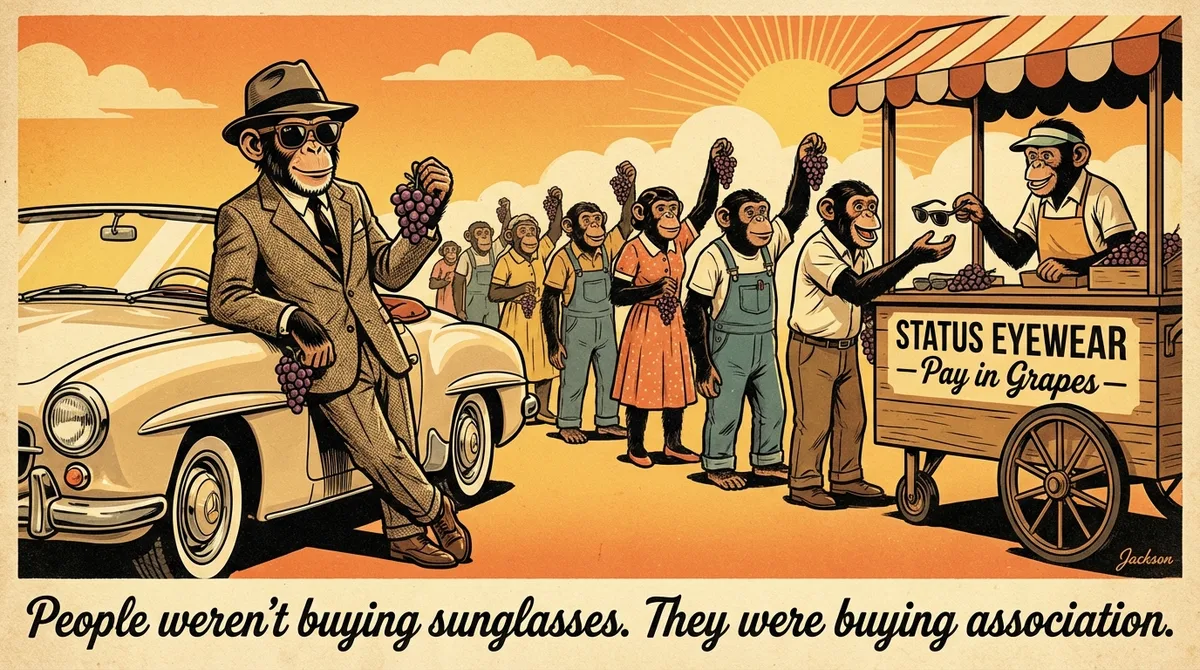
I once read about a fascinating study involving chimpanzees.
Researchers gave chimps a choice.
They could keep a small reward of grapes or juice…or they could give some of it up in exchange for looking at pictures.
Not just any pictures.
Pictures of other chimps.
Here's the part that stuck with me…
The chimps were happy to "pay" to look at photos of high-status chimps — dominant males, socially important members of the group.
But they showed little interest in photos of low-status or unfamiliar chimps.
Even chimps understand something deeply human:
Status has value.
They were willing to give up something tangible just to look at it.
Once you see that, a lot of human behavior starts to make sense.
Von Dutch didn't become a phenomenon because trucker hats suddenly got better.
It happened because high-status people like celebrities and musicians were wearing them.
Once the "right" people had them on, everyone else wanted one.
Same thing with Ray-Ban.
Ray-Ban existed for decades, but when movie stars started wearing them in big 80s movies like Top Gun, Risky Business, The Blues Brothers…the brand exploded.
People weren't buying sunglasses.
They were buying association.
They were paying to look a little more like the high-status chimps they admired.
That's why endorsements work.
Why product placement works.
Why social proof beats persuasion every time.
We like to think we make rational decisions.
But a lot of what we do is wired deep into our social brains. We watch who has status. We notice what they do. And then we copy it.
Even if it costs us grapes.
Especially if it costs us grapes.
Once you understand that, marketing gets a whole lot simpler.