I've sent thousands of 9-word emails over the last few years, and I've never seen anything as effective. People use them in every kind of business you can imagine, from real estate to motorcycle jeans to yacht brokering. Every week, someone sends me a message telling me about the amazing results they got.
But here's the thing. Most of the "guides" out there about the 9-word email were written by other people. They didn't create it. I did. So let me tell you the real story, straight from the source.
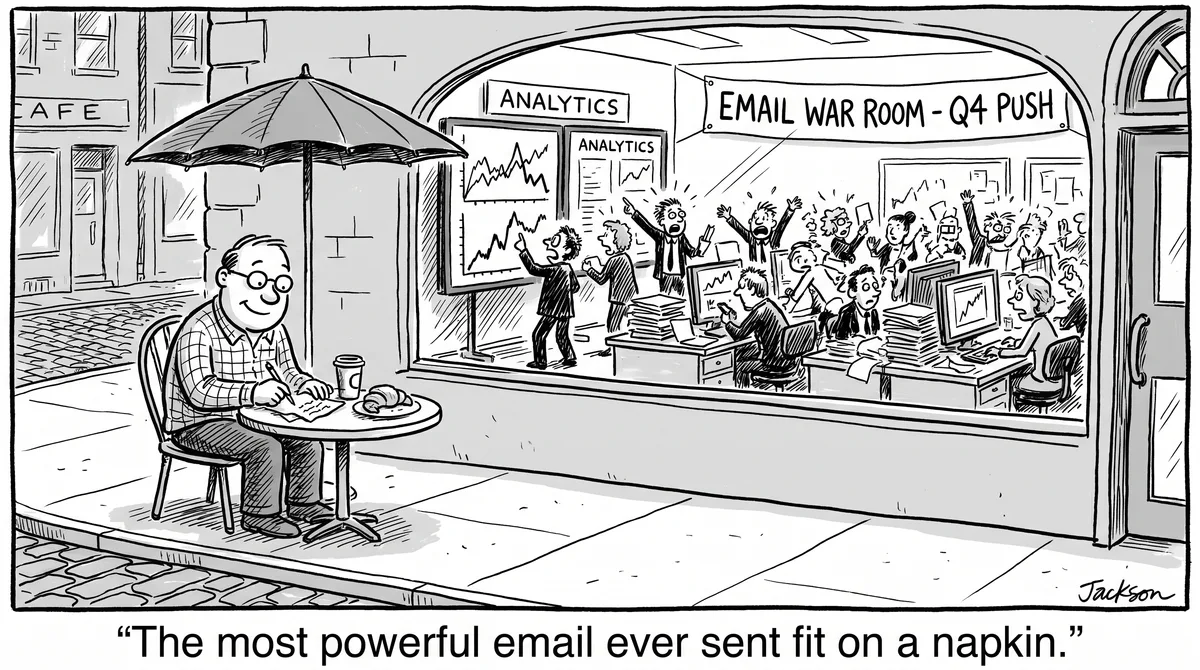
"It sounds like you ran into them at Starbucks and you're asking them a question."
How the 9-Word Email Was Born
I developed this idea for a real estate agent, a client who had generated a lot of leads from their website. They got so busy they ended up neglecting most of the people who had responded to their ads. They had a few hundred people who'd inquired over the previous six months, but they hadn't been in communication with any of them. It's not at all uncommon for that to happen.
So I asked, "Do you know if any of them are still looking for a home?"
They answered what anyone in that position would have to answer. "I don't know."
So guess what I said. "Why don't we email them and ask?"
Simple, right? That was really it. The birth of what I call "The Amazing 9-Word Email That Revives Dead Leads."
There's a longer version of how I got there, starting with a thought experiment about being a wizard, in Please Open This One.
We sent a short email to the list with only their first name in the subject line.
Subject: Jason
Body: Are you still looking for a house in Georgetown?
That's it. Nothing else.
You know what happened? They got dozens of replies and tons of engagement. They even connected with a client who bought that weekend. Even more amazing, they sold several other properties over the next couple of months.
Here's a short video where I walk through the whole concept:
Why the 9-Word Email Works
Most people don't realize where the real value in their email list sits.
There's a company called The Inquiry Handling Service that handles millions of leads across all different industries. They did an analysis and found something that changes everything.
When people inquire about something, just over half of them will buy what they inquired about within 18 months. But only 15% of them will do it within the first 90 days.
Think about what that means. If you've got 100 leads, 85% of the value is sitting past the 90-day mark. Those are people who are going to buy. They're just not going to buy right now.
And what do most businesses do? They blast their leads for 7 or 10 or 14 days in a row, trying to get as many of them to buy as fast as possible. Then they drop them off a cliff. That's their follow-up cycle. A 7-day sequence, then it ends.
They start counting too soon. They only count their conversions on that little window. They don't realize the majority of the value comes much later.
That's where the 9-word email comes in. It's your way to reach back into that 85% and start a conversation.

Get Email Mastery Free
Get winning subject lines, sample 9-word emails, and word-for-word campaigns you can copy to reconnect, revive, and convert more leads.
The Three Elements
The big idea is to send an email that sounds like you just ran into someone at Starbucks and you're asking them a question. Three things make it work:
- It's short. Two or three lines, max. It looks like a personal email, not a marketing blast.
- It's personal. Their name in the subject line. No images, no logos, no HTML formatting. Just text, like you'd send to a friend.
- It's expecting a reply. You're asking a question, not making an announcement. Questions create a vacuum that people feel compelled to fill.
When you get those three elements right, you've got something with the potential to be magical.
My good friend Joe Polish calls our phones a "compulsive poltergeist." There's a magnetic, addictive force built into electronic devices that hijacks your brain and makes you look at them constantly. He's right. Your email is going to be seen. The question is whether it'll be opened and responded to.
And here's the thing about the first-name subject line. Eye-tracking studies show that when you see your own name, your eyes actually dilate. It's like a little squirt of dopamine. "Hey, that's me!" You can't help but pay attention.
The Exact Formula
Here's the template. I'll give it to you straight.
Subject line: Their first name. Just their first name. Nothing else.
Body: "Are you still looking for [the thing they inquired about]?"
That's the whole email. No signature. No pitch. No links. No PS with your latest offer.
The temptation you're going to have is to add more to it. You'll want to solve the mystery for people. You'll want to say, "Are you still looking for a house in Georgetown? Because if you are, I've got a deal for you!"
Do NOT do it.
This dialogue method of email works best when you serve it exactly like a conversation. Just a really slow conversation. You know how it works. You see your buddy Steve at Starbucks. You say something. He says something. You say something. You are talking.
The moment you provide all the extra details, you give the email closure. There's no mystery left. No reason for anyone to reply.
Three Variations That Work
The classic "are you still looking for" version isn't the only way to use this approach. There are three variations, each suited to a different situation.
1. "Are you still looking for..."
This is the original. Use it when someone inquired about something in the past but then things went quiet. Maybe they downloaded a guide, requested a price quote, or asked about availability months ago.
When you send "are you still looking for" or "are you still interested in," you anchor them right back to that original inquiry. It works because you're picking up a conversation they started.
2. "Would you like to get started..."
This one is great when there's a time element. I use it for our 90-Minute Books business. At the beginning of every month, we send, "Would you like to get started on your book this month?"
Towards the end of the year, we send a variation: "Would you like to get your book done before the end of the year?"
Whenever there's a reason somebody might want to get things done because of a deadline or a season, that's the perfect time for this version.
3. "Would you like to join us?"
Here's an example: "I'm getting together with some people on Thursday to brainstorm nine-word emails and subject lines. Would you like to join us?"
There's something about setting things up in a specific way and then inviting people to join you. Even if they don't take you up on that particular occasion, it starts a dialogue that can lead to collaboration.
One caveat for all three variations: they work best when you lead with the giving hand. Don't make these emails about you. Start with something that's going to help your prospects first.
Real Results From Real Businesses
I'm not talking theory here. These results come from real people in real businesses who sent 9-word emails and told me what happened.
A $100 million yacht. A yacht broker sent the 9-word email to some prospects he hadn't spoken to in a while. All the email said was, "Hi Dean, are you still looking for a yacht?" He uncovered a buyer for a $100 million custom yacht. That's what can happen when you send nine words.
$9,000 in motorcycle jeans. A manufacturer in the UK sent a message that simply said, "Are you still looking for stylish motorcycle jeans?" They sold over $9,000 in less than a week.
A UK plumber's full schedule. A plumber sent his client list an email asking, "Have you had your boiler serviced yet this year?" He booked appointments as fast as they could take them.
A billionaire responds in an hour. My good friend Joe Polish was getting ready to go to the Jay Leno Show. He sent an email to Richard Branson: "I'm going to go meet with Jay Leno tonight. Do you want to be on the show?" "Richard, would you like to be on Jay Leno?" is a 9-word email. It took Richard Branson less than an hour to reply. That's the power of the right offer, no matter who the person is.
From 5% to 30% click-through. A real estate postcard company called "Getting Listings Sold" had been sending beautiful HTML graphic emails. They were thrilled to get click-through up from 3% to 5%. I came in and we crafted a short, personal-style email instead: "Hi, Joe. I put together some marketing ideas for 22 Graystone. Take a look and let me know what you think." That one email went from 5% click-through to over 30%. All we did was imagine we were sending one email to one person.
Common Mistakes (And How to Avoid Them)
For every ten 9-word emails that work, there's one that flops. Usually it's because of one of these mistakes.
Making it about you, not them
Wrong: "Are you still interested in attending my LinkedIn webinar?"
Right: "Are you still interested in using LinkedIn to get more business?"
The second version focuses on the benefit to them. This sounds like a subtle distinction, but it can make or break your 9-word email. Always focus on what your prospects want.
Solving the mystery
The biggest temptation is adding more after the question. "Are you still interested in using LinkedIn to get more business? Because if you are, I'm having a new training starting next week..."
No. Your email should be just the question. That open loop is what makes people compelled to respond. The moment you provide the extra details, there's no reason for anyone to reply.
Using it cold (the cheese and whiskers problem)
Let's take Matt, the marketer. He's cold-emailing audiologists to sell them a lead generation system. Matt sends: "Do you sell hearing aids?" Because it's short and conversational, he gets lots of replies.
Then his next message: "Great! I've got this amazing lead generation system. You pay only $99 to try it."
Crickets.
The tone switched from being all cheese in the first email to whiskers mode in the second, and it immediately felt like trickery. That's not a 9-word email. That's a bait-and-switch.
If instead the second email said, "Great! I've got 5 people who would like to get hearing aids. Can I refer them to you?" That's all cheese. That's bringing money into their business, not trying to take money out.
Not targeting your 5-Star Prospects
Don't blast your entire database. You're looking for the people most likely to respond. Your 5-Star Prospects are willing to engage in a dialogue, friendly and cooperative, know what they want, and ready to do something about it.
Having no follow-up plan
Before you write a single word, figure out where you want the conversation to go. Think like a chess master. Begin with the end in mind and plan ahead. Don't get caught off guard when they reply "yes."
For a deeper look at failure modes, read Why 9-Word Emails Fail (And How to Fix Them).
What Happens After They Reply
Getting the reply is just the beginning. Now you need to guide the conversation like a chess master, where every question is designed so the answer tells you the next question to ask.
The first thing I do is ask a sorting question. "Are you an investor, or are you looking for a house to live in?" That kind of question sorts people into one path or the other. Each answer opens a different conversation.
If they say they're an investor, now you can go down that whole line of questioning. "Are you looking to buy and hold, or something to fix and flip?" When they answer, you move to the next sorting question, something that takes them a little further down the path.
Each question gets them further along, and each answer gets you deeper into the dialogue. I've gotten to the point where it's not uncommon to send emails that get 60%+ response rates. That's the power of sending it one person to one person.
After 3 or 4 of these back-and-forth exchanges, you'll get what I call the "Love Letter." That's the email where they tell you everything you need to know. They now feel like they have the ear of somebody who cares and is in a position to really help them.
For more on the mistakes that kill results, read 5 Mistakes That Kill Your 9-Word Email.
Frequently Asked Questions
What is the 9-word email?
The 9-word email is a short, personal email of approximately nine words, designed to reactivate dormant leads by asking a simple question about their original inquiry. I created it for a real estate client and it's now used across thousands of businesses worldwide. The name comes from the typical length of the question: "Are you still looking for a house in Georgetown?"
Does the 9-word email work for cold outreach?
Not the way most people try it. The 9-word email works because it references a prior relationship or inquiry. When you use it cold without that context, the follow-up almost always feels like a bait-and-switch. If you want to use it in a cold context, your follow-up needs to be all cheese, no whiskers. Bring value first, always.
How long should a 9-word email be?
About 9 words. The constraint is the point. It needs to be short enough that it looks like a personal message, not a marketing email. One question, no explanation, no signature block.
What subject line should I use?
Just their first name. Nothing else. Eye-tracking studies show your eyes actually dilate when you see your own name. It triggers attention in a way that no clever copywriting subject line can match.
Can I use the 9-word email for B2B?
Absolutely. A yacht broker used it and uncovered a buyer for a $100 million yacht. Joe Polish used a version to get a response from Richard Branson within an hour. Any business where someone has expressed interest or you have a prior connection, the 9-word email works.
Who invented the 9-word email?
I did. I'm Dean Jackson. I created it for a real estate client in Georgetown who had hundreds of neglected leads. I described the full technique in my book Email Mastery, and it's now one of the most widely used lead reactivation techniques in direct response marketing.