In 2006, I read an article about a guy named Gamal Aziz.
He had just taken over as GM of the MGM Grand in Las Vegas, and he had an interesting way of looking at the business.
He would look at every individual profit contributor and ask:
How high is high?
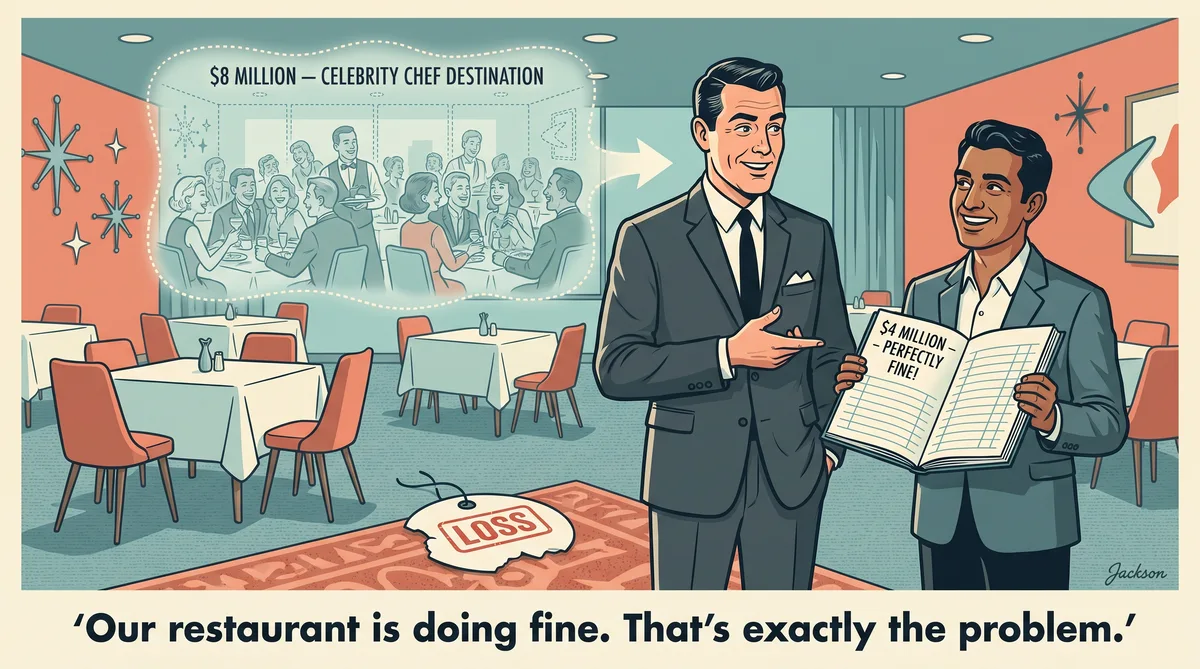
They had a flagship restaurant doing about $4 million a year.
Perfectly respectable.
Nobody was complaining about it. Nobody thought the restaurant was a problem.
The normal approach would have been to ask:
How can we improve this by 10% or 20%?
But Gamal had been watching guests leave the hotel every night to go to destination restaurants like Spago and Nobu.
And he realized something.
If MGM had a celebrity chef and a destination restaurant of its own, that same space could be doing $8 million a year.
Here’s the part that stuck with me:
He booked the other $4 million as a loss.
Not an opportunity.
A loss.
Because once he knew $8 million was possible, accepting $4 million meant they were effectively losing $4 million every year.
So they ripped out the existing restaurant, partnered with Michael Mina, and opened Nob Hill in the same footprint.
First year?
$11 million.
I’ve thought about that story for 20 years.
Because most of us look at our businesses and ask how we can improve what we’re already doing.
But that’s a very different question from:
How high is high?
Look at all the different “buy buttons” in your business.
The different products and services people can give you money for.
What is each one doing now?
And what’s actually possible?
Sometimes the biggest profits hiding in your business aren’t hiding in something that’s broken.
They’re hiding in something that’s working perfectly fine.