For years, I thought my greatest strength was seeing possibilities.
I still think it is.
But I also see the hidden cost.
As I flipped to January 1997 in my journals this morning, I found pages and pages of business ideas.
I’d taken the 7 categories where people spend money: home, cars, food, kids, health, money, and themselves…and started listing every possible business opportunity inside each one.
Under “home” alone there were dozens:
Mortgages.
Home inspections.
Furniture.
Paint.
Carpet.
Garage doors.
Electronics.
Landscaping.
The list just kept growing.
That’s how my brain has always worked. Give it a category and it immediately starts filling in possibilities.
It’s one of my favorite things to do.
But here’s what I wish I’d understood back then:
Life (and completion) moves at the speed of reality.
Your imagination can build a hundred companies before breakfast.
The real world only builds one step at a time.
I was reminded of the early story behind Wayfair.
Before it became the giant we know today, the founders didn’t build one enormous home-furnishings company.
They built hundreds of tiny ones.
One sold bar stools. Another sold grandfather clocks. Another sold ottomans.
Each was completed. Each became a real business. Only years later did they roll them together into Wayfair.
That hit me.
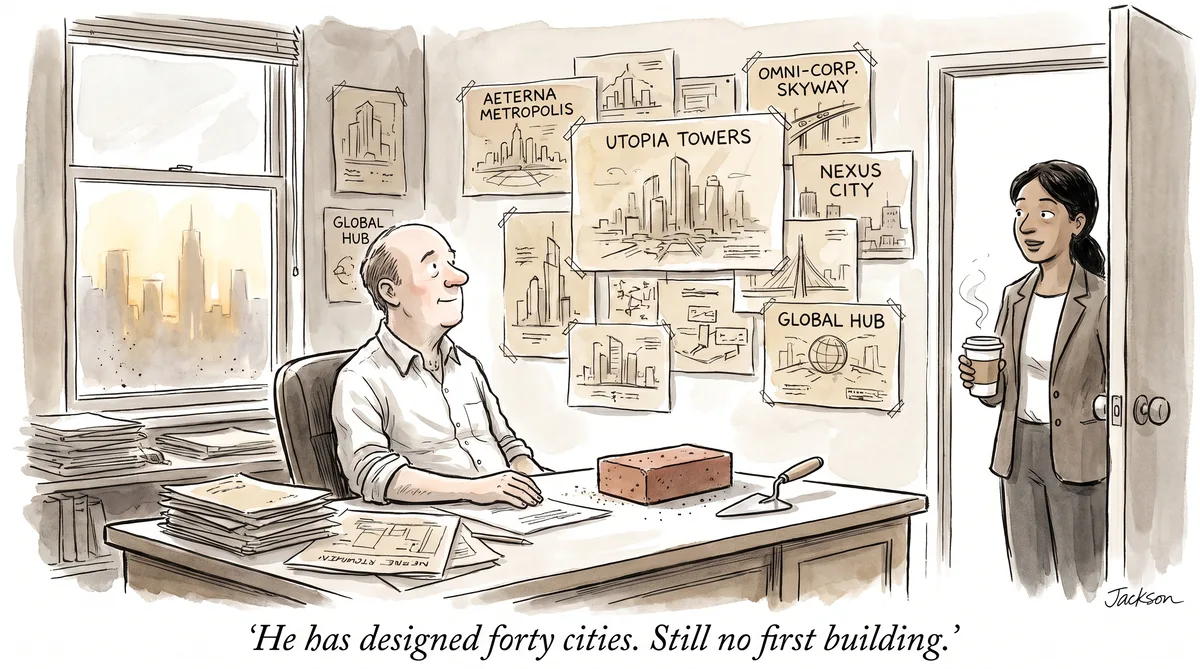
For years, I was spending hours designing the finished city in my imagination instead of finishing the first building.
Imagine if, instead of chasing every possibility, I’d simply completed one meaningful project every quarter for the last 30 years.
120 completed assets.
That’s a very different life than having a thousand brilliant ideas.
The surprising thing I’ve learned is that your brain doesn’t really care what it’s working on.
It just wants clarity about what it’s working on.
You don’t lose your creativity by narrowing your focus.
You give it somewhere productive to live. It amplifies.
Today, when I feel myself drifting toward “what else could we do?”, I try to ask a different question:
What’s the next thing I can finish in the next 100 minutes?
Breadth is exciting.
But depth is what compounds.