When is a diet pill worth $153
Listen
A $153 diet pill outsold the $19 ones by speaking to one exact frustration. The friction stopping people is where the opportunity is.
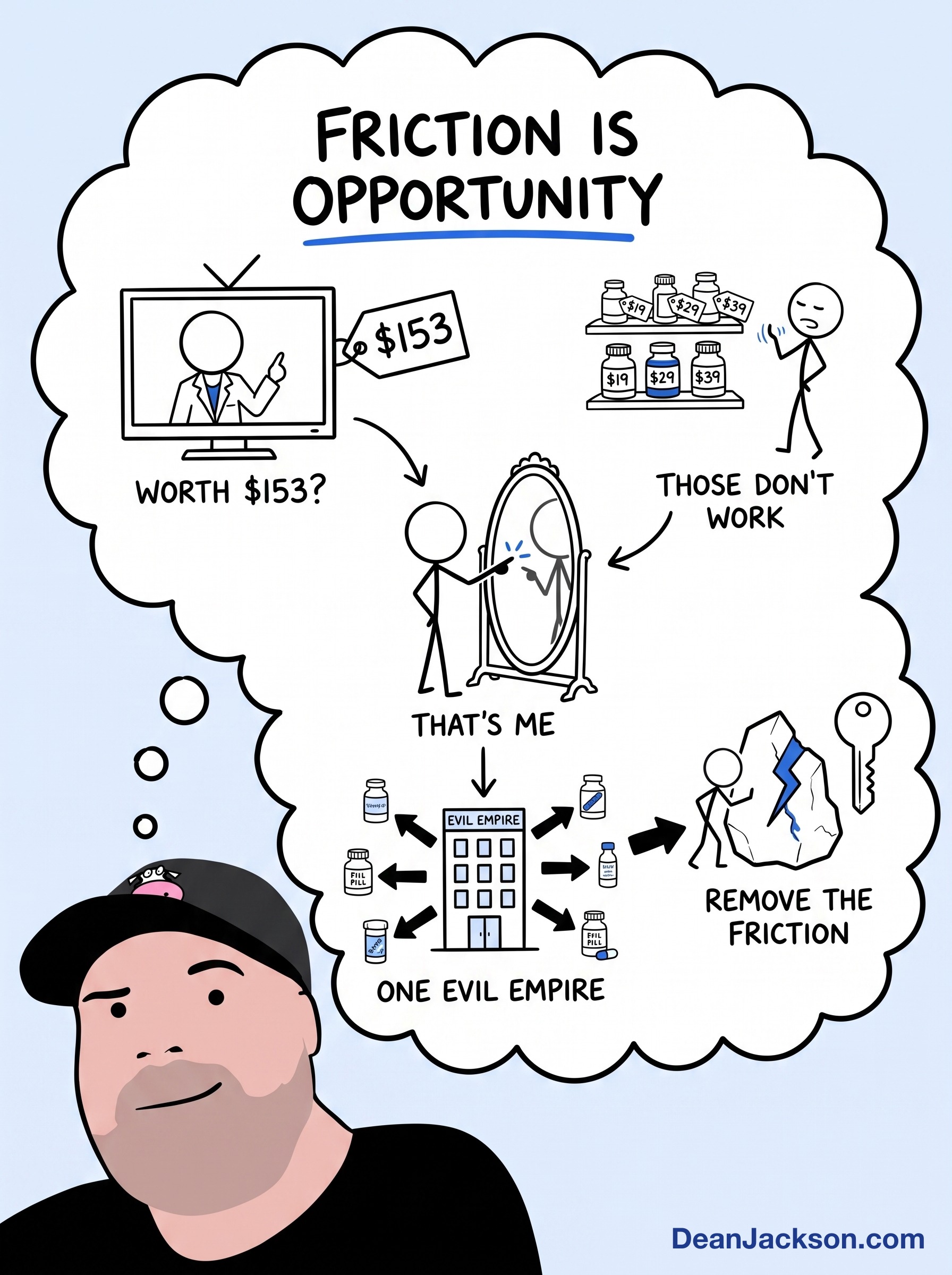
I still think about the Leptoprin infomercial that opened with when is a diet pill worth $153 a bottle. Everyone who'd already tried the $19 and $29 pills and given up perked right up, because finally here was one expensive enough to have the good stuff, and one that told them it was too powerful for vanity dieters.
Then I saw a knockoff, Leptopril, running the pharmaceutical generic play, and dug in. The same company owned all of them. Thyroid ATC for undiagnosed thyroid, Estrin D for menopausal women, each one speaking to a very specific reason someone believes they can't lose weight.
The lesson is about friction. If someone doesn't have that particular frustration, they're blind and deaf to the message, but name the exact thing that's stopping them and they perk up and think that's me. Get specific about why people are delaying, address it directly, and they line up for the help you can give them.
Join me live on the next free 50-Minute Profit Finder call, Friday, October 9 at 1:00pm ET. Save your spot →
Transcript
Auto-generated transcript, provided as supporting material. It may contain errors, and speaker labels are occasionally mis-attributed.
Good morning. Sunday morning, and I am heading to south beach, so I've got about a three hour drive ahead of me. And I thought, you know what I'm going to do? I'm going to record a mixtape.
I'm going to record just some stories and thoughts that I want to get down on the podcast here because I tell these a lot, but I don't know that I've ever really said them uninterrupted in a podcast format. And I think there's some pretty cool lessons that we can lay out here. So the first one that I want to share with you, I don't know how many I'll do on the way here, but first one that comes to mind is the revelation that I had. This is quite a while ago now, but you may remember when there was a infomercial, short form infomercial, you know, minute and a half or two minute infomercial on the air that started out saying, when is a diet pill worth $153?
And it was for a product called Leptoprin. And leptoprin was being, you know, they were positioning it as the most powerful weight loss pill in the market. So the infomercial basically went, when is a diet pill worth $153 a bottle? When it works?
And they would go, you know, if you are seriously overweight and you need, you've tried everything to lose weight, you need leptoprin. Leptoprin is the most powerful diet formula on the market. And it's not for the casual dieter. It's far too powerful.
If you're one of these people that has 5 to 10 vanity pounds to lose, Leptoprin is not for you. But if you've got 20, 30, 40 pounds to lose, you need leptoprin. And you start thinking, okay, first of all, everything about this feels like a pharmaceutical ad. I mean, the packaging looks like pharmaceuticals.
The name sounds like a pharmaceutical. The woman saying those words to you looks like a serious person. And the whole thing about it is that it's appealing to people who've already tried diet pills know that diet pills don't work. Let me unpack that for a second.
Because if you're going to start a diet pill, diet pills have been around forever. You know, magic potions, everybody knows that they're out there. And probably the biggest obstacle that you have to overcome is finding someone who's willing to take a diet pill. And someone who's willing to take a diet pill is probably someone who's already tried a Diet pill.
And they've tried every diet pill and they realize that diet pills don't work. But all those other diet pills, what do they have in common? They're all $19, $29, $39 a bottle. They're all lumped together.
And you can hear the wheels going in somebody's mind when they're presented with an idea that a diet pill is $153 a bottle and that you shouldn't use it. If you're a vanity dieter, you know, and you start thinking about all these people, that's exactly who it would be appealing lose that last ten pounds, or the people who are, you know, it's always the people who really don't need to lose the weight that are most obsessive about losing it. And they will take the diet pill hoping that it's gonna, you know, get them ripped. And there's the thing is, most of the other diet pills that were on the market are all showing.
They're all graphic loaded packaging with, you know, the women in the bikinis and the guy in the six pack. Those are the things. That's who it's appealing to, hoping that if I just take this pill, I'll look like a bikini model. So there's everybody who's kind of given up on those diet pills.
Now they're feeling like, of course those ones don't work because they don't have enough of the stuff in there. This is $153. That's why finally we're getting all the good stuff. I don't care that they say I shouldn't take it if I don't have 20 or 30 or 40 pounds to lose.
I'll stop when I get too skinn. All I need to do is take a few of these and then I can stop once I just get to my ideal weight. So you could see how people would try that. And it became a very popular infomercial.
It was one of the top performing infomercials, short form on the air at the time. And it ran for like that, for over a year. And then one day I was in Reston, Virginia, and we were doing a big real estate seminar there. And I was on watching the tv, and on came a commercial that started out with a camera focused on a TV.
And the TV was saying, when is the diet pill worth $153 a bottle? They were showing this ad. Then they zoomed out and there was another woman in a lab coat with a stethoscope. And she was saying, she's right.
Leptoprin is the most powerful formula on the market. But now, thanks to the folks at generics labs, you don't have to pay $153 a bottle. Now there's leptopril. I thought, oh, my goodness, this is fantastic.
Because they're knocking off the whole pharmaceutical model of one company comes out with a drug, and they get a patent protection for a period of time, and then when a patent expires, the generic brands can come out. And I thought, that's just beautiful. But thing that would make this better is if it was the same company. So I started my research, and I looked up and I found what I describe as maybe the most evil marketing empire I've ever seen.
The same company owned all of the diet pills that were on the market. And now I really started paying attention to them because they were just running in the background. You were thinking, oh, these are just. Seems to be a lot of diet pills on the air right now.
But all these commercials were running concurrently. So you had a woman in a lab coat, again, saying to the television ladies, have you tried everything to lose weight? And nothing seems to work. When you're looking at this, she's saying, you may be one of the millions of people with undiagnosed underactive thyroid, and you need thyroid atc.
And I thought, wow, okay, that's like a very specific thing. And then there was another lady saying, ladies, remember when it was easy to lose 5 or 10 pounds? Now that we've hit menopause, it's not so easy. That's why you need Estrin D specifically formulated for the needs of menopausal women.
And then you start looking and you think to yourself, okay, what's going on here? What are they doing? I don't know how different these formulations are, but essentially they're selling a pill in a bottle that is little caplets filled with stuff that maybe there's a slight change in the formulation, just like we talked about yesterday with the Excedrin extra strength and Excedrin migraine. Maybe there's no change in it at all, or maybe there's some slight change in it to back the claim that it's specifically formulated for menopausal women or for women who have underactive thyroid or for serious weight loss.
And, you know, the one that got them in trouble was one called Pedialine, which was specifically formulated for the needs of overweight children. And so that was kind of the end of the empire there. But, you know, if you look up on YouTube, you can see these commercials for Leptopride and Leptopril and Estrin D and Thyron atc. And it's amazing to see that lesson of speaking to a very, very specific segment of the market about a very, very specific reason that they think that they can't lose weight.
They're talking about the friction that's stopping people from taking action or the thing that they are resigned to. And I start thinking always about, how can we apply that to our situations? How can you app to what is the friction that's stopping people from taking action to get the product or service that you offer that you can help people get there? The friction is where the opportunity is.
If they don't have that particular friction, they're blind to and deaf to the message. So it doesn't matter that they were running all these commercials on at the same time when they were speaking to menopausal women. Menopausal women perk right up and they think, that's me. Or women who suspect that they have a thyroid condition.
And it's interesting how they even use that language. You may be one of the millions of women with undiagnosed underactive thyroid. And so that's really an interesting set of word choices that they're making that are making it seem like a diagnosis, but not really a diagnosis. And you see that all the time, even with the diet pills.
Look in the mirror. Have you got excess weight around your belly, hips, and thighs? Yes. Look at this.
Where else would you have excess weight if it wasn't around your belly, hips, or thighs? It's so like, everybody's listening in going, yes, that's me. Well, they would say that. And then they go, now there's cortisol.
That's not a claim. It's not anything. It's just unrelated. You might as well say, I like apples.
It's totally non sequitur. There's so much lesson to be taken from that kind of thinking about being very, very specific on why people are delaying taking action on getting your help. And if you address those and make it specific, you're to have people lining up to get the help that you can provide them. So there we have it.
Get BreakthroughDNA Free
Discover the 8 Profit Activators that can transform your business. Get the complete framework, free.