These 3 Principles Built A $2 Trillion Company
Watch
Listen
Thirty years of journals say people don't change. Build your business around what customers will always want, and the payoff compounds.
I'm 30 years into journaling every day, and I've been reading back through journal number one from 1996. Some patterns in me haven't changed, and neither has human nature.
Back then, the realtors I was coaching expected to run an ad today and sell a house this weekend. I had to learn something harder, that investing time to build a system with a future payoff beats chasing the immediate result.
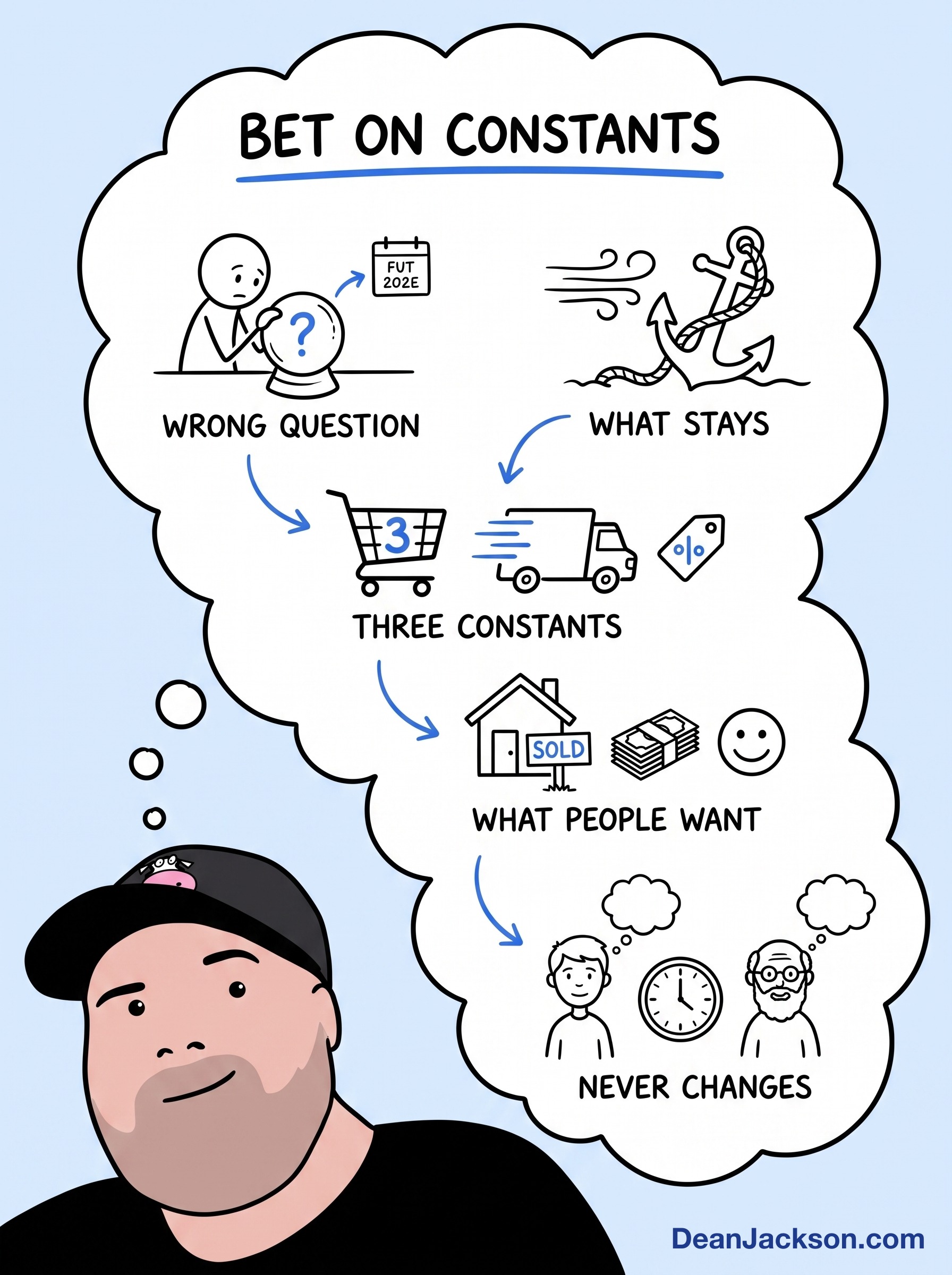
What struck me is that sellers wanted the exact same thing in 1996 as they do now. Sell fast, get the most money, least hassle. It's the same bet Jeff Bezos made building Amazon around what people would always want.
If you keep people focused on the result they really want, and you handle whatever it takes to get them there, that hasn't changed in 30 years and I don't think it'll change in the next 30.
Join me live on the next free 50-Minute Profit Finder call, Friday, October 9 at 1:00pm ET. Save your spot →
Transcript
Auto-generated transcript, provided as supporting material. It may contain errors, and speaker labels are occasionally mis-attributed.
Good morning. It's 8:59 on Wednesday morning and we're sitting back here at Pancom as I do every day because I'm a creature of habit. Listen, how much do you think people change over 30 years? It might surprise you because I've been looking through my journals and mention, you know, again, this is 30 years ago now that I'm looking here and I'm seeing some patterns already evolve that I had this awareness in 1996 and here we are 30 years later and they still hold true.
Some of them I are repetitive things in my own life that I've noticed about me that I have not changed. But more importantly, there's some things about people in general that haven't changed. So, I'm going to share some of these with you. Um, one of the things that I always love to do is I don't know why, but I love hotel lobbies.
I love hotel lobbies as an environment for and cafes. I just love like public places with a comfy chair and my journal and my pen and time to just reflect and think. And this particular journal I was writing this was in the lobby of the Delta Hotel in Missaga. It was close to my house in Georgetown and they had a fireplace in the lobby.
It was a nice, you know, big lobby, comfy chairs, and I used to go and spend hours there just reading and thinking and looking at magazines and writing. And even to this day, when I think about these, it brings me joy. I had a surreal moment where this was maybe 10 years ago. I was uh I was running full page ads in success magazine and I got this particular magazine.
I had one of these Sunday mornings where I was I went and got coffee and I had some magazines and I was sitting at the Books a Million cafe kind of looking through and I realized this is exactly the kind of day that brought me joy, you know, 25 years earlier and except this time I was looking at it. So, you know, my friend Tony Robbins was on the cover of the magazine and inside my friends Brendan Brashard and uh Nick Nanton and Joe Polish and I are all running, you know, full page ads in the magazine. There was a list of the top 25 influential people and I had half of them on speed dial and I realized how much things had changed kind of in the terms of the scope of things. But the core joy that I get out of sitting in a lobby with some books and magazines and my journal is evergreen.
That's not changed. And I can't imagine that that's going to change 30 years from now. So in my reflections here I noticed that for me I have a tendency to be a very future oriented person and I all of my journals are primarily designing and uh engineering something that's going to happen in the future like making I call hatching evil schemes or making um plans for things and I do a lot of that in the pages of these journals. So I that hasn't changed for me being completely uh future oriented like that.
But in this particular journal I noticed a couple of conversations that made me believe that just people don't change much. and I looked at it. I had a I' been mentioning we've been doing Toronto and Beyond at this point, which was my first kind of venture into giving other people the intellectual property, the plan, the uh coaching to do what I had done in my own business to show them how to do it. And I realized very quickly that people uh that not everybody is future oriented, that we all want results right now.
And I had this one particular conversation with one of our Toronto and Beyond realtor who was realizing that he didn't have a uh he didn't have a followup system or mentality. people were at this point they were hoping that they're going to run the ad today that people are going to call on tomorrow and they're going to come out and buy a house this weekend. That was the expectation level that people have when they're running ads. Not thinking that if they generate a lead today that maybe that person is going to buy in 90 days or 9 months from now.
non-starter. That's something where people didn't have the patience or the the system to do that. And it's a very short-term mentality, you know, and it's because we're all looking for that immediate gratification. It's why it's the difference between doing cold calls.
Imagine what I went through where I was making cold calls and I would go and go and go until I find somebody who wanted to sell their house right now and I would go out and see them and help them get their house on the market. And the payoff between the activity was very short. It was like you did it now, you did it until you found someone that wanted to sell their house and then you want and you got the reward. It was a very short distance from it, but as soon as you stopped doing it, you weren't getting the results.
So, you had to continue. When I first put together the guide to uh Halton Hills, I had to stop doing the cold calling. So, I wasn't getting the immediate payoff. I had to invest my time in creating something that was not gonna pay off immediately because I took the time to create the guide.
I had to get the guide uh designed, had to get it printed up, take all the photo, do all the work, write all the words, do all of the things, write the ad. All that took hours where I wasn't doing the thing that I knew reliably got the result. Then I had to spend money to run the ad and wait for the publication to come out and then get people to call and send them the guide. But it didn't take very long.
Within 30 or 60 days, I started having people that were calling me to go out and look at homes. And then by the third or fourth month, I had people every single month popping out because they had been getting my monthly or bi-weekly at the time market watch newsletter where I would send them by mail every 2 weeks all the new listings that came on the market and they would call and then come out and look at homes. So, by the time I got through that first 100 days, and I wasn't really counting it as that, then I've just learned that now that that was an actual reality that the payoff was now super sonic because now I was getting leads and having other people put together the newsletter and send out the uh mailings. So while I was not working, this system was working for me, but it took all the work to get the system up and running.
And that was a big impact for me is learning that the um making capital investments of time that are going to have a future payoff rather than just investing time with an immediate payoff expectation. So, I noticed that the realtors that had the most success with this were the ones that bought into that idea that I was able to uh convince them that that's the thing that uh was going to have the big payoff. And I noticed in this same journal because I was still at the time running my uh on the tail end of running my own um real estate uh business as well. And I noticed that in this journal, I was reflecting on a conversation that I had with one of my uh one of my sellers.
And I realized in the time that they're they want certain things. Sellers only want to that their house is sold. And it was such a a very interesting thing to get that understanding that what if you can focus on what people really want and you understand that that the seller that I was talking with, his desires were the same in 1996 as any of the sellers today. They want to get their house sold as quickly as possible.
They want to get the most amount of money and they want to have the least hassles or or u you know inconsistency around it. And so it's kind of like Jeff Bezos. Someone asked him, you know, what's going to change in the next 10 years? And he said, I don't know, but what we're building the company around is that I know for certain that in 10 years, people are going to want as wide a selection of products as they can get.
They're going to want to get them at the lowest possible price, and they're going to want to get them as fast as they can. So everything that they did going forward was built around that unchanging part of human nature. So the big lesson for me looking uh back at it now and seeing what carried over 30 years is that if you can get keep people in the lane that they really want to be in focused on the the result and you can accommodate whatever needs to be done to get somebody um to the point that they're ready um to buy or to sell or to do whatever service or product that you offer, it's going to be a gamecher for you. That hasn't changed in 30 years, and I don't think it will change for the next 30 years.
So, that's it for today. Stay tuned. We're going through 30 years of journals and insights. We're in journal number one.
All of these are on YouTube if you want to follow along there as well. And I'll be back tomorrow.
Get BreakthroughDNA Free
Discover the 8 Profit Activators that can transform your business. Get the complete framework, free.