If You're in Business & Have ADHD -- Watch This...
Watch
Listen

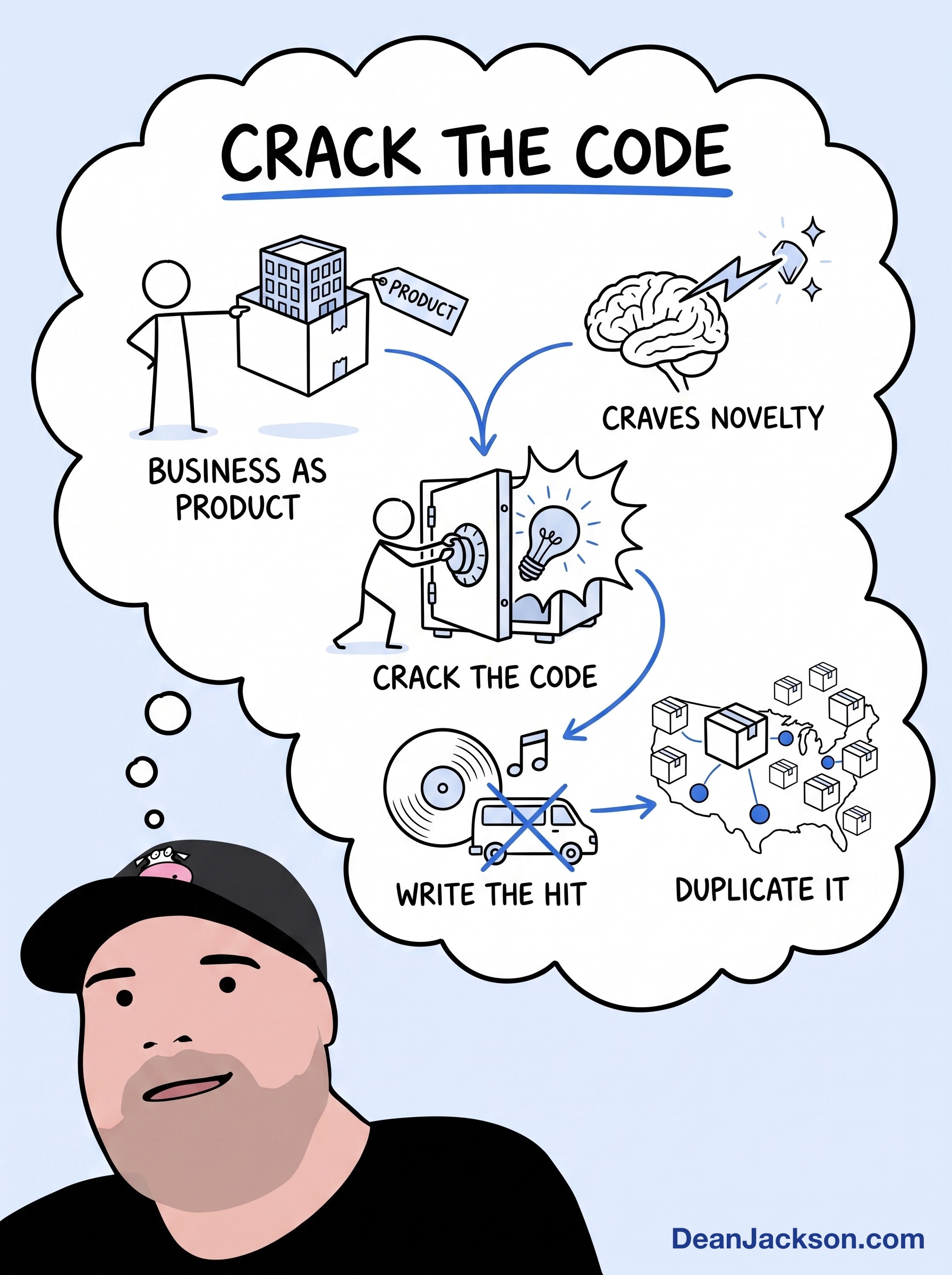
Why I build every business as a duplicatable model I can copy 5,000 times, and how being wired for novelty means I create the system but never scale it.
The foundational thing behind everything I've built is a duplicatable model. Michael Gerber taught me to treat the business as the product, something separate from me, not something I identify with.
My guide to Halton Hills was one core unit I could copy again and again. Toronto and Beyond was just that same thing duplicated, the way Ray Kroc built Hamburger University to prototype every McDonald's.
I'm great at getting something scale-ready, cracking the code the first time. I'm not the guy who wants to sing the same song every night on tour, and that's the first place I can see my ADHD wiring, looking back.
Most businesses live in a five-mile bubble. If you can make something work in one market, you've got the key to duplicate it. So look at your own business and ask what parts you could copy.
Join me live on the next free 50-Minute Profit Finder call, Friday, October 9 at 1:00pm ET. Save your spot →
Transcript
Auto-generated transcript, provided as supporting material. It may contain errors, and speaker labels are occasionally mis-attributed.
Hey, good morning. It's Dean Jackson. m. I'm kind of liking this uh morning routine here.
And as I was preparing for today, I was realizing that this insight that I'm going to share is I think the foundational thing. I've been really like looking back over the path of the 30 years or even the 30 eight years if we take it all the way back to when I first started working on my business, that everything that I've done has been based on a a duplicatable model. I talked yesterday about intellectual property and about working on the business, which was the big thing that I learned from Michael Gerber is treating my business as the product. Treating your business as something that you are creating separate from you rather than something that you're identifying with as I am a realtor or I am a lawyer or I am a plumber or whatever business you are.
It's uh it was a big impact to start thinking about that I'm building a real estate system. And uh so I I we're halfway through journal number one. Almost halfway through journal number one. And what struck me here is we're in San Francisco in this one.
Now, up until this point in my life, I had been largely an East Coast guy. I was trying to reflect and think. I don't think I'd been more than one time zone to the west out of my little channel from Toronto to Florida and everywhere in between. >> [snorts] >> Uh but coming to California was an eye-opener for me.
It was the first time I'd ever been to California and seen the the West Coast. And this started the beginning of uh I mentioned Eben Pagan. That for the next couple of years here, Eben Pagan and I probably spent 25% of our lives within 8 ft of each other by traveling to these main events, extending our trips, doing uh evil scheming and exploring um as we were going. But, as I was looking in my journal, I realized that this realization about duplicatable models started years before.
I grew up in Toronto, just outside of Toronto in a place called Halton Hills. And so, looking back on it, that world that I grew up in, everything that I experienced growing up was kind of filtered through this lens of being in that greater Toronto area bubble and that being in Canada, but also having exposure to the United States. And I remember driving down to Florida one of the first times. I'm starting to think about things that I'm realizing as we're going through, you know, we'd stop in Dayton.
And there was a Dayton newspaper and there were Dayton TV channels and Dayton radio stations. And then we'd get down to Knoxville and there'd be a whole 'nother newspaper and uh going all the way Atlanta and all the way down. And I realized, wow, if when you think about the the things at scale, that we're all really made up of these individual lenses that we're looking at things through, these marketplaces. This is before I knew what a a defined market area was, a DMA.
And uh you know, you realize that that filters everything that we experience, but it also lends itself to the scaling of something that you create with an intention of having a duplicatable model. So, we talked about Toronto and beyond, which was really a scaling, a duplication of what I had done in the core unit of my business in Halton Hills, just like Ray Kroc did with McDonald's when he created Hamburger University in in Des Plaines, Illinois to create the prototype of what all of the McDonald's would be. And I realize now, looking back, that that's really been my go zone, my my strength, my um preference is to what I've later started calling getting something scale ready. And that's cracking the code, that's creating something for the first time, understanding what does it take, like if we take the guide to Halton Hills, what if I it starts out as a proposition, an idea, I bet if I put together a guide to Halton Hills, people would want to know what can you get for your money cuz there was really no other way for them to get it.
No internet, no access to information. So, if I could advertise, I knew there were a lot of people thinking about moving to Halton Hills, but once I figured out the independent uh steps in that process, I had the guide, I put the ad together, I had the voicemail script that people would hear when they called, I had the actual physical guide, the cover letter that I would send to people. I mentioned the homebuyer college, which was all of the newsletters that I would send along with all of the information. And once I created that duplicatable system, my work was done, sort of thing.
I've realized I am uh, I I have a tremendous aptitude for creating scale-ready, uh, things and not for scaling. It's a whole different skill set and you realize that I don't get joy out of, uh, the just systematic duplication of something where I've already figured it out. For me, I need novelty. And this is before I really knew that I was ADHD.
I didn't have that inkling. I'm just looking back and and it all all the pieces kind of come together now, 30 years later, and I see and know that I am ADHD and this explains why the things that I'm attracted to are things that are, um, that have novelty. I like working on the new thing and cracking the code. I've started referring to these scale-ready algorithms as a, uh, likening it to a hit song.
Like once you you write a song and the song is recorded and there, that is now the the creative work of that is done and it takes a whole different personality to go out and sing that same song every night around the world on tour. Um And you know, I've come to that realization. We'll see in some future journals how that really uh comes together. But what I think the encouragement or the the lesson for insight for um if we're following along here is Whoa.
We got Did you hear all those sounds? That's fantastic. Somebody's out racing motorcycles today. Um that the the insight is to think about your business as what parts of it could you duplicate?
Like most businesses, we really do live in a primarily a 5-mi bubble. You know, like we're super local. If you look at the the line items of a standard budget, a household budget of where all the money goes, probably 85% of it is spent within 5 mi of where you live. So, many businesses are are local.
And if you can create something that works in one of those markets, you've got the key that it can be duplicated again and again and again. And your model, everything that you're doing to create that result, that outcome, is part of the uh the intellectual property, the asset that you're creating. And so, it's neat to see as I'm I'm going through what uh the insights that kind of led to those things. And Michael Gerber was the foundation of it.
Of really looking at the um looking at the business as something that you're going to replace 5,000 times or you're going to recreate 5,000 times and then overlaying that with realizing that there are lots of small markets. There are markets that are we're surrounded by them and uh that has been a um you know, what's the thing with baseball been very very good to me? Well, duplicatable models have been very very good to me and I'm hoping that they'll be very very good to you.
Get BreakthroughDNA Free
Discover the 8 Profit Activators that can transform your business. Get the complete framework, free.