The Less I Do, the Richer I Get.
Watch
Listen
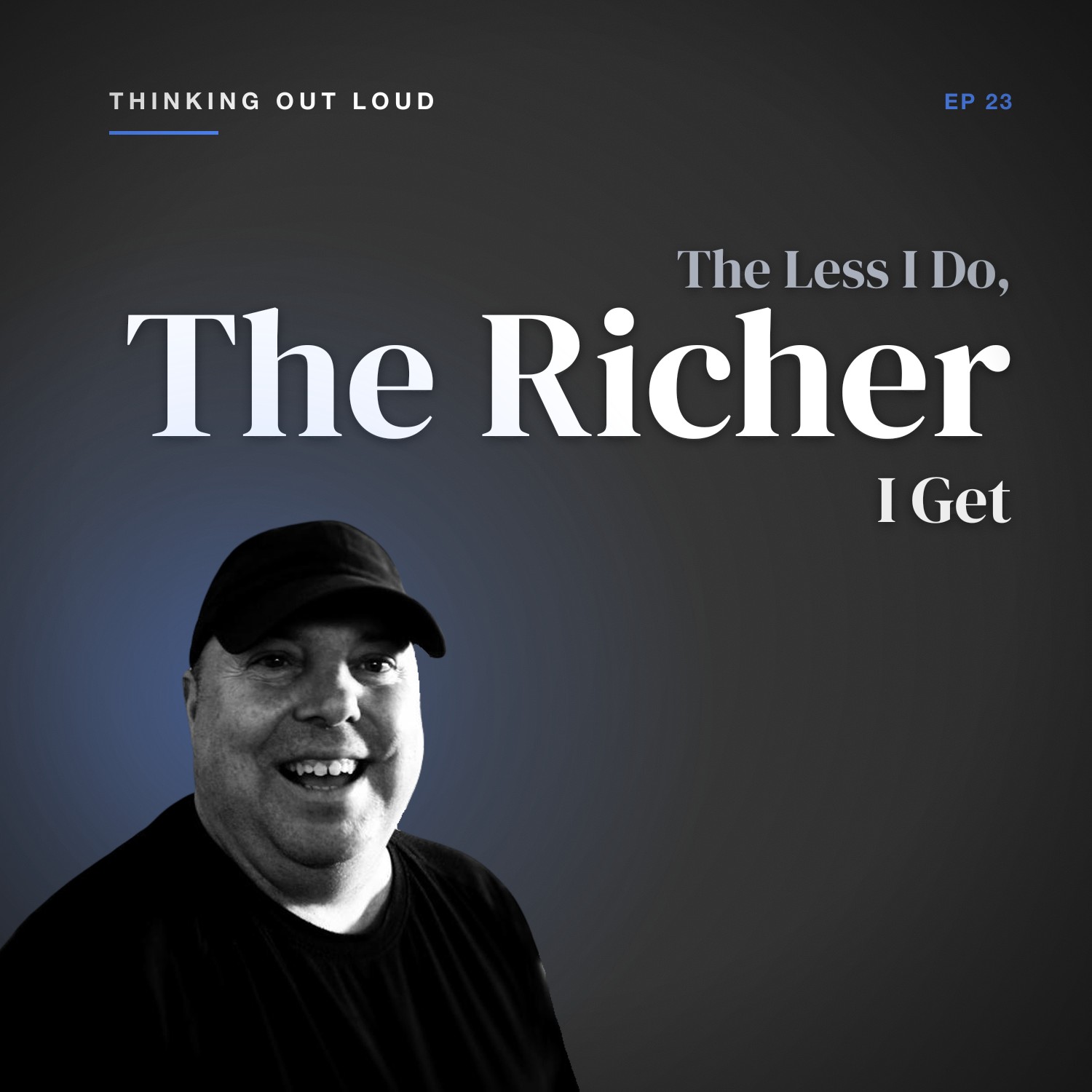
The less I do, the more I make. How I mapped out a system where every step gets done by someone else, and I still get paid for deals I never touched.
San Francisco, 1996, sitting across the bay from the city with Eban Pagan. This is where I first felt income showing up that didn't come from my own effort.
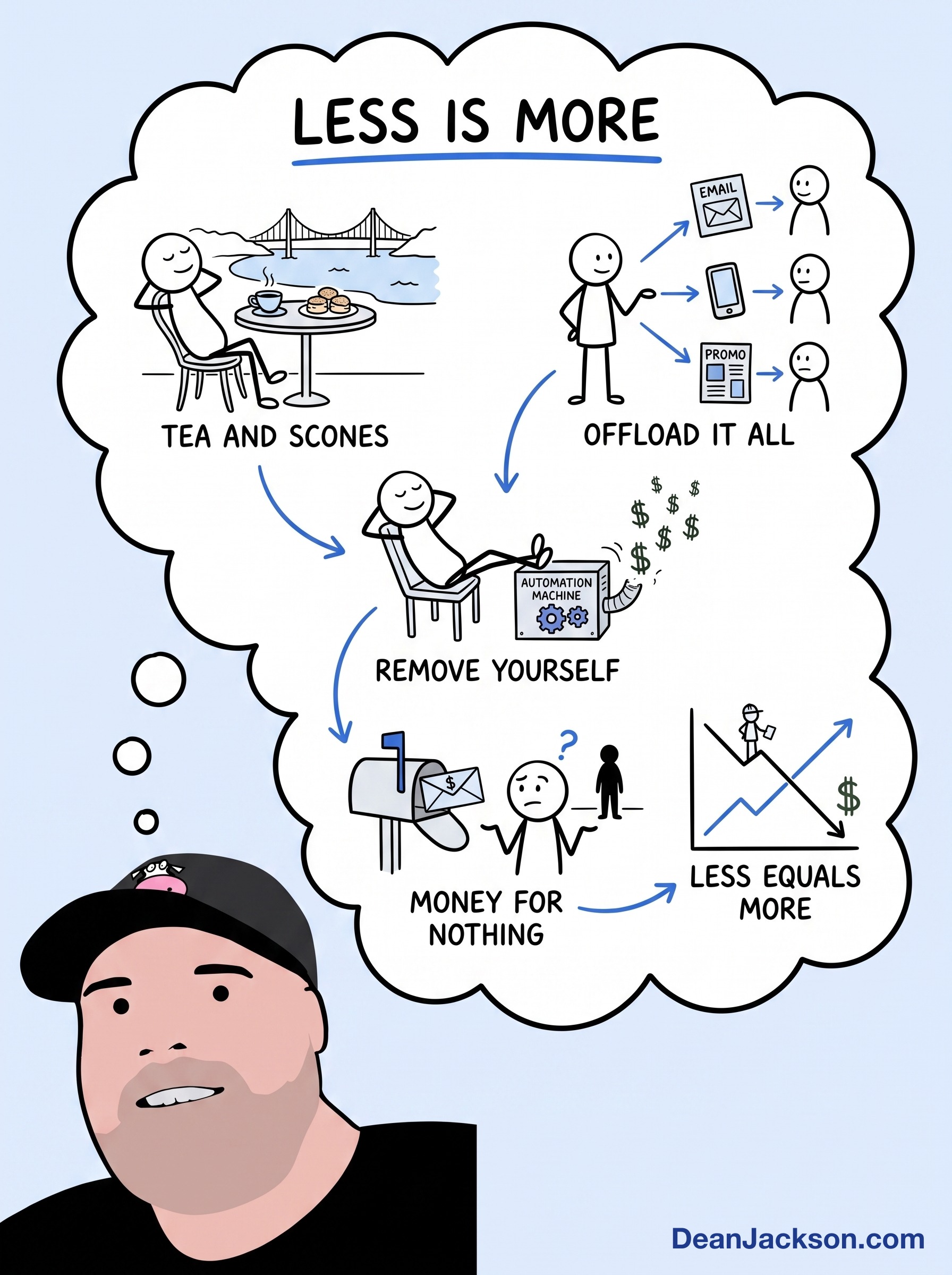
Eban and I mapped out a system where every piece, the ads, the voicemail, the follow-up calls, the newsletters, could be done by other people. The less I did myself, the more I could actually make.
What most people really want isn't to do the work. They just want someone ready to buy or sell. So the goal grew from replacing me to replacing the client too, doing everything for them.
Back then it was outsourcing to other humans. Now it's AI, which I couldn't have imagined in 1996. Same core model though: build something that runs without you, then duplicate it.
Join me live on the next free 50-Minute Profit Finder call, Friday, October 9 at 1:00pm ET. Save your spot →
Transcript
Auto-generated transcript, provided as supporting material. It may contain errors, and speaker labels are occasionally mis-attributed.
Hey, good morning. Okay, we are approaching now the halfway point of journal number one, eight episodes or nine episodes in. And uh this may take a while to get through all of it, but I'm having so much fun kind of reliving these things. And today, one of the most amazing parts of this where we're in May, early May of 1996, so I just turned, was it my birthday yet?
Yeah. So, I just passed I just turned 30 on May 10th and Eban Pagan and I are in San Francisco. This is my first trip to San Francisco and we discovered Salcelo and it's a, you know, if you've ever been, it's an amazing town on the other side of the Golden Gate Bridge. So, first of all, going across the Golden Gate Bridge was an amazing thing.
Seeing this iconic site that you've, you know, you've seen uh growing up, you've seen it in movies and on TV. And here we are going across the Golden Gate Bridge. And then when you come down the hill, what you're into is this amazing almost European type village where you see all these houses on the side of the hill looking across past Alcatraz to the city and there was this restaurant that we discovered called Horizons and I think it's still there and we could sit outside and for the next few years that was our like home base. Every time we were in San Francisco, we would go and we would sit on the dock, look across to Alcatra, past Alcatra to the city, and we'd have all these amazing, you know, conversations cuz we were both marketing nerds and we were both sort of becoming philosophical in this uh in our approach to life and designing what we really wanted our life to be.
But this particular moment is something that was very interesting to me because I started realizing that this is where the money from the passive or the intellectual property revenue was starting to come in that I for up until that point every dollar that I had earned had come from my effort and and starting it doing all the pieces, finishing, putting the deals together, doing all the things. And uh it was happening now where the system that I created in the hands of other people was starting to generate revenue for them of which I was getting a referral. And in my own business where I was transitioning from doing my own real estate business into now traveling all over uh doing with Joe Stump and with Eban doing the main events and setting up Toronto and beyond. And Eban and I realized in this thing that we were at a stage where I was starting to realize the less that I do, the more money I can make.
And it seems counterintuitive, but I started realizing we mapped out this system where we we started thinking about everything that needed to be done to run this system could be done completely by other people. So remember there's no internet uh now. So we had the two books that were uh top of mind that were kind of evolving this uh this system in my my large language model consisted of input from uh I talked about the E-Myth and then there was a book that Tom Peters wrote called the pursuit of wow and the thing that really I remember the most about the pursuit of wow was treating each division of the business like its own professional service firm uh PSF you would call it and to start thinking about looking at every element of the business that needed to be done and seeing if you could get other you could replace yourself in it so that it's being done by uh without you and so I in the last years of my real estate business even Before we did Toronto and beyond, I started looking and every single thing could be done by other people except I would get to the point where I would want to go on the listing appointment so that we could uh I could connect with people uh get the listing, but everything leading up to that, preparing all the paperwork and the uh the the comps for helping uh just what the price was. All of that could be done ahead of time and I could go in with the folder and have everything done, get the listing signed and then come back and have all of the things that needed to be done for getting a listing on the market handled.
And I really developed a a preference for that. Eban and I were talking about how much we really liked the idea of being sophisticated gentlemen and just kind of we couldn't punch any holes in whing away an afternoon over tea and scones and uh in San Francisco looking across the bay to the city and having great discussions that was like that's a great life. I really loved that that kind of thing. And so we were outlining on this page 89 and I'm not even quite halfway through the thing.
We started looking like what is it that would need to happen and to run the system like we could have the ads needed to be placed u for the lead generators like we're running for the guide. We had an 800 number um voicemail with a caller ID service that would get not uh capture all the callers, have somebody do the fulfillment for the reports. And we were talking about now that this could be done um anywhere cuz we were both starting to realize me through telling Eban about my experience with Toronto and Beyond that people don't do what they could do just because I figured out that these are the things that that need to be done. Most of the time people realtors and I've learned it's all entrepreneurs now.
what they really want is just somebody to come and want to look at homes or want to sell their house or want to do whatever it is that whatever the business um does. They don't want to do any of the work. So thinking this way of how could you replace first of all myself but then it's evolved to how can I replace them having to do anything? How could we provide a level of service where we could do everything for them?
We had the telemarketing uh company to make the follow-up calls, have a database to set everybody up. And even databases were new at the time, like you know, setting everybody up online to have a a CRM uh was a relatively new thing. I mean, when I first started out, it was, you know, a recipe box with index cards is how we kept track of uh of people. And then having a fulfillment house for doing all of the follow-up u newsletters.
I mentioned the home buyer college that we would send that along with the new uh along with the new listings that went up. And as I look at this, you realize now, man, we're in a world where every single thing can be done for us now. There's no need to be able to do anything other than having the ideas. I mean, who could have even imagined?
I was thinking about that as I was reading this uh reading in these journals here. How would I have described what AI is to myself in 1996? There's not even a possibility to comprehend that, you know. So, it's fun to see the thinking, the systems thinking that got me um you know to the point of thinking about how can I create something that just works without anybody human having to be uh having to interact with it or in this case it wasn't AI but it was outsourcing.
It was humans but other humans. it wasn't me or our clients having to do the uh to do the work. And so I think from that foundation, everything that I've done since then has been kind of a building on that core model, that core mental model of how can I set this up so that I'm going to duplicate it 5,000 times and how can I create a system that all the work gets done without me or the ultimate the owner of this uh system doing any of the work. And I thought that was kind of funny that that was this around this time was the first time that in my personal real estate business that I was getting commission checks for people that I never met that I had a lady who was taking over my business, my my real estate sales business in uh Georgetown.
And it was great because, you know, I had received a few now checks where they were people who had responded to the guide to Halton Hills, had been getting the monthly newsletters, and when they called, Andrea was able to connect with them, help them find a house, and I got half the money. And that's kind of that was uh that was a fun thing. I kind of got hooked on the idea of getting money for nothing. It was kind of It's kind of addicting.
I still kind of enjoy it. That joy doesn't go away. I'm kind of excited because, you know, I said this is 30 years ago. Josh and I just at breakfast this morning met a gentleman who's 91 years old and I was sharing with him that I've been, you know, journaling for 30 years.
I asking him if he remembered like, you know, what it was like when he was 30 and it was just so amazing. He's going all the way back to the 40s telling us about his uh time in Samoa and all these things. So, I think that if you're not doing it yet, my big hope is that you start to kind of document and journal what's happening in the present so that 30 years from now, you can look back at your journals and see what an amazing journey it's been and that maybe this is a little bit of a vector change for you. that some of these ideas you're able to take and have an impact uh in your own life.
So, let's keep going.
Get BreakthroughDNA Free
Discover the 8 Profit Activators that can transform your business. Get the complete framework, free.