Master These 4 Marketing Skills First...
Watch
Listen
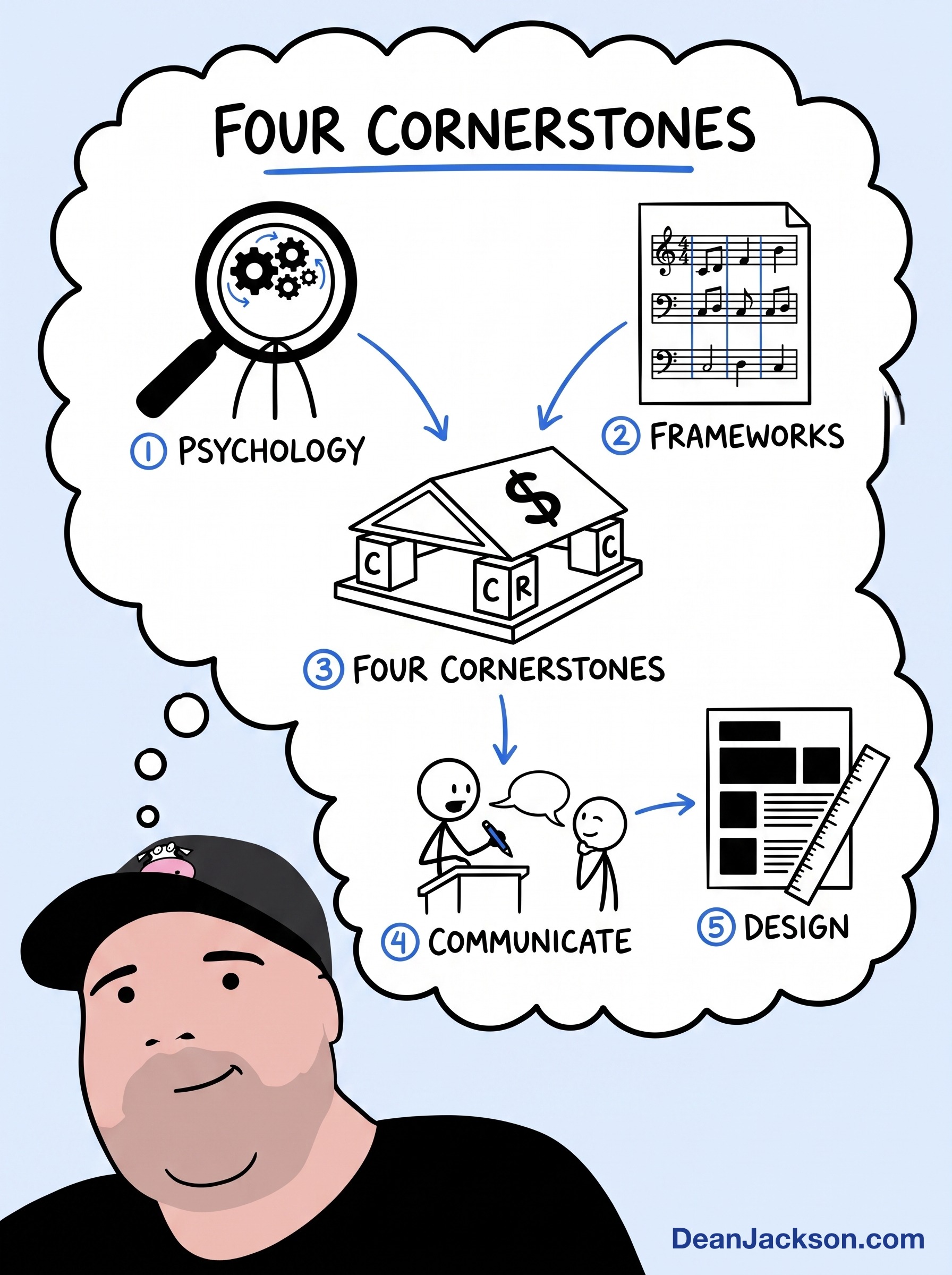
The four skills every marketing thing I've built traces back to: behavioral psychology, mental models, copywriting, and design. Master these first.
A man named Jerry Ballinger shaped a lot of my thinking when Eban and I were in our late twenties. Looking back, everything I've done traces to four cornerstones I picked up around him.
First is behavioral psychology, understanding why people do what they do so nothing baffles you. Second is building mental models and frameworks, like knowing music theory so your ideas fit together instead of being random.
Third is copywriting, which I really mean as communication in every form, speaking and writing your ideas so people accept them and change. Fourth is design, framing your message so there's zero friction between your idea and the world.
AI can help with all of it now, but the thing that hasn't changed is behavioral psychology. People still do what's in their own self-interest, and if you frame your ideas around that, you win.
Join me live on the next free 50-Minute Profit Finder call, Friday, October 9 at 1:00pm ET. Save your spot →
Transcript
Auto-generated transcript, provided as supporting material. It may contain errors, and speaker labels are occasionally mis-attributed.
Hi, good morning. It's Dean Jackson and we're here at Streamong Resort in the middle of nowhere, Florida. I'm actually lying. It's probably You go to the middle of Florida and then you turn left and it's about 10 more miles outside of the middle of Florida.
And uh this is an exciting time in my journal here. You know when you're watching a series and all of a sudden a key character comes in in the fourth or fifth episode and there's an arc with that character. Well, that person in my journals was a man named Jerry Ballinger and uh Eban Pagan and I were really influenced by Jerry when we met him. He was probably mid4s.
we were, you know, late 20 to 29 or 30 and we went and spent uh well, we talked to Jerry on the phone all the time, but we went and spent a full day with him while we were doing a a main event in Virginia. And I realize now looking at these journals how much of like cornerstone influence the things that I learned from Jerry Ballinger were. So, there's going to be a few episodes where I talk about insights from um things that I learned from him, but the core of it, I really looked at it and there's four cornerstones that are the foundation of everything else that I've I've done. And if I look at it, I can trace it all back to developing a mastery of these four things.
And number one is behavioral psychology of understanding people and understanding psychology of why people do what they do. When you understand that, everything uh goes through that lens of being able to understand why people do what they do and how to present things in a way that they'll want to do the things that you want them to do. If you understand, you don't get baffled by it. You understand and lean into it.
I was thinking, well, one of the first pages of uh things that in my experience with Jerry was I wrote this list of books on Jerry's bookshelf and and he was explaining these like picking them out and explaining to both Eban and I like what the important things. But there's I'll read a couple of the books and you can see the the kind of impact that one was the nature of personal reality. He had a book called dog training by Lou Burke and it was very very interesting of how you train dogs is the same way you kind of train people and the psychology of it was amazing. He had a a he introduced us to uh Frank Ferrelly who wrote a book called provocative therapy and he was an Ericsonian uh therapist um thinking for a change by Michael Gelb and the strategies of genius by Robert Dilts and that you know Eban and I both really went down that was our awakening to the the psychology.
He also introduced us to Wyatt Woods small who was one of the founders of NLP known throughout the world. He created modeling and uh when Tony Robbins talks about going into the army marksman program and increasing the number of people that were at expert level and reducing the time incredibly. Well, Wyatt is the person that he did that with. So Wyatt became a a good friend uh and Ebban really took uh had a deep relationship with uh with Wyatt.
So behavioral psychology on one cornerstone. Then the next thing is creating mental models or mental frameworks of how you look at things, contextual frameworks. And the best way to describe it is kind of like understanding music theory where you understand how systems work and how things um contextually fit together so that you can run your ideas within a framework. The reason you can make a hit song is because you understand music theory of how the time signature changes, what harmonizes with other chords, how the pentatonic scales work, all of those things.
And so for me, it's been around matching the behavioral psychology and matching marketing frameworks. That's what I've really spent all my time. If you hear me talk about the before unit and the during unit and the after unit and the whole eight profit activators is a is a framework is a mental model that everything filters through. The third thing that I would put in the four corners of the things I learned from Jerry are copywriting and the importance of being able to communicate your ideas.
I put it as copywriting, but I'm talking about communication in all its forms. Being able to speak your ideas. Being able to write your ideas. Being able to communicate your message in a way that fits with the behavioral psychology of what people are doing.
makes solid sense rooted in this bedrock principles of your almost first principles thinking of the way that you look at your own uh framework for things and being able to communicate it in a way that people will accept it and that they'll make change because that's ultimately the reason that we're sharing ideas that people will do something and get a transformational result, but if you don't have the first three in place, you're not going to be able to do it. And then the fourth, I think, is design. Is being able to frame those things. Jerry was really responsible for me learning to use the tools that can help me lay out and create the things, the copy in a way that was presentable.
um being able to do lay ad layout, postcards, direct mail. It was all print at the thing. There was really no um internet at the time. So, I learned Adobe Page Maker was kind of state-of-the-art of the thing.
But learning how to do that and learning the principles of how to how the fundamentals of design work. um learning about contrast and alignment and uh positioning and all of those things that allow me to remove the friction between my idea and getting it out completely in a way that I didn't have to depend on other people to do things. Now, that's a that's a different thing at 29 than at 59 or 60 where uh in the beginning it's a competitive advantage because you can do the stuff. But when you uh get more money and you start to realize that you can all the things that can be done by other people, you of course then evolve to uh being able to just express what you want.
But having a grounding in design helps you recognize and describe what it is that you want. uh and makes it so much kind of easier for you to get your ideas out there in the world. So those are the four that I would look at as the cornerstones of things and I'll go deeper into each of them in the next upcoming um videos. But behavioral psychology, mental models and frameworks, copywriting, communicating your ideas in a persuasive way, and design, being able to create the message that's going out in a way that there's zero uh friction.
Of course, AI now is the ultimate thing for us that you just need to know if you're grounded in all of these things. The thing that hasn't changed is behavioral psychology. It's still to this day, people primarily do things that are in their own self-interest. And if you can frame your ideas around that, you're going to win.
So this will be an exciting arc here for the next three, four, five uh videos.
Get BreakthroughDNA Free
Discover the 8 Profit Activators that can transform your business. Get the complete framework, free.