Turning Buyer Psychology Into A Marketing Model
Watch
Listen
How I turned buyer psychology into a repeatable model: don't convince anyone, just get people to raise their hand, then treat them like they'll buy.
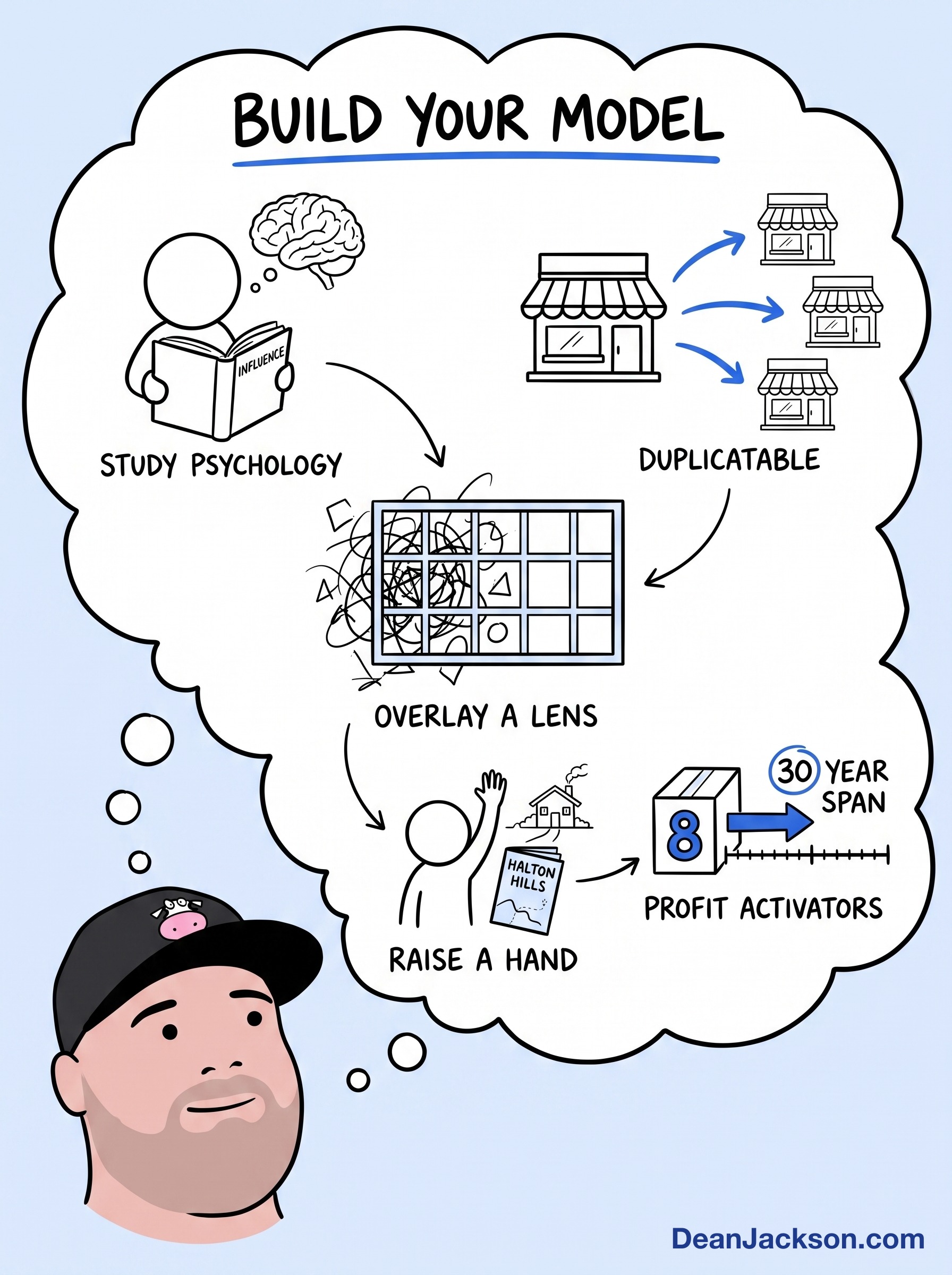
The second cornerstone is creating mental models, frameworks you can overlay on a situation to give yourself a shortcut. Michael Gerber's franchise prototype was the first one I was ever exposed to.
My model was simple. Create a guide, run ads to get people to raise their hand, then treat them like someone who's going to buy and give them valuable information. I've since learned that's roughly a 50% chance over the next two years.
I'm not trying to convince anyone up front. I'm identifying the invisible prospects who are already thinking about buying, then letting reciprocity, liking, and commitment and consistency do their work. Those eight profit activators grew out of this exact thinking.
There's a line I love: a man with an experience is never at the mercy of a man with an idea. Take whatever you do, build your own model, document it, and you'll trust that anything you run through it has a better shot.
Join me live on the next free 50-Minute Profit Finder call, Friday, October 9 at 1:00pm ET. Save your spot →
Transcript
Auto-generated transcript, provided as supporting material. It may contain errors, and speaker labels are occasionally mis-attributed.
Okay, good morning. Well, we're moving along and one of the things that I mentioned as the four cornerstones of being a lifetime marketer was my >> [snorts] >> focus on creating and learning mental models or frameworks. You know, I mentioned studying behavioral psychology all under this grand context of marketing. Everything I was doing, I was obsessed with how does this apply to marketing?
So, learning all the behavioral psychology, the influence and being predictably irrational and why people do what they do, all of that knowledge you take it in and then what I was really focused on doing was creating duplicatable models for this. Having to make things that you can overlay on a situation and give yourself a shortcut. Now, looking back at this, I know now after 30 years of doing this that this was the beginning of that. Being exposed to people like Jerry Ballinger that kind of taught me the focus of this and I I look at it's not many sort of of these models that I've really been able to build on, but understanding that psychology and understanding from the very first one that I was exposed to of the franchise prototype.
That's a mental model. What Michael Gerber was talking about in terms of creating, looking at a business like you're going to duplicate it 5,000 times and making sure that the consistency of the system was duplicatable. That's really what I think about when I look at creating these models. Now, going forward, the eight profit activators and my before, during, and after model are the end result of the beginning of what I was thinking here.
But, it's very much like taking the scientific >> [snorts] >> method approach to things where you create experiments, you test your hypotheses, you document the results that happen, and then you try and duplicate them. And so, if I look at it right now, at this stage, I had figured out a duplicatable model for identifying people who are going to buy a home in any marketplace by creating a guide to Halton Hills, by which again was a duplicatable model, but the framework of it was create the guide, run ads to get people to raise their hand, which would indicate that they're likely to buy a house in in Halton Hills over the next whatever amount of time. I've learn I've learned going forward that the likelihood is 50% over the next 2 years that they're going to buy a home. And then treat them like they're someone who's going to buy a home and give them valuable information.
Those are all powered by the model of a duplicatable prototype and the the six weapons of influence in terms of reciprocity and liking and commitment and consistency, moving those things forward that if somebody is if somebody asks for a guide to Alton Hills and you're sending them information about it, it would be it would feel like, okay, there's a much higher chance that they're going to like you because of that. And there's a much better chance that because they started down the path with you, that they're going to continue down the path with you because of commitment and consistency. So, I've been able to use that sort of model as a foundational thing over the last 30 years. And I see it now everywhere.
Like I I look I've been able to transfer that model into the things that I do now where any of the lead generation things we do, whether it's books or whether it's catalogs or whether it's price reports or all of the things that just focus on getting somebody to raise their hand and then knowing that that creates another category now of people who are higher likelihood than the general population to do whatever it was. So, I've kind of removed I'm not trying to convince people to do something with me initially. I'm just trying to identify the invisible prospects who are already thinking about doing this and giving them a way to think through that. So, if I look at it, you know, the big models that I've been able to create are the the profit activators which will discover haven't even been calling it that here.
I will say that I've been working on these eight profit activators for 35 years, and the first 15 years of it was unconsciously, and then the last 20 years has been fully consciously with the name of them and everything being able to to apply them. So, my encouragement or the takeaway from this kind of thing is whatever your big context is, whatever marketing for me, whatever it is, taking the idea of learning the the underlying supports of that, behavioral psychology, why people do what they do, identifying your your interpretation, your lens that you can look through. And the most valuable thing about having a lens that's your own is that you have an experience of something. You know, it's not just about reading the books and getting the book knowledge of something, it's the experimenting and experiencing it for yourself.
Um there's something There was a a quote, I think about Mike Hardwick, Josh, his father was a pastor in Nashville, and I may or may not get the exact thing, but his saying was a a man with an experience is never at the mercy of a man with an idea. And there you can understand something theoretically, but when you've experienced something and you see for yourself that this is a tested and valid process, that's the beginning of your own kind of model that you can apply to whatever it is that that you're doing. So, this model initially everything I was doing was focusing it on how can I find people who want to buy a home in Halton Hills, how can I educate them and build a relationship with them, send them valuable information, endear them endear myself to them that so that whenever they're ready that they want to work with me or to work with whoever the client that I was sharing this model with is. And that that framework model has been very valuable in many different ways.
So, I'm going to encourage you to take whatever it is you're doing, start to look for and create your own models, document them, and you're going to have the confidence that going forward anything that you anything you put through that model is going to have a higher likelihood of success.
Get BreakthroughDNA Free
Discover the 8 Profit Activators that can transform your business. Get the complete framework, free.