The Psychology Behind Why People Buy
Watch
Listen
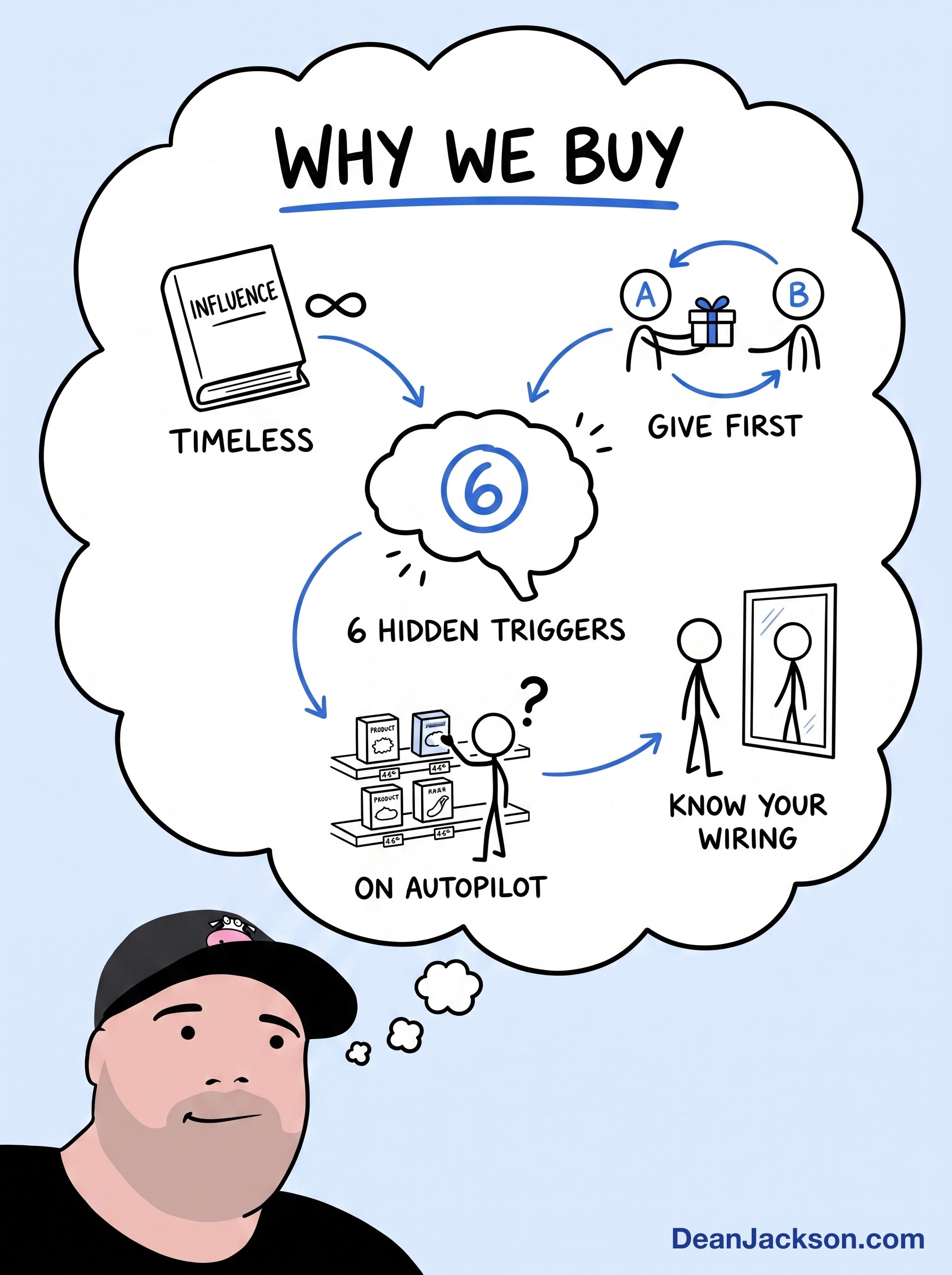
Why Cialdini's Influence never goes obsolete, and how reciprocity and commitment-and-consistency quietly drive buying decisions you never notice.
If you want one place to start with behavioral psychology, go down the path of social psychology. The most cited name in it is Robert Cialdini, and I read his book Influence back in 1996. There's a direct through line from that moment to everything I do today.
Cialdini calls them the six weapons of influence, things hardwired into us that shape our decisions without us knowing. Reciprocity is the first. Do something nice for someone and they feel they owe you one back.
That's why I lean so hard on giving away free books. It starts a relationship, and it stacks with commitment and consistency, where once you've raised your hand for something you feel pulled to keep moving in that direction.
Technical skills go obsolete. Everything I learned about building sites in Microsoft FrontPage is useless now. These psychology principles are durable, so I'd start with Influence and Pre-Suasion, then Predictably Irrational by Dan Ariely.
Join me live on the next free 50-Minute Profit Finder call, Friday, October 9 at 1:00pm ET. Save your spot →
Transcript
Auto-generated transcript, provided as supporting material. It may contain errors, and speaker labels are occasionally mis-attributed.
Hey, it's Dean Jackson and this is episode 10. 10 episodes now of 30 years of insight from journaling every day. And what I discovered yesterday is that one of the things that I talked about was the four cornerstones of being a marketer, a lifelong marketer is behavioral psychology. That was the number one thing.
And I was thinking about the books that are foundational of those things. And the reason that I talk about and choose and put so much emphasis on understanding behavioral psychology, both your own by understanding your Myers-Briggs type and your Kolbe and your Working Genius and StrengthFinder, all of those things are very useful because we don't fundamentally change very much. So knowing how to work within what your own behavioral sort of psychology is, that's a great thing. But on the whole humans we have been the same.
We're motivated in the same ways. Our our underlying things are principle-based reactions to things and the the ways that we uh respond to stimulus and the ways that we kind of interpret things and take action have not changed. And I don't think you could go wrong if your first entry into understanding behavioral psychology is going down the path of social psychology, which is the practice of understanding how people react in in very specific situations. And the leader, the most cited social psychologist ever, is a gentleman called Robert Cialdini.
And he wrote a book called Influence. This book was written in 1984. It's been millions of copies sold. This revised edition came out in 1993.
So, when I started reading it right around here, 1996, as soon as I understood all of these things, I can see now a direct through line all the way back to this moment that has stuck with me all the way to today. And what Robert Cialdini, who's become a friend, and you know, I've gotten to know him over these 30 years, he spoke at both of our I love marketing conferences. He actually lives in in Phoenix. And uh so, one of the things that that he has really kind of dedicated his life to is understanding what he calls the six weapons of influence.
And these are the things that are kind of hard-wired into us that we that are influencing us even without us knowing them. So, just off the top of my mind, the cuz I've studied this for so long, I know I know them back and forth. And one of the first of the weapons of influence is called reciprocity. And that means that we're very influenced by if I do something for you nice, then you owe me a favor back.
You need to do something nice for me. And when you really understand this, you see why we are so guarded about entering into any kind of engagement where we might be obligated to something. And that's why when you go in, this is internationally, when you go into any retail store and the person in the store asks you, "Can I help you?" Our immediate response to that is, "No, thanks.
I'm just looking." Chop, chop, chop. I don't want to have any obligation uh to this. But the real breakthrough idea around this is that if you just start doing things for people, they it's they're obligated.
They're feeling You can trigger this sense of reciprocity even when it's uninvited. It's a very So, going out of your way for somebody is one of the most amazing things that you can do. One of the things that I've used, and by the way, that's why I use so much things like free books, giving somebody something for free, you're starting a relationship with them. The The next weapon of influence that he talks about is something called commitment and consistency.
And that means that the when you start down a path, when you've made a public sort of um um commitment to a position or you've taken some action that is leading in a in a specific direction, we feel compelled to act in a manner that's consistent with the behavior that we've already demonstrated. And when I look all the way back, the reason that the nine-word email, which I haven't even invented yet, hasn't come out, but I see the through line of it going all the way back to this commitment and consistency, if I've had some interaction with someone and they're looking for a beach condo at some point, when I send an email to them and say, "Hi John, are you still interested or are you still looking for a beach condo?" That subtle shift of "Are you still looking for a beach condo?" implies and indicates that I know that at one point you were looking for a beach condo because you asked for my you know, June 2026 report on beach condo uh Longboat Key beach condo uh house our price report.
That that's you made a um movement in a specific direction, and so when I called back to that, there's certainly a underlying drive to act consistently with that. And it's a very So, that's why when we're using book titles that we there's a commitment and consistency element that stacks on top of the reciprocity. So, if you, for instance, ask for a book called um How to Sell Your House for Top dollar fast. And the ad that you saw that got you to ask for it said, "If you're going to sell your house in the next 6 to 12 months, what you do right now can make a difference of thousands of dollars."
And we show a cover picture of the book and you ask for it. There's a really good chance that if I follow up with you and I just provide helpful information to you that is going to uh that goes out of my way to bring these good things to you, there's a really good chance that you will reciprocate that by at least giving me a chance to talk to you about selling your house. And so there's a real these things are amazingly powerful when you understand that they're happening at all times. They're happening without us even having any conscious awareness of it.
Um and Robert Cialdini in this book and in uh follow-up book called Pre-Suasion, which is how do you engineer situations or what's going on that will set up the reason somebody um is motivated or goes into action because of these principles. And understanding this and really putting in the time to master this one skill as a cornerstone, one of the four cornerstones, is that it has durable advantage for you. It's a long-term thing. It's not like learning a skill that is going to maybe go away.
Like everything I learned and invested in the technical skill of how to build a website using Microsoft FrontPage is useless today because it doesn't it changed, right? All of the technology skills, all of those things, the tool skills are things that are going to uh change along the way. These behavioral skills, these psychology understandings that you can develop are going to be enduring. They're not going to go away.
So, I would recommend this is a really good place to start with the influence, the psychology of persuasion, pre-suasion by Robert Cialdini. There's another great book called Predictably Irrational by Dan Ariely, which is in that same vein. And I think just those books alone, if you were to understand that at the core, will put you a long way down the path of being a better marketer.
Get BreakthroughDNA Free
Discover the 8 Profit Activators that can transform your business. Get the complete framework, free.