30 years later people still spend their money on these core things.
Watch
Listen
The contextual certainties of life, from babies to retirement, never change. Organize a whole category as people's advocate and you win.
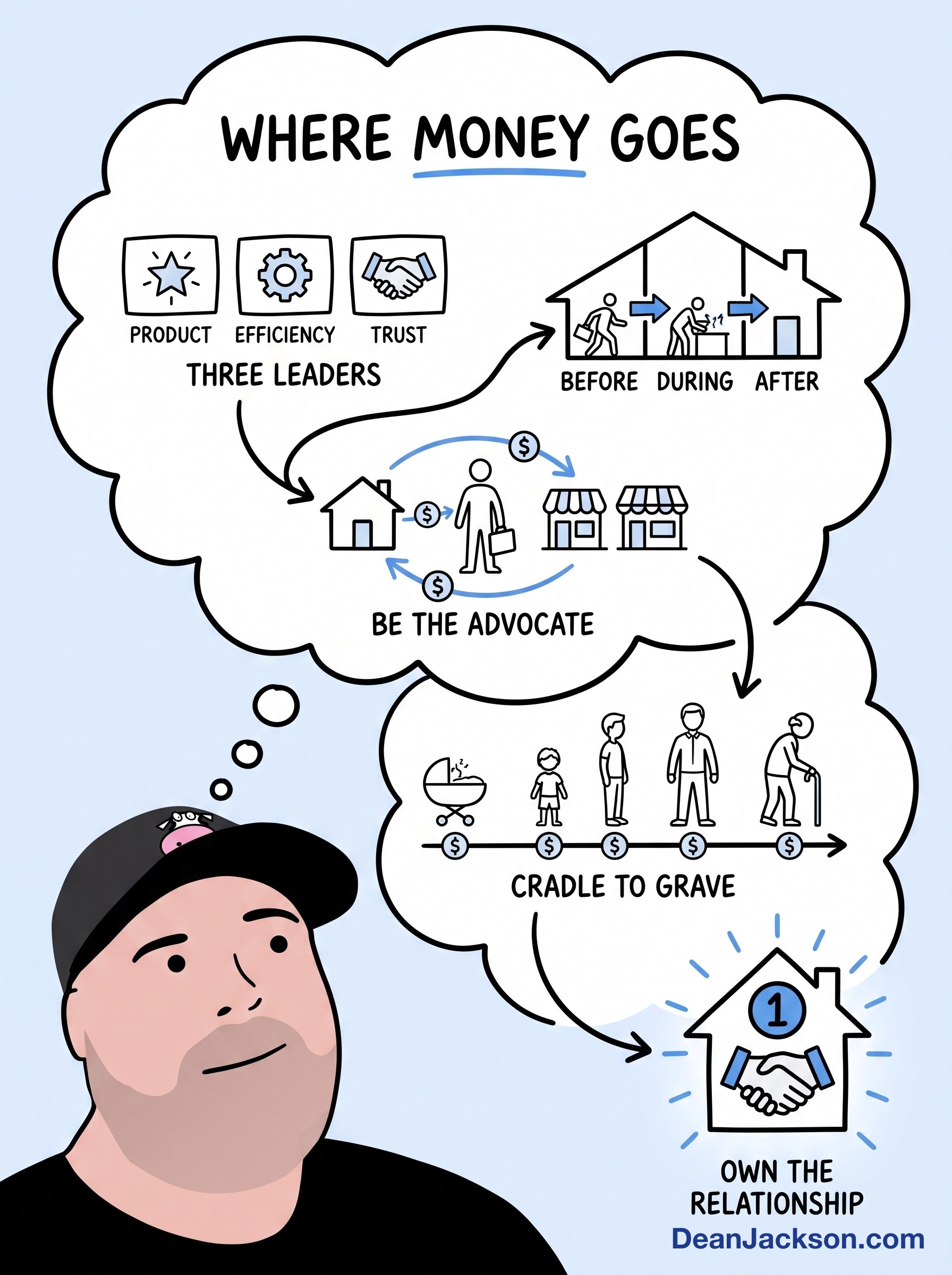
Filing this one under we are living in the future. As I close out journal number one, a couple of books from 1996 planted ideas that have stuck with me for 30 years. The Discipline of Market Leaders says businesses win as product leaders, operationally excellent companies, or customer intimate companies, and I realized real estate is really all three across the before, during, and after units.
The One to One Future by Don Peppers and Martha Rogers predicted the privacy issue and imagined a future where we'd each have an advocate, someone we share everything with who acts as our intermediary with the marketplace. I coupled that with the customer intimate idea and saw the opening.
Then I mapped the cradle-to-grave list of where people spend money, from babies and toddlers through weddings, homes, cars, and retirement. Every one of those is a contextual certainty, something lots of people are moving through, and almost nobody steps up to organize the category and be their advocate.
The biggest prize is the first-party relationship with a homeowner, which is why companies like Rocket are combining mortgage, insurance, and brokerage. Whatever your business is, start asking who else serves the same person. That closes journal number one, 17 episodes in, with about 150 journals still to go.
Join me live on the next free 50-Minute Profit Finder call, Friday, October 9 at 1:00pm ET. Save your spot →
Transcript
Auto-generated transcript, provided as supporting material. It may contain errors, and speaker labels are occasionally mis-attributed.
Good morning. Okay, let's file this one under we are living in the future. And if you're new here, I'm Dean Jackson. I've been journaling almost every day for 30 years.
These are my journals and this is what I know so far. We're going back one by one and we're coming to the end of journal number one, 17 episodes in to unpack the lessons from journal number one. Um, I read a lot and this is one of those things where a couple of ideas that stuck with me for over 30 years were planted in this little time period here of journal number one. And one of those books was a book called The Discipline of Market Leaders.
And I forget who the gentleman was, but he was with Boston Consulting Group. And they found that businesses usually fall into one of three categories. Market leader businesses fall into one of three categories. They're either a product leader like Nike or like Apple or things that are leading with the the best products in an industry.
It's exciting and uh you know brand leaders, people want to be around them and they build momentum that way. The second category is what he calls operationally excellent companies. So operational excellence is about the uh removing the friction making something as uh profitable as possible by paying attention to the operational detail. So a company like Walmart would fit into that where they drive low prices through operational efficiencies.
Federal Express has to be an operationally excellent company just because of the logistical details. Airlines have to really focus on uh on doing that. And then the third company type or category is what he calls customer intimate companies. And those are companies that are blended with companies that you wouldn't even be able to see the difference between where they start and where the other uh where the other company begins.
And so companies that are like um there in the the medical field in the health care field there are companies that manage um hospitals and those would be a an example of that or companies that manage hotels like hotel groups um have very customer intimate um type of things and I coupled that So my thought about it because remember everything that I'm doing in 1996 is filtering everything through a lens of how does this apply to the real estate business? And so my thought was well what what is real estate? Is it a is it you know product leader? Is it operationally excellent?
Is it a customer intimate? And that was the seed of well, it's really all three. And that was the seed of helping me separate the before unit, the during unit, and the after unit. Because the before unit of the business is really a product leader of leading with identifying people who want to buy or sell their home.
And we do that through the guide to Halton Hills or through later you'll see in the journals a book on how to sell your house for top dollar fast. Those kind of things are product uh leadership. The operational excellent part is the during unit where it's really about the efficiencies and the systems and the checklists and the processes to take somebody from we want to find a house all the way through to moving in. That little during unit period is the uh operational excellent portion and the uh after unit after somebody is done.
That's where it becomes a customer intimate business where now not just abandoning people once they've moved in and they're no longer you're not going to make money for another 7 to 10 years if somebody decides to sell the house and which is often I was my observation was that people that's exactly what people were doing. you're helping them find one house and then abandoning them and uh going on to the next and not really revering the opportunity there. So all these books, all these things that I'm learning sort of layer on top of each other because in this same period of time I was introduced to a book called the oneto-one future. And it's by uh Don Peppers and Martha Rogers.
And when I first read that book, this has been one of those things that's really stuck with me for a super long time. I mean I you know lay I layer these concepts and try and create my own models around things. That's one of the things I talked about is in the four cornerstones is understanding behavioral psychology then forming your own models of the way things work. And so this onetoone future, one of the things that they talked about was creating an advocacy relationship.
And this was it's kind of wild when I look at it now. The things that he was talking about, they were talking about in 1996 were not even on our radar really. He totally predicted the privacy issue that was going to come up. This is before we've even really gone online.
He was saying how in the future his vision was that instead of people having to be bombarded with everybody trying to sell them individual things that he envisioned a future where we would have an advocate and we would reveal everything about our personal information. We would share that with our advocate who would then be an intermediary between us and the marketplace. And I immediately coupled that with the customer intimate uh type of business and realized that once people move into a house, they are now in a new role of being home owners and there's lots of things that homeowners are going to need over the lifetime of owning a home. And I it was almost like putting on 3D glasses or almost like being able to step one level higher and look at the whole ecosystem and realize contextually if you can understand what's going on in a market and you can be an advocate for somebody realizing that they're going to need lots of different things.
this is going to be a winning formula. And so I started looking through and having these conversations with Eban. We would talk about I was looking for where could you advocate for somebody. I started looking at on page 157 we have the complete cradletograve analysis of every man's economic expenditures.
And I started going down like you think about things that are repetitive, things that are are going to happen, right? Like so it starts out babies. That's the beginning of everything that there's an entire economy around babies that they're going to need diapers and baby food and clothes and all of the things that that go into that. Then babies become toddlers and they're going to need toys and a bike and all of those things.
Then preschool kids where education and uh you know prek and daycare and all of those things. Then kids move into grade school where they need school supplies and all of the things that go with that. They become teenagers. They need their first car.
Then they get into where maybe they go to school, go to college, get their own apartment, they get uh engaged, they have weddings, they have babies, they buy a house, they join health clubs, they buy cars, they go on vacations. All these things you can see if you go all the way through to uh where people retire, they have to retirement planning and into retirement and assisted living and funerals. And you see all of those things are contextual certainties in somebody's life. There are things that there are lots of people that are um are in those uh categories.
And I started thinking that every one of those could be how could you be an advocate in the each of these categories of somebody. Like if you think about it that you could have an amazing business and there are amazing businesses that are only built around the baby economy and you start to think not just how do I do one thing with this but how do I do uh how can I serve them and be an advocate for them in this entire category. And by the way, if you have a business that serves one of those elements of that, I'm just thinking about one of my friends, one of our our uh email mastery members, Louisa, who does she helps entrepreneurs do planning for their maternity leave. And we were talking on one of our member calls that she has another friend who helps people do uh get their benefits that they're entitled to in maternity.
And we had a conversation on the call talking about this whole thing cuz when you think about all of the people that are involved in this, there's lots of opportunity, but nobody is stepping up to organize the category and that's where there's a big opportunity. You're going to see in a couple of journals how we did this in the wedding category. And of course, I've been thinking this through on how to do this in the real estate category, but suffice it to say, understanding the contextual certainties of what's going on in people's lives really creates an amazing um opportunity. I on page 177 and this gets more fully expanded into journal number two which we're moving on to next is I started thinking about what are the big categories of where does everybody's money go and we the first four that I thought of here are every what do people need all the time and groceries is one of those things.
And there'll be some fun stories that'll tell you about the grocery things. Cars, people, everybody spends money on cars and transportation. Everybody spends money on their home in terms of all the way from either buying or renting a home to furnishing a home to maintaining a home to improving a home. And that's where I've had a lot of my um um focus on this.
But I'm excited as a precursor to kind of set the stage for unpacking a lot of the stories of how we've applied this thinking. But it would be good for you to start thinking who else whatever your business is, who else is serving the same person here? I saw there's an article where if you notice in the real estate world there's a lot of consolidations going on. Rocket Mortgage is buying and they're combining insurance companies and real estate brokerages and this and I the words that really struck out at me were when one analyst described it that the reason that all these companies are doing this is to have firstparty relationship with the most valuable relationship in America which is a firstparty relationship with a home owner.
That's where all of the the biggest expenditures uh get spent in the home category. So, exciting stuff. This concludes journal number one. Stick with me, hit that like button, subscribe, tell your friends, come back, get notified, all of the stuff.
This is journal number one. 17 episodes. We got 150 journals to go. And I hope that you'll stick with us for the whole journey.
Get BreakthroughDNA Free
Discover the 8 Profit Activators that can transform your business. Get the complete framework, free.