Stop Trying to Convince People. Just Start Telling the Truth & Watch What Happens…
Watch
Listen

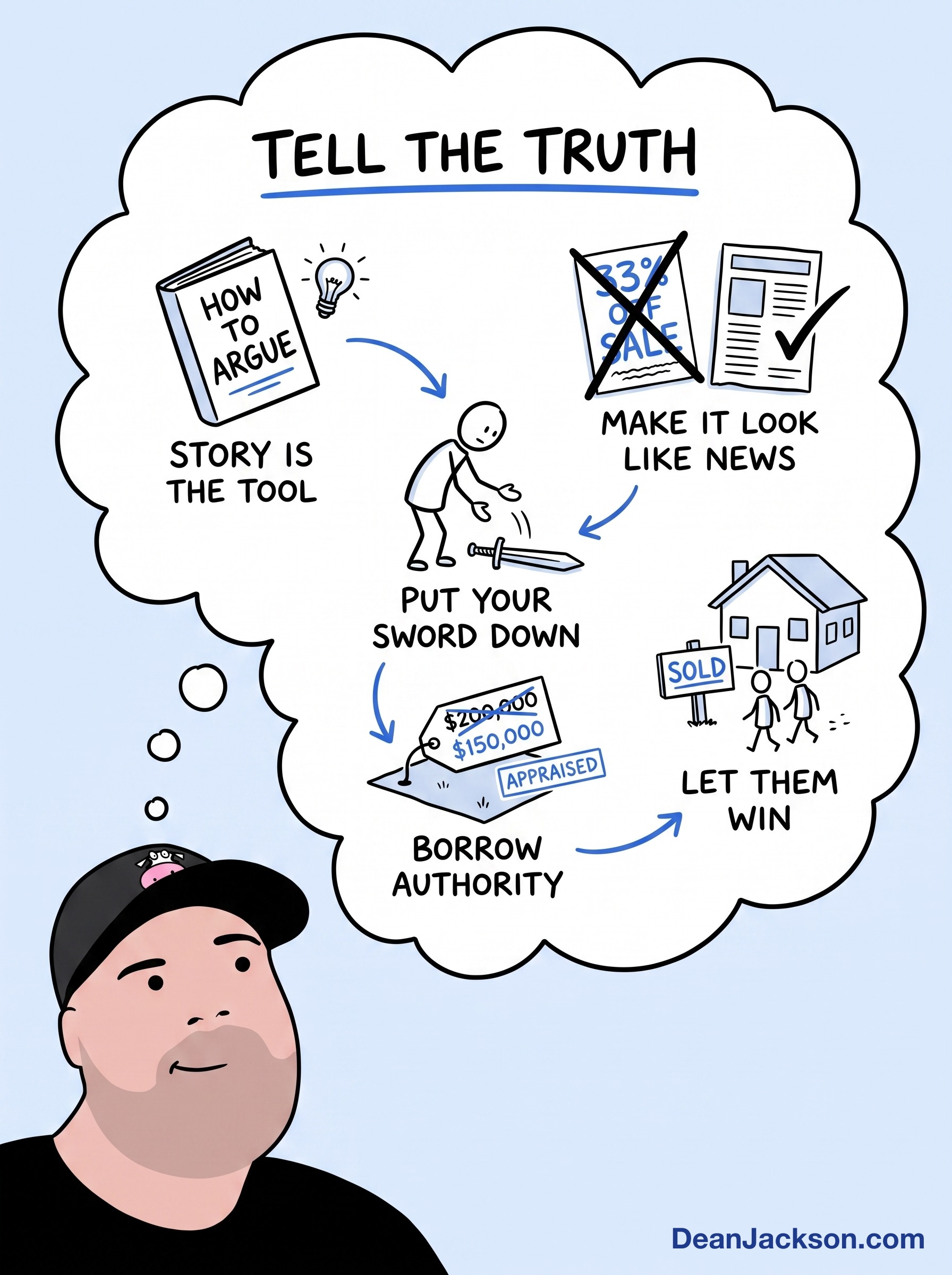
Summer 1996: the most exciting thing you can do in marketing is tell the truth. Put your sword down, say here's my dilemma, and watch people lean in.
This one goes back to the summer of 1996, when I read Jerry Spence's How to Argue and Win Every Time and realized the real tool isn't the pitch, it's the story. Stack that on Cash Copy and Robert Cialdini's Influence and you stop collecting separate lessons and start owning a durable model you can use again and again.
The first time I used it, I had a developer client north of Toronto with six unsold cottage lots in Muskoka, and it was already past Labor Day. His ads looked like ads, 33% off, blowout sale, all of it trying to convince people. So I asked the only question that matters. What's the truth here? The truth was he had a balloon payment coming due on another property and needed these lots sold to make it.
We had the lots appraised so the discount carried real authority, then I wrote the ad as a newspaper article in his own voice. I need to sell these six Muskoka home sites in the next 30 days, 33% below their appraised value, and here's my dilemma. When you put your sword down like that, people stop resisting and get curious. He sold all six lots in two weekends and blew out his fax machine.
That became a permanent hammer in my toolkit. A townhouse that sold over asking in a single weekend. A giant postcard for Joe Polish's house at the top of Camelback Mountain, an open letter to anyone who ever wondered what it'd be like to live up there. The move is always the same, tell a story that lets the other person feel like they're winning. Thirty years later I'm still running this exact playbook.
Join me live on the next free 50-Minute Profit Finder call, Friday, October 9 at 1:00pm ET. Save your spot →
Transcript
Auto-generated transcript, provided as supporting material. It may contain errors, and speaker labels are occasionally mis-attributed.
Good morning. In the summer of 1996, I learned that telling the truth in marketing is the most exciting thing that you can do. And I was inspired. I read a book called How to Argue and Win Every Time by Jerry Spence.
And as I'm looking back over everything, uh, first of all, I'm amazed that 30 years feels like yesterday because I can still get into exactly the feeling and the mindset of when I was discovering these things and applying them for the first time. And by the way, they're equally true today and they've been a huge uh throughine. I would definitely put Jerry Spence up on my Mount Rushmore of influential people. And I think that you should uh read How to Argue and Win Every Time.
But the the lesson that I learned from uh reading that book was using story to communicate with people. That's really what we're doing. and and it's very as a lawyer. He's a lawyer who had never lost a a case, had some very high-profile cases.
If you're uh you know, if you're Gen X or or a baby boomer, you'll know who Jerry Spence is. You remember seeing him on CNN all the time, the guy with the tassel uh coat, the suede coat as a legal analyst on on CNN. And one of the things that is that was exciting about applying these things is applying it along with things that I was learning from the other books that I was reading. I mentioned I was reading cash copy was a very uh important book at that point and the and Robert Chaldini's book influence and then you overlay how to argue and win every time and it's not the individual lessons from each one of those books independently.
It's the collective, it's the combination of those combined with experience that you've had. So I mentioned how creating looking at behavioral science, experimenting, building your own models for something and then you've got a durable thing that you can use again and again. And I've used this a lot. So, the first time that I used an ad uh using the the toolkit that I developed from uh Jerry Spence, I had a a developer client in Toronto who built uh you know, we developed property and then uh you know, built homes.
He had a project in Mscoa, which is like cottage country north of Toronto. And this is a property that they had been developing for almost 30 years. It was big, you know, family uh property. They had hundreds of of lots that they were developing.
And I had lunch the day after Labor Day with this developer. And I still remember it cuz we're sitting at the country club on the terrace and he was a little bit disappointed that he had been unable to sell the last six lots that he had available in this Mscoa subdivision. And I asked him, you know, he showed me the ads that he was running. He was, you know, running.
And it was so funny because if we put them through the checklist that I talked about, the sevenstep uh ad checklist, you know, did it does it look like news or does it look like an ad? These definitely looked like ads. 33% off blowout sale, you know, all of these things were trying to get people, convince people that these lots were a a good deal. And I said to him, he was disappointed because it was September now and cottage country is kind of decidedly a summer seasonal thing.
So the end of the season is basically Labor Day. And he thought now he was going to have to sit all the way through till the spring when people start thinking about cottages again. And so knowing what I know, I said, "Let me put these uh let me put an ad together for you." And he told me, I said, "What's the what's the truth here?
What?" Because I that was in my mind. What's the truth? Like what's the real story here?
And it turns out that he had another property that he wanted to develop in the city. He had an opportunity to make a balloon payment on that property, but he was planning on using the money from this uh development to pay that thing. And he only had until the end of October to uh make the the balloon payment. And so I asked him again about the um the lots themselves.
I said, "What is this 33% off?" Right? like what what does that mean? And he I said, "Is it just 33% off whatever your inflated price was?"
And I knew that in uh Robert Chaldini, one of the weapons of influence is authority. That if there were if we actually had these lots appraised and they he was offering them for 33% below what their appraised value is. That gives it some authority, right? So I said, you know, let's get the lots appraised.
And he said, "No, I'm willing to sell for, you know, 33% below." So, we had the lots appraised and then I wrote an ad that we placed one time, actually two times, two weekends in the uh in the Toronto uh Sun newspaper and it looked like a newspaper article, had a beautiful wooded picture of the lots, and the headline was, I need to sell these six Msoka home sites in the next 30 days and I'm willing to sell them for 33% below their current and then in brackets September 96 appraised value quotes and it so it looked like a you know a newspaper article then we went on to tell the story and I told it in his voice. My name's Don Naylor. I'm a real estate developer.
We've been developing property in Mskoka for over 30 years. I have this last six lots available in this development. And then we use the words here's my dilemma. And that's a very interesting thing.
When you're putting yourself in the hands of other people, you're triggering something that society we don't kick somebody when they're down. When you if you come up with a sword against somebody and you're trying to activate resistance to something, we're going to be resistant. But if you put your sword down and you say to them, here's my dilemma. Now people are curious.
We're leaning into this. And he said, told the thing, we've been developing this property. I have an opportunity to buy to uh there's another property that I want to develop and I have opportunity to make a payment a balloon payment on the uh property but I only have until November to do it and I need the money from these lots to be able to uh apply to this property. So, here's what I have done is I've had all the lots appraised and we show the where they range in size from 1 acre to 5 acres.
They uh we show the value had the actual appraisal um things on them and then told the story of uh why give people a reason why we're selling these lots for below 33 or 33% below appraised value. and then invited people to call their phone number and he would mail them or fax them a info package all about the um the properties. We use the words free recorded message of course and um and he ended up selling all of those lots in the next two weekends. m.
Sharp. If you call this recorded message, I'll fax you or send you the uh the details." And it was so funny because literally the ad ran that weekend. He called me after the weekend and said, you know, they blew out their fax machine, you know, have because they had so many people calling to uh get the info and they ended up selling it.
Now, that became like a new hammer for me, this model of telling the truth. I had a townhouse listing that was uh a, you know, beautiful townhouse. they found a property that they wanted to to buy and we needed to sell it. And so I ran an ad again, showed the view from their uh their townhouse and said, "Uh, we need to sell our Kings Mill townhouse this weekend and we're willing to sell it for $5,000 below current val market value."
And told the whole thing, "My name is Tim Alberts. I live my wife and I live in this townhouse." and we found our dream home, but in order to get it, we need to sell our house and we have to do it quickly. and tells all about the house and uh had people come by the house on the weekend.
And it was immediately uh we sold the house that weekend um for more than what we were asking because people recognized there are other people here who want this house as well. And we ended up selling for more than we would have if we had priced it uh if we had put it on the market hoping for the the best thing because we put it under it ended up selling for more than we were asking creating that auction effect. And then you know years later 20 something years later this we you I still use this same uh the same model. And here's a a giant postcard that we used when I was helping uh Joe Polish sell his house in in uh Paradise Valley in Scottsdale.
And we had sent this giant postcard. This was his house right at the top of Camelback Mountain. And we told the story of the the house here. So, we sent this postcard down to everybody who lived in the valley who could look up at Camelback up at the house and we said an open letter to anyone who wonders what it would like be like to live at the top of Camelback Mountain.
It's awesome. Here's why. And we just told the story about the the views. Have you ever noticed how virtually every listing in Paradise Valley claims to have views?
Then you learned you have to walk so to the far corner of the property, stand on your tippy toes only to see a sliver of mountain. And it was just so um so funny to to tell the story. And then we set up a special website where people could go and take a virtual tour of the property and see all about it. And that is has become a durable thing in my toolkit of just telling the stories that are going to make people feel like they're winning.
You you have to choose. Are you going to tell a story that lets them be the winner? And ironically, you know, Joe Joe's written a wonderful book called What's in It for Them? And you know, this really fits in there.
When you take a perspective of writing from their mindset, when all you're doing is not trying to impose your will on people, but really understanding what their desire is and telling a story that lets them live into feeling like they're getting what they want. That's a that's a winning formula. So, I'll post up uh the example here for you of this. But I I'm loving going back and seeing these um seeing how these play along.
Uh still 30 years later, I'm still using this same playbook.
Get BreakthroughDNA Free
Discover the 8 Profit Activators that can transform your business. Get the complete framework, free.