"WOW" Experiences Don't Happen By Accident
Watch
Listen
Page 111 of journal three: the seven-phase buyer wow cycle. A wow never happens by accident. You storyboard the journey, then build one in on purpose.
Good morning.
Journal number three. And it keeps happening... I'm reading pages from 30 years ago and finding the exact things I still do today.
One pattern shows up more than any other. Storyboards.
I've mentioned them before. But what I'm seeing now is what they really are. A focusing tool.
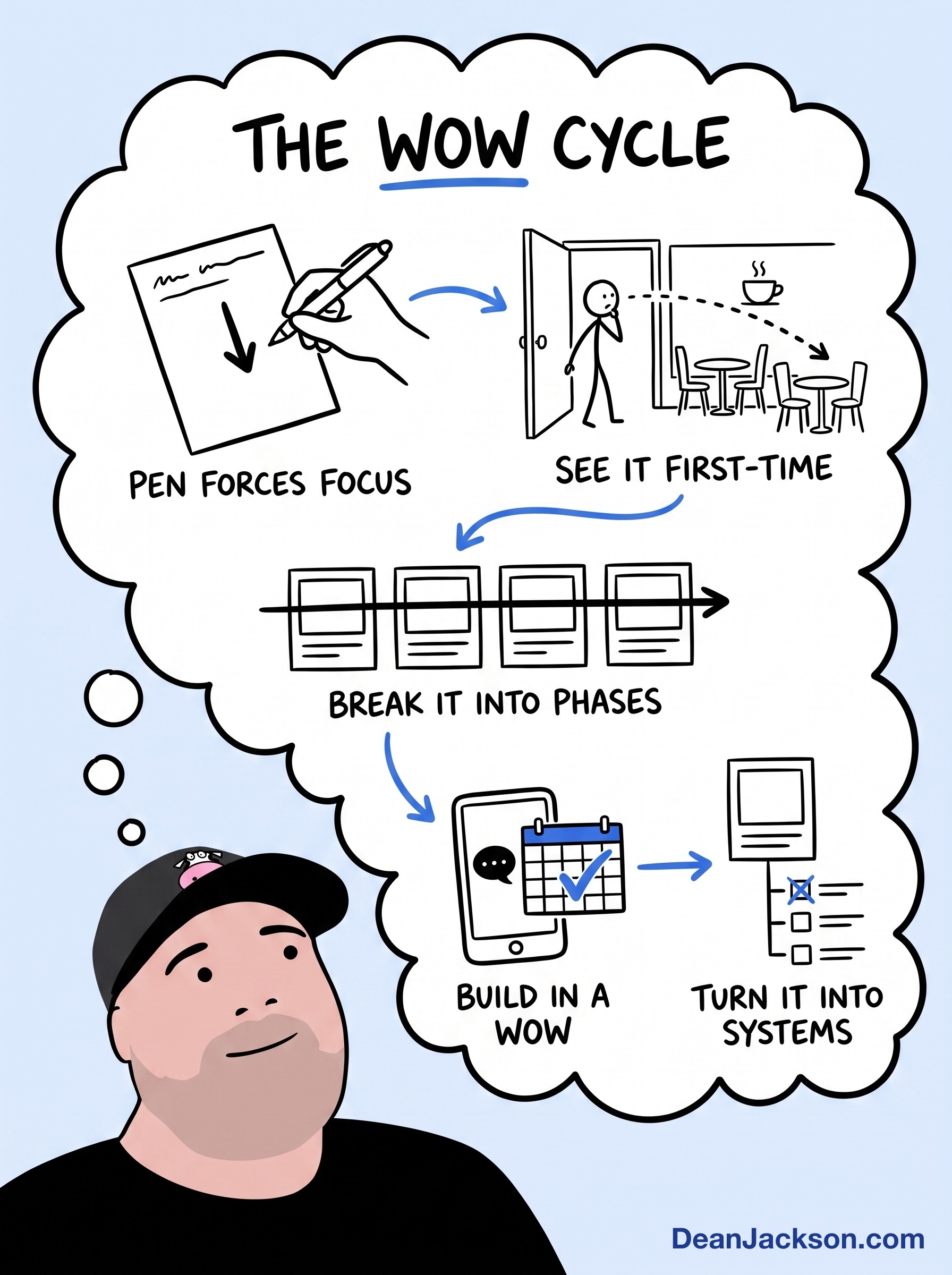
Here's the whole trick. Put a pen in your hand. Put a piece of paper in front of you. Write one instruction across the top.
And your mind has no choice. The pen forces you to think about only that thing. It gives your thoughts somewhere to go... out of your head and onto the page.
Page 111. The thing I was working out was a storyboard I called the seven-phase buyer wow cycle.
The magic is in breaking the journey into its segments. Where does somebody actually start? Where do they cross into the next stage?
Think about this cafe I'm sitting in. Lay out the whole experience through the eyes of a first-timer. The parking lot. The door. Walking in. Where do their eyes go? What are they looking for?
How do you make it so nobody feels out of place or confused? Because being a regular somewhere is a completely different feeling than your first time.
And that's the hard part. We're too close to our own thing. We know what it's supposed to be, so we can't see it fresh anymore.
Getting into the eyes of a brand-new person takes some creativity. Identifying the segments is what unlocks it.
So phase one of the buyer wow cycle... find someone looking for a home, and be so helpful they want to meet with you. That's the whole Before Unit, really. The eight profit activators are just this same storyboard, laid out as a timeline.
Then the appointment. What has to happen for them to feel secure with you? Then you go out and look at homes. Every one of these phases is full of little places to create a wow.
Take phase four. The conditional period. They found the home, the offer's accepted, and now you're removing conditions. For someone who's never done it, that stretch is nerve-wracking. Precarious.
So how do you create a wow right there? A daily check-in call. Getting the inspection booked. Pushing the mortgage approval along. Once you can see what the moments are, you can turn each one into a process.
That's the thing I keep coming back to. Look at the experience someone goes through with you. Find the benchmarks. Think of them like the locks in a waterway... each one lifts you to the next level.
What triggers the entry into a phase? How do you create a wow while they're in it? What's the exit into the next one?
Every page in the journal is a chance to walk it through. Tell the story to yourself. Imagine the ultimate version. Describe it from the buyer's side. Then isolate the pieces that need to be built or systemized to make it real.
That's a lot of what journal number three was for me. Laying these experiences out, one page at a time.
Because here's the truth underneath all of it. Every idea I've had, every dollar I've made in 30 years, went through my brain, down my pen, onto a page in my journal... before it ever went out into the world.
So here's your nudge for today.
Pick one experience somebody has with you. Walk it, box by box, through the eyes of a first-timer.
And find the one place you could turn into a wow.
Transcript
Auto-generated transcript, provided as supporting material. It may contain errors, and speaker labels are occasionally mis-attributed.
Good morning. Okay, as I'm going through journal number three, it's amazing to me that so much of the things that I was writing about and thinking about are things that I still do today, 30 years later. And uh structurally what I'm noticing in the way that I'm using my journals is there's many many many pages of some basic patterns that I would see. So, I mentioned using my journal for dialogues with myself and there are lots of examples of pages of thinking about my thinking and having conversations with myself to work something out.
That's one of the most u common uses that I'm seeing developing here. Um, but the the other thing is these story boards. And I did mention the story boards in one of the videos, but what I'm recognizing right now is how much these story boards are a focusing tool. What I've learned is that if you put a pen in your hand and you have a piece of paper and on the top of that piece of paper you write something that instructs your mind.
What the pen actually does is it forces you to think about only that thing. It directs it gives an outlet to go from the thoughts that you're having out onto the page. And I'm looking right now on page 111. The thing that I was focused on in this particular journal was creating the story board for a home buyers journey for and I called it the sevenphase buyer wow cycle.
And part of the important thing about setting up your story board is to recognize where the ind where the individual segments are in somebody going through your journey. And I use this all the time whenever I'm creating any kind of experience for somebody. Even if you think about this cafe here that if you lay out the experience timeline of somebody arriving at the restaurant, arriving in the parking lot, their entry into the uh into the cafe, the if you're imagining these things through the eyes of your ideal buyer that they're coming in, what are they going to be looking for? What is, you know, where do their eyes go?
How do you make it easy so people don't feel out of place or feel, you know, like confused about anything? Cuz we want to feel confident. It's a very different experience when somebody is a regular at a place compared to their first time going through something. And in order to we're often very close to the experience, so we know what it should be and we know what they should be um experiencing.
But to get into the eyes of a uh a new person going through this, that requires some creativity and focusing your thinking by identifying those segments are the very best thing. So, as I was going through the the buyer wow cycle, you know, phase one is that you've got to find someone who's looking for a home and educate them to the point that they want to meet with you. That's and this all became part of the the before unit thinking. This is an evolution of it.
the eight profit activators are essentially a storyboarding um timeline and then what happens on that appointment when you're meeting with somebody for the first time. What has to happen in order for them to secure that relationship with you? and then you go out and look at homes. That whole phase, there's lots of little places that you can create wows here.
And that's what having this, you know, story board and then one page for each of the the sections on there really gets directs your thinking to think about what would somebody be going through [snorts] during that stage? How can I remove friction? How can I get the actual um objective of that? If we look at, you know, phase four of the buyer wow cycle is that conditional period where now they've been out looking at homes, they found the home, we got the offer negotiated, everything's accepted, now we've got to go through the period of removing conditions.
And that can be very nerve-wracking for somebody who's never gone through it. It's very precarious. So, you know, if you think about how could you create a wow, having a daily check-in call with people, getting the home inspection arranged, getting the mortgage approval advanced, getting all of these things. when you recognize what the things are, it gives you the opportunity to now turn those things into um actual processes.
And so I I was very um amazed looking through this to see that as a tool that I've used um again and again and I I'd highly recommend for you is looking at the experience that people are going to go through with you in your business identifying the benchmarks creating the individual little silos or thinking about it like rat hatcheting in uh benchmarks that people have or like the locks in a a waterway system where you kind of are advancing um through the process and what triggers the entry into it. How can you create a wow experience for people while they're going through it and what's the exit into the next phase of this? And every page in your journal is an amazing opportunity for you to think that through narratively. Walk through, have a conversation with yourself, imagine the ultimate scenario, describe what that looks like from the buyer's perspective, and then isolate the individual things that need to be systemized or uh supported to make that vision uh come true.
So, I think that is a uh that's an amazing tool and that's what a lot of journal number three was for me is laying out and identifying these uh experiences for people. I got a funny email the other day from Rick. It says, "Dean, question. Are you saying you can teach me to make fat stacks by hanging out at a pub drinking coffee like you?"
And I laughed to myself because I was thinking, you know, yes, I I can do that. That's what I do. Is the funny thing, what I really realized is that every idea that I've had, every dollar that I've made over the last 30 years has gone through my brain, through my pen onto a piece of paper in my journal before it went out into the real world. And if I can turn people on to that activity as a driver for what to do, what to think about, what to ask yourself to draw out, what the next most valuable action is for you, and how to find the most profitable things that you can install in your business.
I'm all for it. m. I'm going to do for the first time a 50inute profitfinder workshop and you're going to join me live on Zoom and we're going to go through a 50inute exercise. Bring your pen.
Bring a notebook or piece of paper. And I'm going to guide you through a thinking process that will help you identify where the lowest hanging fruit is in your business and maybe some fruit that you didn't even know was there. But I'm going to show you where to look for it. So, it's free.
It's for you. m. this Friday. Just watch.
Go to What did we call the website, Josh? >> 50inut profitfinder.
Get BreakthroughDNA Free
Discover the 8 Profit Activators that can transform your business. Get the complete framework, free.