Google Reviews Are Killing Your Business… Try This Instead.
Watch
Listen

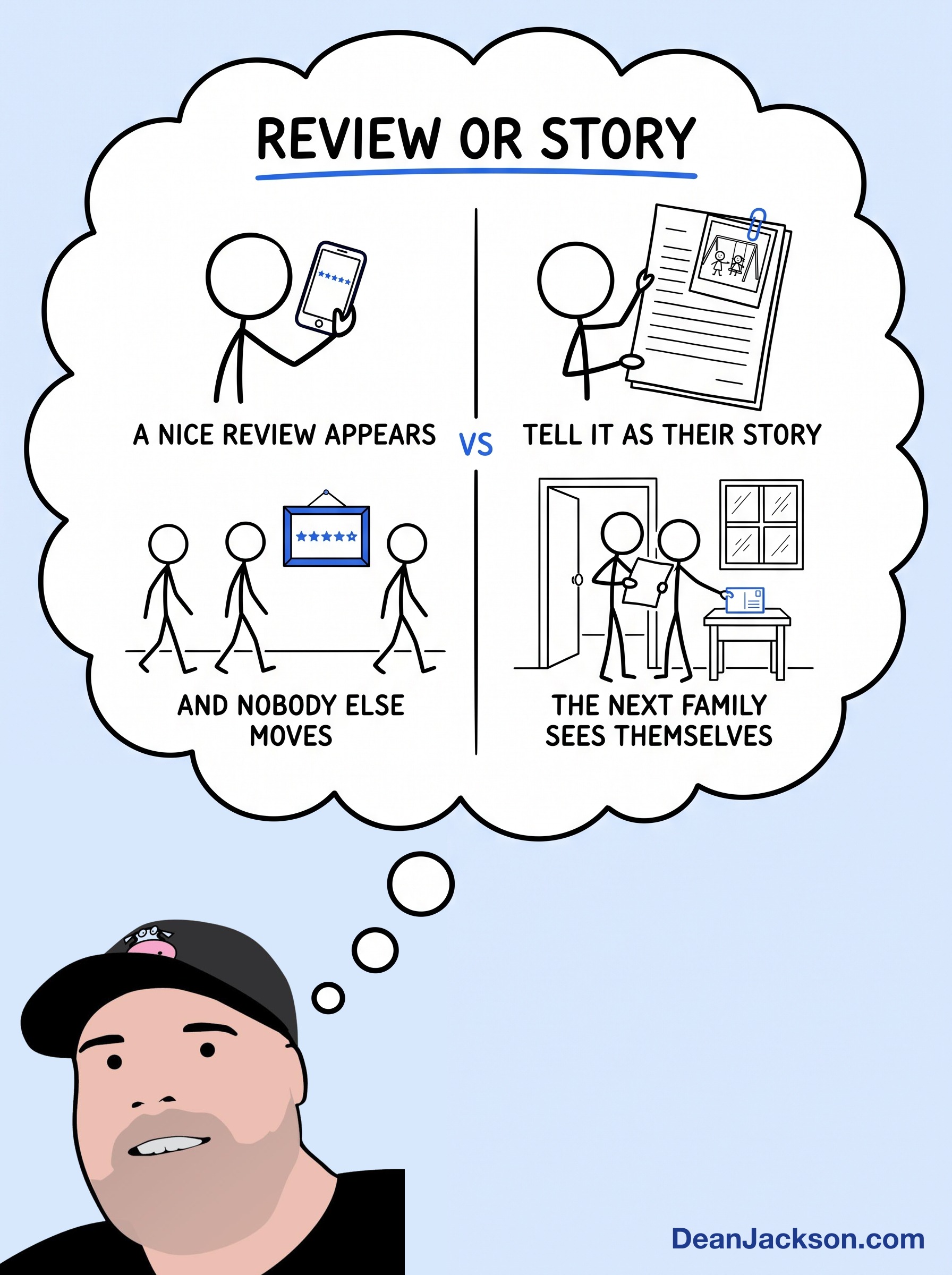
A five star review just sits there. A testimonial built as your customer's own story reaches the next person living that exact situation, and moves them.
Good morning.
I had a nice flood of memories this morning, back in journal number six.
Eben Pagan and I used to do these live main events with Joe Stumpf. Big real estate seminars, all over the country.
Every month we'd do ad makeovers, things on the fly, right there in the room.
The only reason we could do that is that we had formulas. Patterns we knew would apply to whatever situation somebody handed us.
And one of them was a format for creating testimonials that actually get you business.
Here's the thing about testimonials.
Most people think about them completely the wrong way.
You graciously accept whatever people say about you. Somebody writes a nice Google review, and you hope more of them happen, and you feel good when they do.
All of it just... happens to you.
But it can be so much more than that.
Because a testimonial, done properly, is an opportunity to help somebody who is in exactly the situation your customer used to be in.
And most people genuinely want to help. They want to spare someone a problem they went through, or show them the way to something better.
So let me walk you through the formula.
Say you helped a family move out of an apartment building and into a detached home with a yard, somewhere the kids could actually play.
First sentence is a headline. It gets attention and it sets the stage.
We'd attach a photo of the twin boys out on the swing set, and the letter would open:
"Six months ago we were living in the River Lake Apartments just like you, and I never thought we would be able to own a home."
Look at what that one sentence does. It names the exact building. And it says just like you.
Then the dilemma.
"The apartment was fine while the boys were young, but as they were growing I wanted them to have somewhere safe to play outside, in our own yard. It was always a dream of ours, but we thought it just wasn't feasible."
Now they're likable, and the dilemma belongs to the reader too.
A young couple in River Lake, three or four years in, kids getting bigger, quietly longing to own a home if only they knew they could.
They're reading their own life on that page.
Then how they came to meet you.
"We got a postcard in the mail offering a report on how to buy the bigger house you've always wanted, without all the money you thought you needed. We called and got the report, and we met Julie Matthews."
Then what changed.
"Julie showed us how we could get down payment assistance and a low interest rate mortgage, and that a house was only a couple of hundred dollars more than we were already paying in rent at River Lake. We couldn't be happier."
And then the encouragement, with the way in attached to it.
"I've put in a photo of the boys playing in the backyard. If you've been thinking about getting a yard for your kids, I'd highly recommend Julie. I've included a copy of the postcard she sent us, so you can get the report too."
That's off the top of my head. I'd refine it.
But you can see the sequence.
Headline. Dilemma. How they found you. What changed. Come and do the same.
And it isn't only for houses.
I told you about helping Don Naylor sell the last of the Muskoka home sites. Telling that story properly is how you get introduced to every other developer sitting on lots they need to move.
So the real work here is the thinking.
Who is just like this person? What were they thinking before? What are the ones coming next thinking right now?
And how do you retell the story so those people feel there's hope... that there's a way out of where they are, or a way toward what they actually want.
Testimonials are so much more than a nice Google review you hope is enough.
You can orchestrate this. You can turn every single person you help into more people you get to help.
That's one of those multiplier mindsets. Profit Activators five and six.
Here's your nudge for today.
Take the last customer you genuinely helped, and write their first sentence. Just the headline.
Name where they were, and say just like you.
Transcript
Auto-generated transcript, provided as supporting material. It may contain errors, and speaker labels are occasionally mis-attributed.
Good morning. I had a nice flood of memories this morning looking back in journal number six, 1997. One of the things that Evan Pagan and I used to do at the live main events, doing big real estate seminars with Joe Stumpf all over the country, every month we would create — we'd do ad makeovers or things on the fly. One of the ways we were able to do this is we had formulas we knew could apply to different situations, and we came up with this format for creating killer testimonials that actually get you business.
A lot of times people think about testimonials the wrong way — they're almost graciously accepting what people say about them, thinking people saying nice things or writing a Google review are all things that just happen, and you hope they happen and appreciate them, and feel good about it. But it's so much more powerful than that if you can use a formula that turns it into an opportunity to help other people just like them.
If you think about a situation, most people want to help other people — they want to help people avoid a situation that could be a problem, or move toward a situation that could improve their place in life. One I've used pretty reliably: let's say you've helped somebody move from an apartment building into a detached home with a yard and a playground for their kids. Here's how we'd apply the formula.
First, a first sentence that's a headline, that gets attention or sets the stage. In one situation, we'd attach a picture of twin boys playing in the backyard on the playground, and the letter would say: "Six months ago we were living in the River Lake Apartments just like you, and I never thought we would be able to own a home." So we've set up a headline, we've set up a dilemma.
"The apartment was fine while the boys were young, but as they were growing I wanted them to have a place outside they could play, that was safe, in our own yard. It was always a dream of ours, but we thought it just wasn't feasible." Now you've set up a dilemma, made them likable, and it's a dilemma other people in River Lake are feeling too — a young couple who started out, maybe have kids now, and as the kids grow, and they've been in the apartment three, four, five years, they're longing to own a home, if they knew they could do it. They're relating to what's happening here.
Then we go into how they came to meet you: "We got a flyer or postcard in the mail that offered a report on how to buy the bigger house you've always wanted, without all the money you thought you needed. I was intrigued when I saw the postcard, we called and got the report, and we met Julie Matthews. Julie was able to show us how we could get down payment assistance and a low interest rate mortgage, and living in a house was really only a couple hundred dollars more than what we're paying in rent right now at River Lake. We couldn't be happier."
"I attached the picture of the boys playing in the backyard, and I wanted to share this as an encouragement — if you've been thinking about getting a yard for your kids, I would highly recommend Julie, she could help you get that done. I included a copy of the postcard she sent us so you can get the report and get the house you've always wanted."
Now that's a testimony I'm just riffing off the top of my head — I'd definitely refine it, but you get the sequence: first sentence is the headline. I told you in one of the videos about how I helped Don Naylor sell the last Muskoka home sites — telling that story would be very helpful for introducing him to other developers who may be in a similar situation, who had remaining lots they needed to sell.
When you think it through — who is just like them, what were they thinking, what are the future people thinking who could do the same thing — and how could you retell the story so they feel there's hope, that there's a way to get out of the situation they're in, or move toward the situation they really want.
I was excited to see this page in my journal, and I want to encourage you: testimonials are way more than just getting a nice Google review and hoping that's enough. You can orchestrate it to turn every person you help into additional people you can help. That's one of those multiplier mindsets we talked about in Profit Activator five and six. So go for it.
I got a funny email the other day from Rick. It says, "Dean, question. Are you saying you can teach me to make fat stacks by hanging out at a pub drinking coffee like you?" And I laughed to myself, because I was thinking — you know, yes, I can do that. That's what I do. The funny thing I really realized is that every idea I've had, every dollar I've made over the last 30 years, has gone through my brain, through my pen, onto a piece of paper in my journal before it went out into the real world.
And if I can turn people on to that activity as a driver for what to do, what to think about, what to ask yourself to draw out what the next most valuable action is for you, and how to find the most profitable things you can install in your business — I'm all for it. So this Friday at 1 p.m., I'm going to do, for the first time, a 50 Minute Profit Finder workshop. And you're going to join me live on Zoom. We're going to go through a 50-minute exercise. Bring your pen, bring a notebook or piece of paper, and I'm going to guide you through a thinking process that will help you identify where the lowest-hanging fruit is in your business — and maybe some fruit you didn't even know was there, but I'm going to show you where to look for it. So it's free. It's for you. It's Friday at 1 p.m. This Friday. Just go to 50minuteprofitfinder.com and I'll get you all the details. And hopefully you can join us then, Friday at 1 p.m.
Get BreakthroughDNA Free
Discover the 8 Profit Activators that can transform your business. Get the complete framework, free.