How to Get Your Buyers to Call You Instead of Chasing Them
Watch
Listen
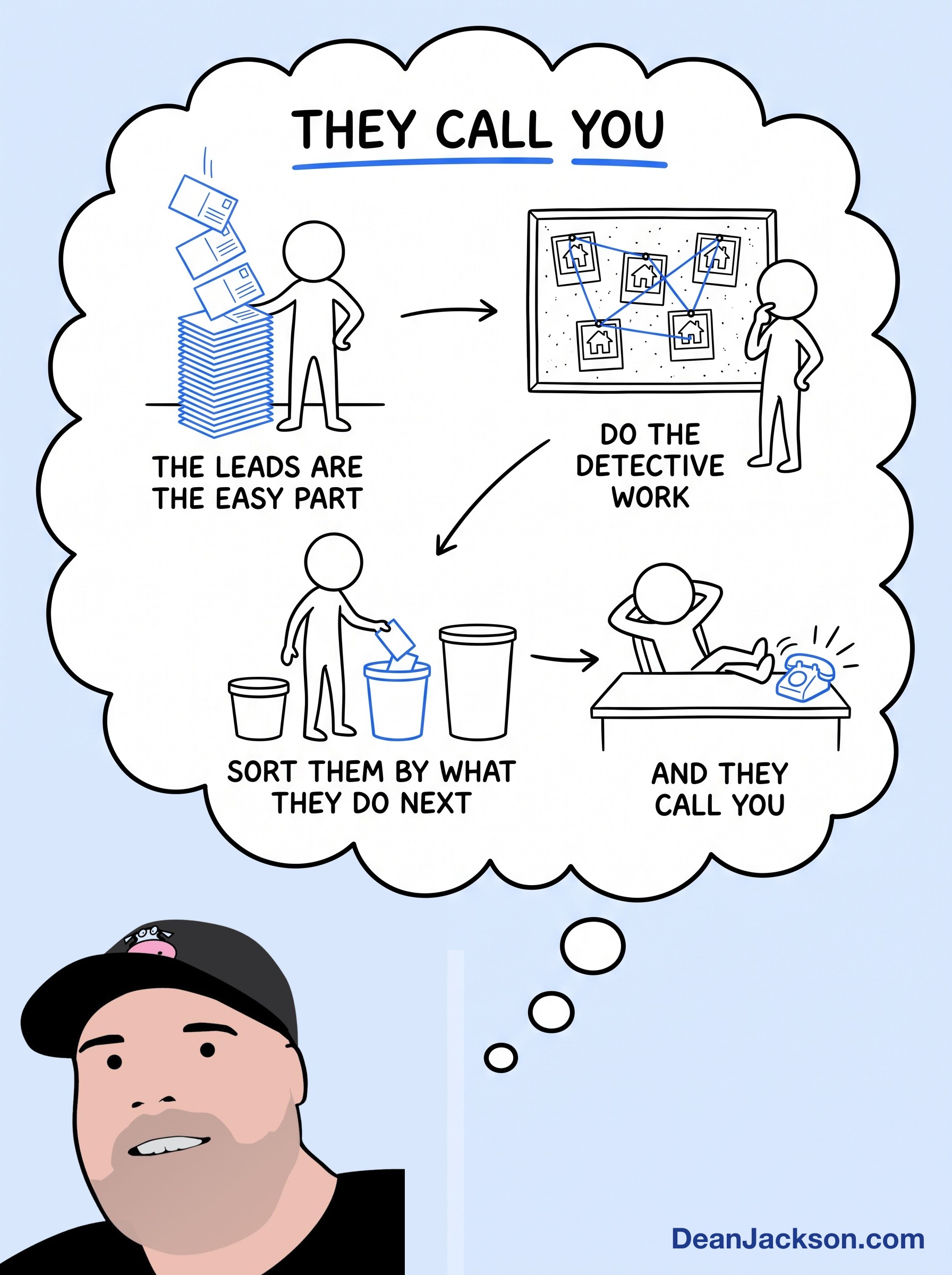
Generating leads is easy leverage. The work is the detective pass that sorts who's really moving, and a follow-up list you never take anyone off.
Good morning.
If you want to convert more leads, this is where it starts.
Here we are in journal number six, and what amazes me going through it is how much I've stacked on top of these foundations over thirty years.
But fundamentally, these pages are the core of it.
Dan Kennedy once said the person who can spend the most to get a new customer is going to be the winner.
And one of the things that lets you spend more is being able to convert more.
That's where the big opportunity is.
Back then I was starting to realize I had a hit on my hands with the seller book. How to Sell Your House for Top Dollar.
It generated leads like they were going out of style.
Here's the thing about lead generation. It's the ultimate leverage.
You just multiply. Run another ad, get more leads. Send more postcards, get more leads.
The leads aren't the problem. It takes zero extra effort to get them.
Where the effort actually lives, and where you can distinguish yourself, is converting them. That takes a human touch.
And the more you operationalize that, the more you stop thinking of it as converting leads at all.
You start thinking of it as discovering the people who were always going to buy... and then serving them so well that you'd be the only choice.
People ask me how I journal.
Always in fifty minute blocks, under a timer, so I can gather my attention in one place.
I set a guidance thought for the session and then let my mind go wherever it wants inside that.
Focused within a constraint, but with novelty to roam. That's the ADHD accommodation right there.
So, looking at these pages. This is how I built my brief for converting those leads.
It's labeled the follow-up system for the seller's guide, but it could just as easily be the follow-up system for the stop your panic attacks book.
It starts with questions.
How can I get more of the people who expressed interest in selling to want to meet me?
Notice that's the next step, not the final destination.
People ask how do I get them to buy, how do I get them to pay me. But it's a series of incremental steps, and if you focus on the next one, the one after it gets easier.
Newton's law. An object in motion stays in motion.
Once people are moving toward you, everything else kicks in. Reciprocity. Commitment and consistency. Liking you. Social proof.
Next question. What messages do I want to keep expressing to them?
This is where the research earns its keep. Think from their point of view. If you were them, what would you want to know?
Then, how long should I keep contacting these people before I take them off my list?
My answer is never.
I was guessing back then. Now I have the evidence.
Everybody who has raised their hand is an asset that yields revenue every year, and grows in value.
People come out of the blue after ten years and buy for the first time.
In our case study with Tony Kelsey on the getting listings program, we mailed postcards into one neighborhood for ten years. Over four and a half million dollars in commissions out of that neighborhood.
And we tracked when people first responded against when they actually listed.
In the tenth year, somebody who had answered the very first postcard we ever mailed, and had a newsletter every month for ten years, listed and sold their house with Tony.
As long as they're active, opening, clicking, showing signs of life, keep the relationship going.
Then my favorite question of the whole page.
How can I get them to call me, instead of me calling them?
Here's the provocation I use. What would I do if my phone only accepted incoming calls?
That forces you to work out how to show up and provide value without chasing anybody.
This isn't about pouncing on people and getting them to do what you want. It's about knowing and serving them so well you're almost unbothered.
So I listed all the questions. And on the next page, I listed the facts.
They called for a guide to selling their house for top dollar. I didn't force that. They saw an ad, decided to go to a website, entered their name, left their details after a recorded message.
They volunteered. At some level, they're interested in selling.
And I have their name, address and telephone number.
Now you start thinking like a detective. What can I learn from what I already hold?
A picture of the house. What kind of house it is. The transfer information. How long they've lived there. What it's worth.
There was no Zillow then. Now it's the first thing we do.
And the data enhancement available today, from just a name and an email, is genuinely crazy. Four hundred data points to build a picture of who this person is.
It's those detective shows with the bulletin board, the photographs and the red string running between them.
Josh and I were talking about lead generation for people who build decks. You get a name and an address, you take a satellite view of the backyard, you see the value of the house and how long they've owned it, and you can approximate their equity.
Then you sort people into likelihood buckets.
Some aren't selling in the next six to twelve months. That's probably half of them. Maybe seventy percent if you take the full year. And that's fine.
Some are. Some are buying another home locally, some aren't, some are leaving the area altogether.
On that page I circled my best client. Selling in the next six to twelve months, and buying another home right here in Polk County.
Which is also why I love transitional real estate like townhomes. First-time buyers moving in don't have a house to sell first, and people already in a townhome aren't likely to buy a detached home next.
That triangulation is a beautiful thing.
Understand all the possible paths, sort people onto one of them, and you can customize the follow-up to the path they're actually on.
That was thirty years ago.
Today we do exactly the same thing with scorecards and profiles and assessments.
Somebody downloads the book on stopping panic attacks, and we invite them to take a panic profile. Questions that sort them from the very beginning stages all the way to severe.
Because you talk very differently to someone with severe panic than to someone who just had their first one and has no idea what to expect.
That detective work, inquiring, finding out what people actually need, is the real foundation of converting as many leads as you possibly can.
Here's your nudge for today.
Take the last twenty people who raised their hand, and write down everything you could find out about them without asking.
Then write the one thing you'd still need to ask.
Transcript
Auto-generated transcript, provided as supporting material. It may contain errors, and speaker labels are occasionally mis-attributed.
Good morning. If you want to convert more leads, this is where it starts. Here we are, journal number six, 1997. I'm going through and what's amazing to me is seeing how I've stacked on top of these foundational things over the last 30 years, but fundamentally these are the core of it. Dan Kennedy once said the person who can spend the most to get a new customer is going to be the winner. One of the things that lets you spend more is being able to convert more — that's where the big opportunity is.
I was starting to realize I had a hit on my hands with the seller book, "How to Sell Your House for Top Dollar." It generated leads like they were going out of style. The great thing about lead generation is it's the ultimate leverage — you literally just multiply, run another ad, get more leads, send more postcards, get more leads. The leads aren't the problem, it takes zero more effort to get them. Where the effort is, and where you can distinguish yourself, is in converting those leads — that takes human touch. The more you operationalize that, the more you can stop thinking about it as "converting more leads" and start thinking about it as discovering the people who are actually going to buy, and then serving them so you'd be the only choice.
People have asked how I journal — I always do it in 50-minute blocks, under a timer, so I can focus my attention, but I just set a guidance thought for the period and let my mind go, because that satisfies my need for novelty as someone with ADHD. Focused within a constraint, but with novelty to go wherever inside it.
Looking at these pages — this is how I'd build my brief for converting these leads. It's labeled "the follow-up system for the seller's guide," but it could just as easily be the follow-up system for the Stop Your Panic Attacks book leads. It starts with questions like: how can I get more people who express interest in selling their house to want to meet me? If you focus on the next step, not the final destination — a lot of people ask "how do I get people to buy my stuff" or "pay me" — but it's a series of incremental steps, and if you focus on the next one, it makes the following step easier. Newton's law — an object in motion stays in motion. Once you get people moving forward, reciprocity, commitment and consistency, liking you, social proof — all of it kicks in.
So: how can I get more people to express interest in meeting you? What messages do I want to continually express to them? This is where doing the research helps guide what you say — think from their perspective, their point of view. If you were them, what would you want to know? How often should I continue to mail or contact these people until I take them off my list? For me, the answer is never. I've got the evidence now — I was guessing back then, but now I look at everyone who's raised their hand as an asset yielding revenue every year, growing in value.
I have people who, after 10 years, come out of the blue and buy for the first time. In our case study with Tony Kelsey on the getting-listings program, at the 10-year mark, one of the most elegant things happened: we mailed postcards into a neighborhood for 10 years, made over four and a half million dollars in commissions from that neighborhood over that time, and we tracked when people first responded versus when they actually listed and sold. In the 10th year, somebody who responded to the very first postcard we mailed 10 years earlier, and had gotten newsletters and updates every month for 10 years, listed and sold their house with Tony. As long as they're active prospects — opening emails, clicking, still showing signs of life — keep the relationship going.
My other question was always: how can I get them to call me instead of me calling them? One of my favorite provocations: what would I do if my phone only accepted incoming calls? That forces you to think about how to show and provide value for people without chasing them. This isn't about pouncing on them and getting them to do what you want — it's about knowing and serving people so well that you're almost unbothered.
So I'd list all those questions. Then on the next page I started listing the facts — what are the facts of this situation? Fact one: they called for a guide to selling their house for top dollar. I didn't force them — they voluntarily saw an ad, made a decision to go to a website, voluntarily entered their name and email, or called and left their contact info after a recorded message. They volunteered. At some level they have an interest in selling their house.
Fact two: I have their name, address, and telephone number. Now you start thinking like a detective — what information can I get from what I already have? I could get a picture of the house, see what kind of house it is, look at the transfer information, see how long they've lived there, how much it's worth. There was no Zillow back then, but now that's one of the first things we do — look it up on Zillow, how long they've lived there, how much it's worth, the history. The data-enhancement options available now, for just a name and email, are crazy — you can get 400 different data points to build a full picture of who this person is. It's like those detective shows with the bulletin board, pictures, and red string connecting facts.
Then I ask myself: what do I want to know that I can't gather just from a bit of diligence? Josh and I were talking about lead generation for people looking to build decks — you get a name and email, the address, you can do a Google satellite view and see what's going on in their backyard, the value of the house, how long they've owned it, approximate their equity. You can sort people into high-likelihood buckets: are they selling, are they going to be buying another house, what are they looking for?
I started listing all the possible options for what this person could be. One option: they're not going to sell in the next six to twelve months — that's probably half the people, maybe 70% if you take a full 12 months. That's okay. But some might sell in the next six to twelve months — some buying another home locally, some not buying, some moving out of the area. I circled: my best client is selling in the next six to twelve months and buying another home in Polk County — thinking Winter Haven here.
Strategically selecting who you generate leads with matters — that's why I love transitional real estate like townhomes: first-time buyers moving in don't have to sell a house first, and people already in townhomes aren't likely to be buying detached homes next. That triangulation is great. Understanding all the possible paths and sorting people into one of them lets you customize your follow-up.
That was 1997. Now, in 2026, we do this with scorecards, profiles, or assessments — inviting someone who downloaded a book on stopping panic attacks to take a "panic profile," asking questions to understand their type of panic and sort them — from the beginning stages all the way to severe — so we communicate differently to someone with severe panic than to someone who just had their first panic attack and doesn't know what to expect.
Doing that detective work — inquiring, finding out what people actually need — that's the real foundation of converting as many leads as you possibly can.
I got a funny email the other day from Rick. It says, "Dean, question. Are you saying you can teach me to make fat stacks by hanging out at a pub drinking coffee like you?" And I laughed to myself, because I was thinking — you know, yes, I can do that. That's what I do. The funny thing I really realized is that every idea I've had, every dollar I've made over the last 30 years, has gone through my brain, through my pen, onto a piece of paper in my journal before it went out into the real world.
And if I can turn people on to that activity as a driver for what to do, what to think about, what to ask yourself to draw out what the next most valuable action is for you, and how to find the most profitable things you can install in your business — I'm all for it. So this Friday at 1 p.m., I'm going to do, for the first time, a 50 Minute Profit Finder workshop. And you're going to join me live on Zoom. We're going to go through a 50-minute exercise. Bring your pen, bring a notebook or piece of paper, and I'm going to guide you through a thinking process that will help you identify where the lowest-hanging fruit is in your business — and maybe some fruit you didn't even know was there, but I'm going to show you where to look for it. So it's free. It's for you. It's Friday at 1 p.m. This Friday. Just go to 50minuteprofitfinder.com and I'll get you all the details. And hopefully you can join us then, Friday at 1 p.m.
Get BreakthroughDNA Free
Discover the 8 Profit Activators that can transform your business. Get the complete framework, free.