How I Funnel Hacked "The Greatest Show On Earth"
Watch
Listen
I wrote a parable about the circus in 1997. Seven marketing lessons from the greatest show on earth, starting with a free parade at eleven every day.
Good morning.
Have you ever been to the circus?
Me neither. But I've been to the next best thing.
Somewhere around early June of 1997 I went to the Ringling Museum in Sarasota. The Ringling Brothers Museum.
It's an amazing old mansion right on the water. Historic, grand, very Florida. Super inspiring.
We went on the tour.
Now, the big thing in books at that moment were parables. Raving Fans. Who Moved My Cheese. Short books that made their point as a story.
And as I walked around that museum I started imagining one.
A guy comes to Sarasota for an accounting conference. He sold the trip to his wife as a working vacation, so now she's dragging him around a museum.
He's an accountant. Efficient, black and white, nuts and bolts. Does this make sense, yes or no.
He slips off to the side to take a phone call, into one of the barns where they keep the old circus equipment. And there's a mirror.
A ringmaster steps out. Dressed the part, the whole thing.
They get talking, and the accountant admits the obvious. His wife thinks this is wonderful. He thinks it's folly. He can't see the point of any of it.
So the ringmaster tells him that if you look behind the scenes, the circus is actually an extraordinary business.
And he walks him through the magic mirror, back into the height of the circus days, to show him.
I listed seven lessons from the greatest show on earth.
Number one. A free parade, daily, eleven in the morning, rain or shine.
When the circus came to town they paraded everything straight through the streets. Lions, tigers, bears, trapeze artists, all of it in open cages.
A miniature sample of everything you'd get to see. And people simply followed it to the fairground.
That's content marketing. Which is funny, because these videos go out every day at eleven in the morning.
Free parade daily. Take that however you like.
Number two. See the sideshow for ten cents more.
General admission was one low price. A quarter, maybe twenty cents.
But the sideshows were deliberately cloaked in tents, and the barkers stood outside telling you exactly what was behind the flap. The bearded lady. The fat man. The two-headed girl.
Curiosity did the rest. That's an upsell, and they were running them a hundred years ago.
Number three. Reserved seating, five cents more.
Upgrade out of general admission into the good seats in the big top. A better experience for anyone who wanted one, made very easy to say yes to.
Number four. The greatest show on earth.
In my parable this is where the accountant gets it wrong. Why three elephants when two would do? Why all this when less would serve?
He's trying to put on the same show for less money.
But they promised people the greatest show on earth. That promise means extravagance. Things you will genuinely never see anywhere else.
The modern version is Cirque du Soleil. What happens when you mix unbridled creativity with an unlimited budget.
It's the Procter and Gamble lesson again. Build the very best product, judged from the customer's side.
Number five. The show must go on.
A live performance cannot rest on one superstar. Whatever happens, the show still has to happen, so there is always somebody ready to step into any role.
In your business, if one person going down takes the whole thing down, that's the lesson.
Number six. Keep the wheels greased.
The circus moved city to city by railroad, assembling and dismantling everything in a tiny window.
And while the show was running out front, every bit of maintenance was happening behind it. Repairing, oiling, keeping the system able to move again tomorrow.
Entrepreneurs get so busy doing the show that the maintenance stops. Then something breaks, all your attention has to go there, and the show goes down with it.
Number seven. All new, never seen before.
The whole model depended on coming back to the same town next year. So there had to be something new every time, or people had already seen it.
Reading that page back, I hadn't thought about it in a very long time.
I'm going to see if I can dig out the whole terrible little book I wrote, because I was quite proud of how it came out.
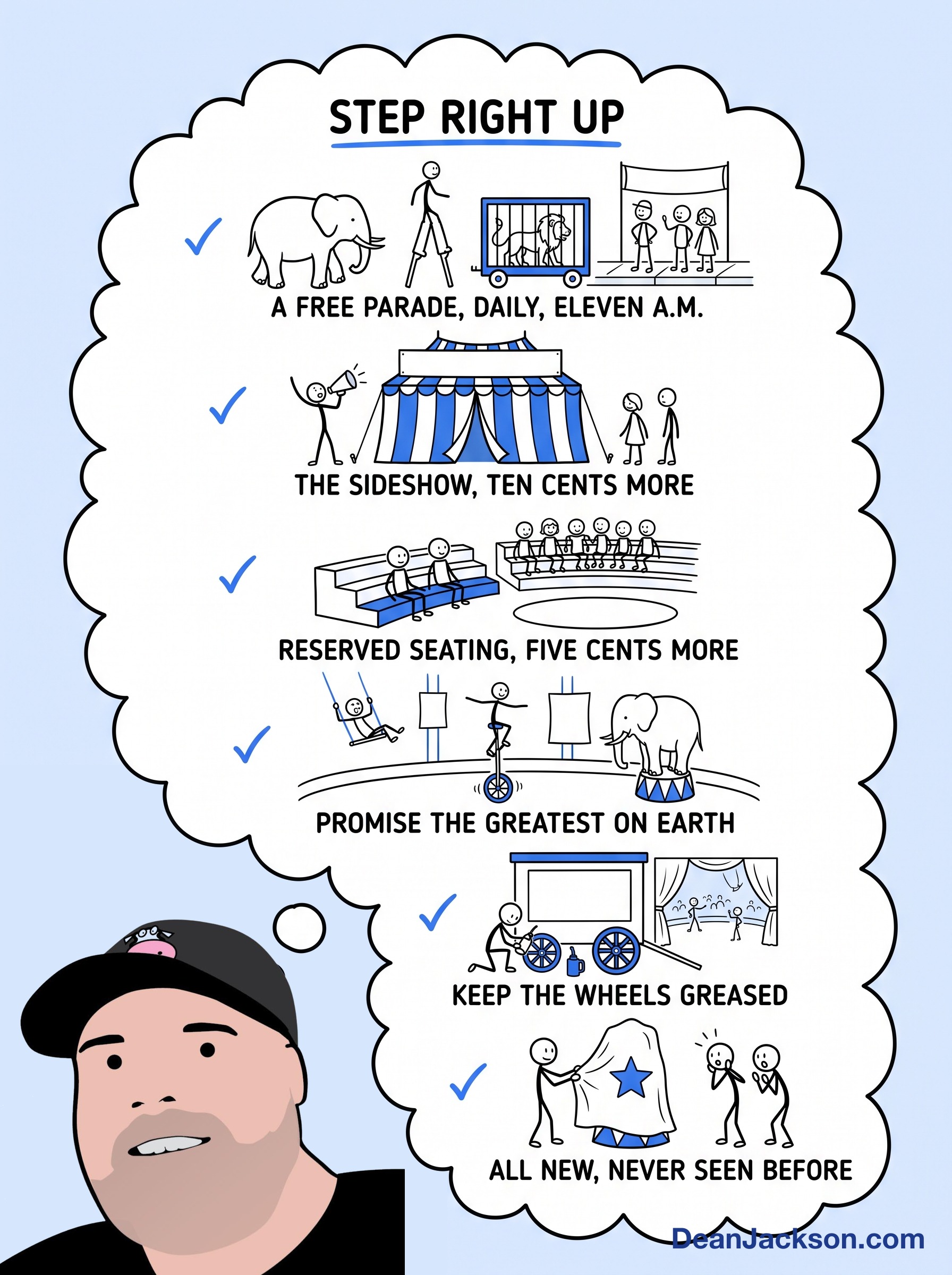
I called it Step Right Up. Seven Marketing Lessons From The Greatest Show On Earth.
A free parade every day at eleven. The sideshow for ten cents more. Reserved seating for five cents more. The greatest show on earth. The show must go on. Keep the wheels greased. All new, never seen before.
You could apply those to any business and feel it immediately.
Here's your nudge for today.
Pick the one of those seven your business does worst.
Then work out what your version of it would look like on a Tuesday.
Transcript
Auto-generated transcript, provided as supporting material. It may contain errors, and speaker labels are occasionally mis-attributed.
Good morning. Have you ever been to the circus? Me neither. But I've been to the next best thing. I went — sometime in early June-ish 1997 — to the Ringling Museum in Sarasota, the Ringling Brothers Museum. It's this amazing old mansion right on the water, this historic, grand Florida thing. Super inspiring. We went on the tour.
One of the things that was really popular at that time were these parable books — like Raving Fans, Who Moved My Cheese — short books told as parables. As I was going through the museum, being inspired by what I was seeing, I imagined this parable: a guy comes to the Ringling Museum in Sarasota for an accounting conference, and his wife drags him to the museum because he sold it to her as "we can go to the conference and it'll be a vacation, I'll still get away for us." So she drags him out.
He's an accountant — very efficient, black and white, nuts and bolts, "does this efficiently make sense" kind of guy. Off to the side, in a barn-type dock where they store all the old circus equipment, he sees a mirror, and a guy comes out — an imaginary ringmaster, dressed the part. The ringmaster strikes up a conversation. The accountant admits he just stepped out to take a phone call — his wife thinks this is fun, but he doesn't see the point of it, it seems like folly.
The ringmaster explains: if you look behind the scenes, the circus is actually an amazing business. He takes the accountant into the magic mirror, back to the height of circus days, and walks him through the lessons directly applicable from the circus. I listed seven lessons from The Greatest Show on Earth.
Number one: a free parade, daily, 11 a.m., rain or shine. When the circus came to town, they'd parade all the animals and performers through town in open cages — lions, tigers, bears, trapeze artists — a miniature sample of everything you'd get to see, right through the streets at 11 a.m. People would follow to the fairgrounds. It drew people in. Translated to now, that's like content marketing — ironically, we launch these videos every day at 11 a.m. Free parade daily. Take that with what you will.
Then, once you got there — general admission was one low price, 20 or 25 cents. But lesson two: you could see the sideshow for 10 cents more. Upsells — they were doing upsells at the circus. Instead of showing everything, the sideshows were cloaked in tents, and barkers would tell you what you could see inside — the bearded lady, the fat man, the two-headed girl — and out of curiosity, people would pay the extra fee.
Number three: reserved seating for five cents more. Upgrade from general admission to reserved seating with better seats in the big top, a VIP experience. So much relevance right there — reserved seating, or a special upgrade, making it easy for people to get on board.
Number four: the greatest show on earth. In the fable, the accountant is looking at it inefficiently — why three elephants when two would do, why so much of this when that could suffice — trying to put on the same show for less money. But the ringmaster explains: they promise people the greatest show on earth. That means extravagance — things people will never see anywhere else. The modern equivalent is something like Cirque du Soleil — what happens when you mix unbridled creativity with an unlimited budget. Nothing else like it. This ties to the Procter & Gamble lesson we've talked about: build the very best product from the customer's perspective.
Number five: the show must go on. A live performance can't depend on one superstar — if anything happens, the show still has to happen. They always have people at the ready who can step in and do what any performer does. Translated to business: if one person going down could take the whole business down, you need that redundancy.
Number six: keep the wheels greased. The circus moved city to city by railroad, assembling and disassembling everything in a very short window. While the show was going on, all the maintenance was happening behind the scenes — repairing, keeping the system running, keeping the wheels greased. Entrepreneurs sometimes get so busy doing the show that they neglect the maintenance and the systems — and when something breaks, all their attention has to go there and the show goes down.
Number seven: all new, never seen before. The circus built itself on coming back to the same town next year, so it had to continually create something new so people would keep coming back to see value, instead of the same old thing.
Reading this, I hadn't thought about it in a long time — I'm going to see if I can find the whole terrible little book I wrote, because I was pretty proud of how it turned out. I called it "Step Right Up: Seven Marketing Lessons From The Greatest Show On Earth."
One: free parade daily, 11 a.m., rain or shine. Two: see the sideshow for 10 cents more. Three: reserved seating, five cents more. Four: the greatest show on earth. Five: the show must go on. Six: keep the wheels greased. Seven: all new, never seen before. I think you could apply those to any business and have an immediate impact.
Every idea that I've had, every dollar that I've made over the last 30 years, has gone through my brain, through my pen, onto a piece of paper in my journal before it went out into the real world. And if I can turn people on to that activity as a driver for what to do, what to think about, what to ask yourself to draw out what the next most valuable action is for you, and how to find the most profitable things you can install in your business — I'm all for it. So this Friday at 1 p.m., I'm going to do, for the first time, a 50 Minute Profit Finder workshop. And you're going to join me live on Zoom. We're going to go through a 50-minute exercise. Bring your pen, bring a notebook or piece of paper, and I'm going to guide you through a thinking process that will help you identify where the lowest-hanging fruit is in your business — and maybe some fruit you didn't even know was there, but I'm going to show you where to look for it. So it's free. It's for you. It's Friday at 1 p.m. This Friday. Just go to 50minuteprofitfinder.com and I'll get you all the details. And hopefully you can join us then, Friday at 1 p.m.
Get BreakthroughDNA Free
Discover the 8 Profit Activators that can transform your business. Get the complete framework, free.