How to quickly get anything started (and done)
Watch
Listen
Seven checkpoints from my 1997 journals for getting anything started and done, from starting on time to knowing when 80% is good enough.
Good morning.
We're back in the journals. Journal number seven, late fall of 1997.
And I noticed something on these pages.
I was building a process for getting things started... and getting them done.
I didn't know it then, but that was my ADHD. I always had the inkling I was different. Why do I struggle so much with things?
But I'm very thoughtful. I love to think things through. That's why I'm a journaler.
So I started working out a process that works for me.
Seven checkpoints.
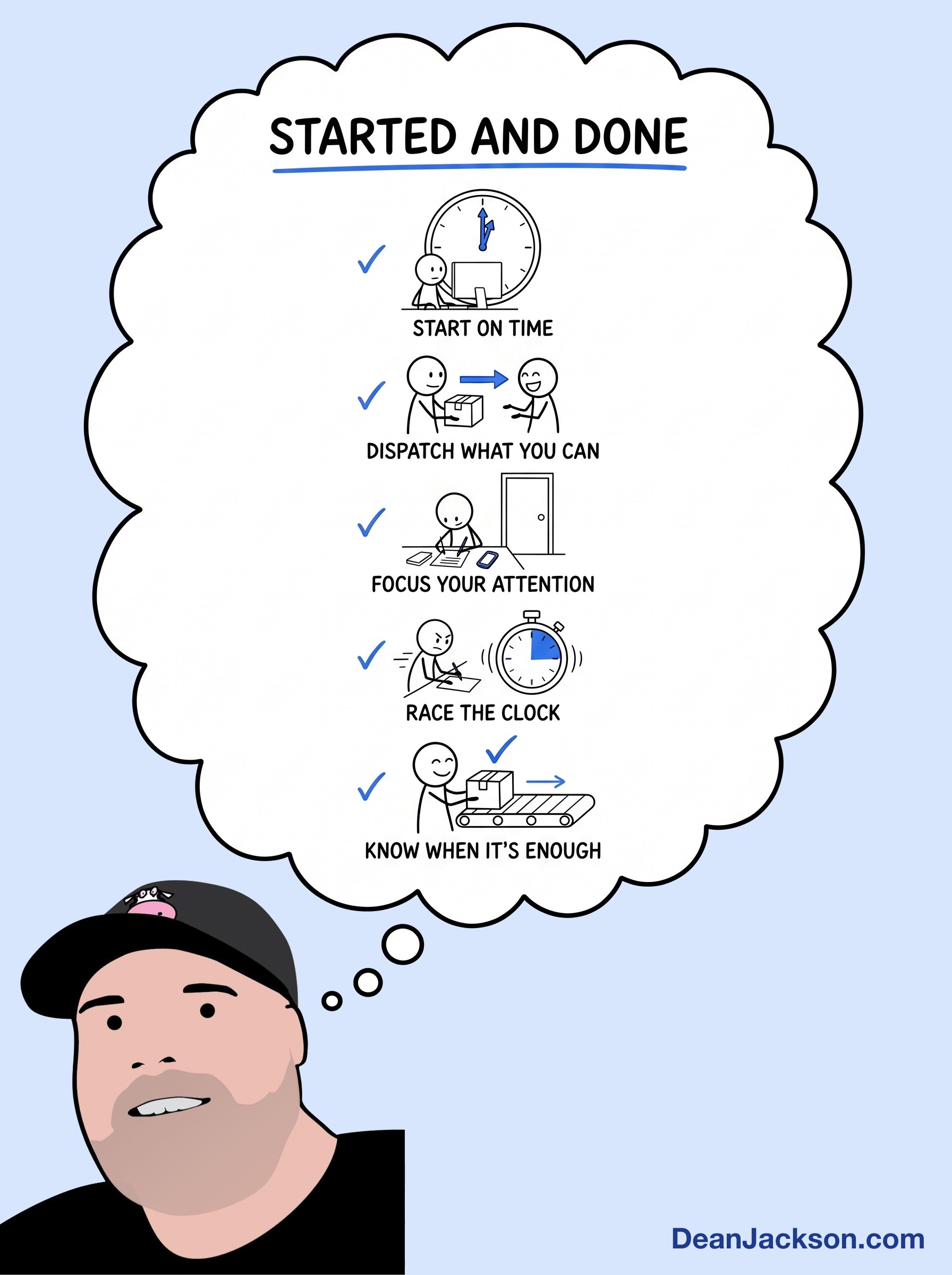
The first is a commitment to getting started on time.
So much of the struggle is "where do I start?"
For me, setting up the environment and setting the time aside is the first step.
I just saw a video with Jerry Seinfeld. When he figured out that everything was about the writing, he committed to two hours a day.
He doesn't have to write. But he can't do anything else.
For me, that's 10am. I'm in position.
The second is deciding what I'm going to focus on in that time.
Being there and prepared means all I have left to do is decide.
The third is dispatching whatever you can.
Dan Sullivan's first question is, "Is there any way I can get this done without doing anything?"
If not, what's the least I need to do? And is there a who that can do my least?
The fourth is focusing my attention.
Eliminating distractions. Putting myself somewhere I have the best chance of working on what I decided, for the time I set aside.
That was the beginning of what became my 50-Minute Focus Finder.
The fifth is having a method.
If you're going to do something again and again, have a procedure for it.
When I write a sales letter, an email, a postcard or an ad, I've got formulas and frameworks. I break it into its components and work on them one at a time.
The sixth is speed of implementation.
With ADHD, what drives us is novelty and urgency. That's why we wait till the last minute.
But you can bring that urgency to the beginning of a project, even if it isn't real.
I set a timer and try to get something done before the buzzer.
The seventh is knowing when it's enough.
I'm a big fan of the minimum viable product.
Dan Sullivan wrote a great book called The 80% Approach. Most of the time, 80% is good enough... and the extra work for the last 20% isn't worth the squeeze.
These videos follow exactly this process.
They go up every day, so I shoot every day.
The journal prompts what I'm going to talk about.
The only thing I'm responsible for is looking at the camera and talking. The team handles everything else.
We do it in an 8 to 12 minute window. One take, no editing.
Could it be better? Could we script it, add graphics, edit it, punch cut?
Absolutely.
But it's not going to make the boat go faster.
What matters is getting it completed and getting it out into the world.
105 days in a row and counting.
So pick one thing... set the clock... and get it started today.
Join me live on the next free 50-Minute Profit Finder call, Friday, October 9 at 1:00pm ET. Save your spot →
Transcript
Auto-generated transcript, provided as supporting material. It may contain errors, and speaker labels are occasionally mis-attributed.
Okay. Good morning. We're back into the journals. We're in journal number seven. It's late fall by now, 1997. And one of the things that I noticed here was me creating a process that. For getting things started and done. That's why, you know, I thought this is a really great way to talk about how to quickly get something started and done. And I had a real process. I would always think I had the inkling, of course, that I was different than the other boys in that I didn't. That was my ADHD before I knew what it was. I just. Why do I struggle so much with things?
But. But I'm very thoughtful. I love to think things through. And that's why I'm a journaler, because I put things in here. And it's great to see the beginnings of the system that I had to put in place to actually get things started. So I started deducing through these things a process that works for me. And I'm going to give you the seven kind of levels, seven checklist points, if you will. So the first thing was, is making a commitment to getting started on time. And so if I know that I'm going to do something and it's going to take some number, some amount of time, even if I can't kind of, you know, if maybe it's not just ADHD, but sometimes people get.
Where do I start? And so for me, setting up the environment and setting the time aside is the first step. If I make a commitment that I'm going to start at this time and get in the position. I just saw a video with Jerry Seinfeld where when he figured out that everything was about writing, he made a commitment to be there, to set aside two hours a day to write and. And be there where he's going to do the writing, get started on time, and he doesn't have to write, but he can't do anything else. And so I started thinking that through, right, of making a commitment to block off the time and then being in the position of where you're going to get things done.
And I think tomorrow I'll show you the position of where. But make that the first step is just practice getting started on time. So for me, that's 10am and so I'm in the position. And that immediately leads to the next trouble that often happens, deciding what I'm going to focus on when I'm in that time. But being there and prepared, at least now I know that I just need to decide what I'm going to do at, at any given time. And then when making that decision of what needs to be done, what, what do I have to do is. Number three is the ability to delegate.
And I call it dispatching. Dispatching whatever you can. Uh, Dan Sullivan and I talk about this a lot, but his, his process, his question loop is, is there any way that I can get this done without doing anything? That's his first thought. So after I've decided what it is that I want to do, that's the first question. Is there any way I could just. That I don't have to do this or that somebody else could do it? That would be great. And then if it's not, then we think through what is the least amount that I need to do to get something done. And then is there a who that can do my least?
So the ability to know what you want and then decide whether it's something that you can dispatch, whether you can delegate, or whether it's something that you're going to have to do. That all comes after deciding. Number four is after we've started on time, we decided what it is that we're going to do. We've determined that I'm the only one that can do it. Now we, I need to be able to focus my attention and this is the beginning of what became my 50 minute focus finder, which we'll find in journals going forward here. But the ability to kind of eliminate distractions, to put myself in an environment where I have the best chance of being able to work on what I've decided that I'm going to work on for the time that I've set aside to do it.
And that's a very useful skill if you're going to get things started and get them done. Then number five is to have a method for working on projects if you're doing something. If we're like looking at ways that if you're going to be doing something again and again, that you have a procedure for it, right? A method of doing it. So if I'm writing a sales letter or I'm writing an email or a postcard or an ad, I've got formulas and frameworks step by step that I can break it down into the components that need to be done and work on those one at a time.
And I've shared some of those and there'll be way more of them coming in the future. Then number six is speed of implementation, doing things quickly and to a ticking clock. I mentioned that, you know, if you have ADHD like I do that. Part of our, part of what drives us is novelty and urgency, right? So working on something new or something in a new way and having a deadline. That's why we often wait till the last minute to get something done. Because that urgency of it having to be done at the end of the, at the end of the time that if we can bring that level of urgency into something at the beginning of a project, even if it's not real.
The skill of being able to create that urgency by just setting a ticking clock. That's something that I often do is look at. I set a timer and I'm trying to get something done before the buzzer and I think that will really help you too. And then the ability to finish something is to know when it's enough. I'm a big fan of the minimum viable product for something so that I know that it's got all of the pieces. Or Dan Sullivan wrote a great book called the 80% approach and based on the 80/20 principle that sometimes 80% is usually good enough for something and that the extra work to get the extra 20% is something that is often not worth the squeeze.
The. It would take way more time to do something to get that just little bit more benefit. I look at these videos that this is exactly following this process. You know, I follow this to get the thing I decide I'm gonna set up on time. We've got a deadline. These go up every day. So I have to shoot video every day. I decide what am I going to write about. This is the tool that prompts that up for me. The ability to delegate. The only thing that I am responsible for doing here is this looking at the camera and talking. But I can't be the one that's responsible for uploading this to YouTube and setting up all the.
The mechanics of things that do it. So we set up all whole scaffolding and teamwork to so that all I have to do is share this with you. The ability to focus my attention and when I'm working on one thing I'm able to get that done. A method for working on projects. I've got a method that I look at the journal that prompts the idea, we turn on the camera and I talk. That's a method speed of implementation. We have to do it in a 8 minute to 12 minute kind of window there. And the ability to finish something. This we always take the 80% approach.
Like I think all of the value of what I'm sharing here with you is. Can be done like this in one take with no editing. Now, could it be better? Could we take this and then create a script for it and create, you know, graphics and edit it, punch cut and do all of the things to get it better? Absolutely. But it's not going to make the boat go faster. The essence of what I'm conveying here is getting it completed and getting it out into the world 105 days in a row and counting.
Every idea that I've had, every dollar that I've made over the last 30 years has gone through my brain, through my pen, onto a piece of paper in my journal before it went out into the real world. And if I can turn people onto that activity as a driver for what to do, what to think about, what to ask yourself to draw out, what the next most valuable action is for you and how to find the most profitable things that you can install in your business, I'm all for it.
So this Friday at 1pm, I'm going to do for the first time a 50 minute profit finder workshop. And you're going to join me live on Zoom. And we're going to go through a 50 minute exercise. Bring your pen, bring a notebook or piece of paper and I'm going to guide you through a thinking process that will help you identify where the lowest hanging fruit is in your business and maybe some fruit that you didn't even know was there.
But I'm going to show you where to look for it. So it's free. It's for you. It's Friday. At 1pm this Friday. Just watch.
Just go to 50minuteprofitfinder.com and I'll get you all the details and hopefully you can join us then. Friday 1:00pm.
Get BreakthroughDNA Free
Discover the 8 Profit Activators that can transform your business. Get the complete framework, free.