Leads Maxxing: More leads. Sooner. For Less.
Watch
Listen
Most people fight over the 3% who are buying right now. Leads maxxing means going upstream, catching people the moment they first start thinking.
Welcome back to maxxing week.
So far we picked the target market with the best ROI.
Today it's leads maxxing.
How to win at getting leads. Which is the most valuable part of the whole equation.
Solve this part and you've got a smooth path through everything else.
Here's where most people go astray.
They put 100% of their attention on in market leads.
The 3% who are ready to buy something right now.
And when you only chase those people, you pay a premium.
Because everybody else is competing for exactly the same 3%.
So you pay the most money and you've got the most competition. Everyone screaming the same message.
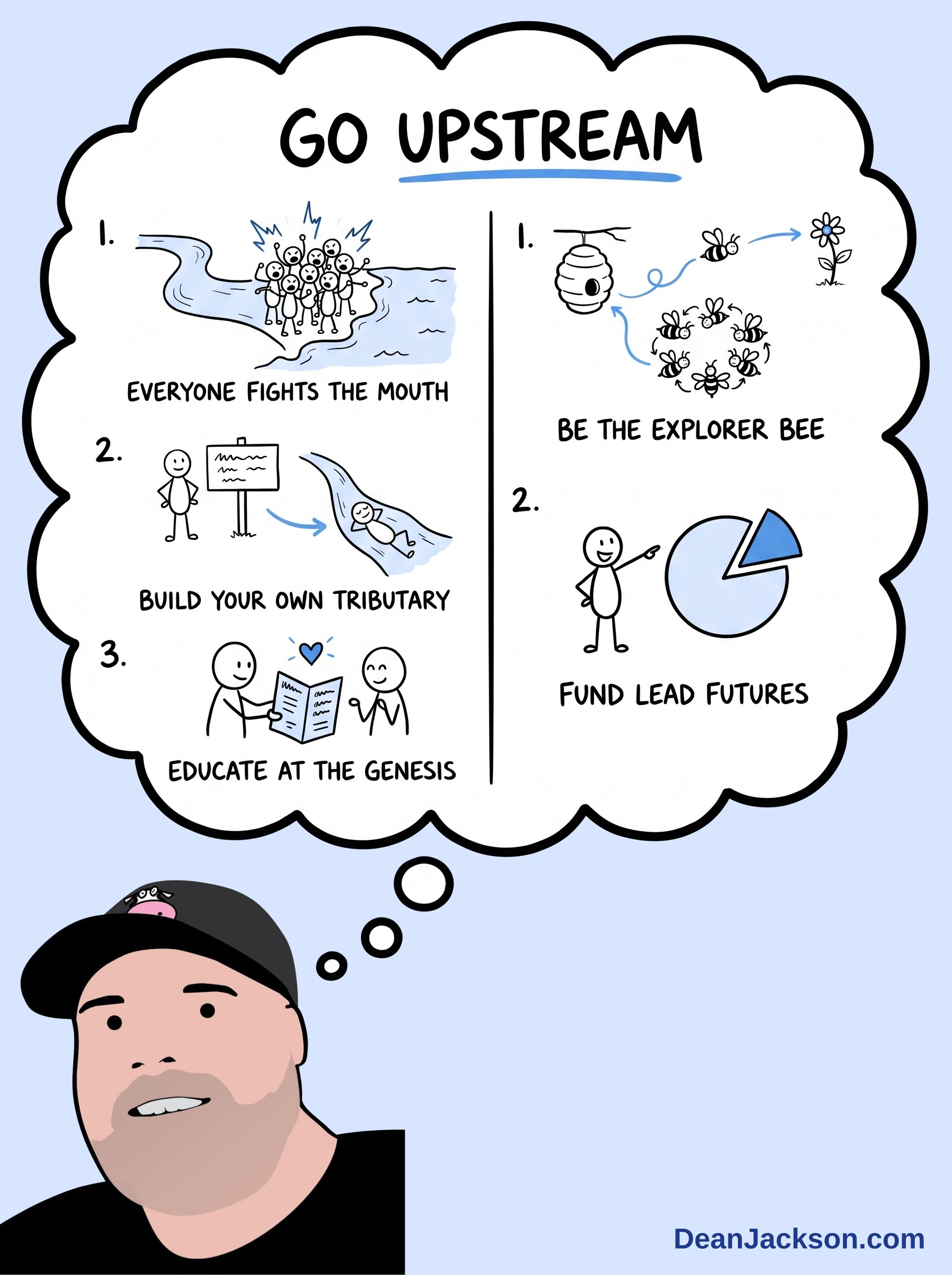
Picture the market as a river.
A meandering river making its way down to the mouth of the ocean.
The mouth is in market. That's where people are ready. New roof, new kitchen, buying a house.
And that's the most crowded part of the whole river.
All your competitors are standing there at the base, shouting over each other.
There's a much better approach.
Go upstream.
Up where people first get in the stream. There's far less competition up there.
Imagine you built your own little side tributary.
And you put an arrow and a sign that says if you're thinking about a new kitchen, go this way.
And people just... drift off down your private tributary.
Meandering down to a quiet cove where nobody else is paying attention.
Let me give you a couple of examples.
The party rental company. We talked about them before.
The highest ROI audience wasn't just anybody. It was outdoor weddings.
So we don't wait at the base of the river for someone to search party rental company near me.
That's where you pay the highest price and fight everyone.
We went upstream. We found people at the very beginning of planning an outdoor wedding.
We put together a directory. A hundred great places to have an outdoor wedding in Toronto.
And now we're in contact with someone who's going to need a party rental company in the next 12 to 18 months.
See what we did there.
We set our own needs aside.
We're not even talking about party rentals. We're talking about what they're looking for.
And what they're looking for is the venue. Where is this wedding going to be.
That has to come before they ever choose a rental company.
Same thing with anything that's a considered purchase.
We've been building a directory for assisted living facilities.
People looking for an aging parent or partner. That's not an impulse.
They're starting to recognize the signs that this is coming eventually.
So you offer them the most helpful information as they begin that journey.
And you're in conversation with them before anybody else.
Now here's the dynamic.
Most people don't want to hear about a lead that takes 6 or 12 or 18 months to mature.
They want bottom of funnel. In market. Right now.
Rory Sutherland told a story about bees that stuck with me.
Bees do the waggle dance. It tells all the other bees where the pollen is.
But about 15% of them don't follow the dance.
They're explorer bees. Their job is to go find new sources of pollen.
And without them, the hive implodes. It would exhaust the known pollen and never find the next batch.
They play an essential role.
So think about your budget the same way.
Maybe you've already optimized for in market leads. The SEO, the AdWords, the Google business stuff. Get a quote, book a strategy session, come on the webinar.
All bottom of funnel. And good at it.
Now what if you allocated 10 or 15 or 20% of your budget to what I call lead futures.
Identify people early in the process. And nurture that.
Stay best in class at the bottom of funnel. Don't switch your whole focus.
But put a slice toward finding the top of funnel, the early ones.
And over time I think the value of those early leads eclipses the now leads.
Because you were the only one they ever talked to.
That's why giving people a way to do research wins.
A catalog. A book. A directory. Something that educates them about the process.
Somewhere they'd go to gather information at the genesis thought. The very first moment they become a future prospect.
Get there first and you're often the only voice in the room.
So here's my nudge for you.
Think about the timeline. Where in the process is this person.
More leads. Sooner. For less.
And stop judging a lead by how fast they're ready to buy.
Join me live on the next free 50-Minute Profit Finder call, Friday, November 6 at 1:00pm ET. Save your spot →
Transcript
Auto-generated transcript, provided as supporting material. It may contain errors, and speaker labels are occasionally mis-attributed.
Okay, welcome back to maxxing Week. And so far we've talked about target market maxxing, picking the target markets with the best possible roi. And today we're going to talk about leads maxxing. We're going to talk about how to win at getting leads, which is the most valuable part of this equation here. If you can solve this part of your business, you've got a smooth path here. Once you've identified who your target audience is, if we're going to win, that's really what I think about with leads maxxing is if we're going to win, we're not just thinking about the short term immediate leads. We're not just focused on the people who are in the 3% of the market that are in market for something.
That is where I think most people go astray. When you focus 100% of your attention only on in market leads, you are a paying a premium because everybody else is competing for those people who are ready to do something right now. And you end up having to pay the most amount of money and you have the most competition because everybody else is screaming that same message. I often liken this if, if we take the market as this meandering river that's making its way down to the mouth of the ocean and at the mouth of the ocean is in market, that's where people are ready and going to get a new roof or do a new kitchen or buy a house or whatever it is.
They get to that point where they're coming into, into the. The most competitive part of the market is all your competitors are there at the base of the river and they are all shouting over each other and competing and trying to win the attention of, and convince people to do business with them. There's a much better approach to this. And imagine if people are coming down that same river and the river, it represents time from being in market. Let's say that, you know, if we go upstream to where people first get in the stream that leads to the ocean of buying, there's much less competition up there.
And so I liken it. The best thing that, that I like to do is instead of competing at the bottom is to go upstream. And imagine that you built a little tributary, a side tributary, and you could put an arrow and a sign that pushes people. If you're thinking, you know, getting a new kitchen, go down this tributary and people just go off there and they're meandering down and this is your own private tributary that's going to make its way down to the ocean in A cove where nobody else is paying attention, where nobody else is competing with you. So let me give you a couple of examples of how we did that.
I've, I've mentioned before the idea of working with a party rental company that was, you know, you could compete with all the other party rental companies to try and get the attention of people who need, who want to have a need. Whatever you, you have. In this case, we, we were targeting the highest ROI audience was an outdoor wedding. That was who our audience was. So if we apply our leads maxxing strategy to the, to the outdoor weddings, we don't just wait at the base of the river and wait for people to start looking for party rental company near me. Where you're competing with everybody, you're paying the highest things, you're paying the highest price for those.
We wanted to go upstream and find the people who are going to need a party rental company by finding people who at the very beginning are starting to plan an outdoor wedding. So we put our directory together of 100 great places of an outdoor wedding in Toronto and now we're were in contact with someone who in the next 12 to 18 months is going to have an outdoor wedding. Some of them would have it in six months, some of them would have it less. But the, the big way that you dominate with leads maxxing is that you focus on getting more leads, getting the leads before anybody else gets them and doing it in a way that gets them at the earliest moment.
So we set our, our needs aside. We're not even talking about a party rental company. We're talking about what they're looking for. And what they're looking for is where are we going to have this outdoor wedding? Where, where, what venue are we going to choose? That's got to come before they ever make a decision for which party rental company they're going to choose. You know, and same thing is true with anything that is a considered purchase. One of the things I use those directories as a great thing. We've just been putting together a directory for assisted living facilities. So people looking for assisted living for either aging parents or an aging partner, they're not, that's not an impulse.
They're not coming and looking for, you know, to put somebody into assisted living right away. So, but they're starting to recognize the signs that this is going to be something that they're going to need to do eventually. So offering them the information that's going to be the most helpful to them as they start this journey is going to get you in conversation with those people before anybody else. Now it's a really interesting and dynamic because most people, they don't want to hear about something that's going to take six or 12 or 18 months or more to mature. They're always and only focused on bottom of funnel or in market leads right now.
And so I had a really interesting way to think about this. I heard Rory Sutherland told a story about bees and how bees, you know, they communicate with one another. They do what he called the waggle dance so that all the bees know where the pollen is and they all go and collect the pollen and bring it back to back to the hive. Except there are about 15% of the bees that don't follow the waggle dance. And they're called explorer bees. They go out, their job is to go out and find new sources of pollen. And if it weren't for the explorer bees, the beehive would implode because they would exhaust the known resources of, of pollen and they wouldn't know where to get the next batch of pollen.
So they play an important role. And that got me thinking about how, you know, if we think about allocating a portion of your budget, especially if you are a modern marketer and you're doing it at scale, you're doing it at a big level, you've probably figured out how and optimized for finding in market leads right now best practices of all the things that are in market, SEO and the AdWords and you know, Google business things so that when people are searching for buying the thing that you do that you're right there and you're, you know, optimized for get a quote or get a consultation or book a strategy session or come on this webinar, all bottom of funnel focus conversion things.
Now imagine a good way to think about this is what if you could allocate 10 or 15 or 20% of your budget to what I refer to as lead futures. What if you could identify people who are early in the process and nurture that? When we talk tomorrow, we'll talk about conversion maxxing. But taking that all the way through, what would that do for to your business? If you were the best in class at both the bottom of funnel, the things that you're using right now that are working that get you the highest roas that you would be unwilling or uninclined to switch your entire focus on generating these top of funnel early in the process leads.
What if you were to allocate 10 or 15% of your budget to finding those and then over time, I think you'd get to a point where the value of the leads that you're finding early are going to eclipse what you would be able to do by just focusing on the. The now leads. And so that I think my, you know, encouragement for you is to think about the timeline of where in the process people are the first that. What's the genesis thought we call it, of when they become a future prospect there. And if you can do that, you are often the only one that they end up talking to.
That's why giving people the ability to do research, we've found, you know, using a catalog or using a book or using something that is going to educate them about the process where people would go if they're gathering information, that is going to be the biggest win for you. If your goal, like I said at the very beginning, is to get all the leads, to get them before anybody else and to get as many of them as you possibly can at the lowest possible price, these leads are valuable. Stop, you know, judging the quality of a lead by how quickly they're ready to buy.
Get BreakthroughDNA Free
Discover the 8 Profit Activators that can transform your business. Get the complete framework, free.