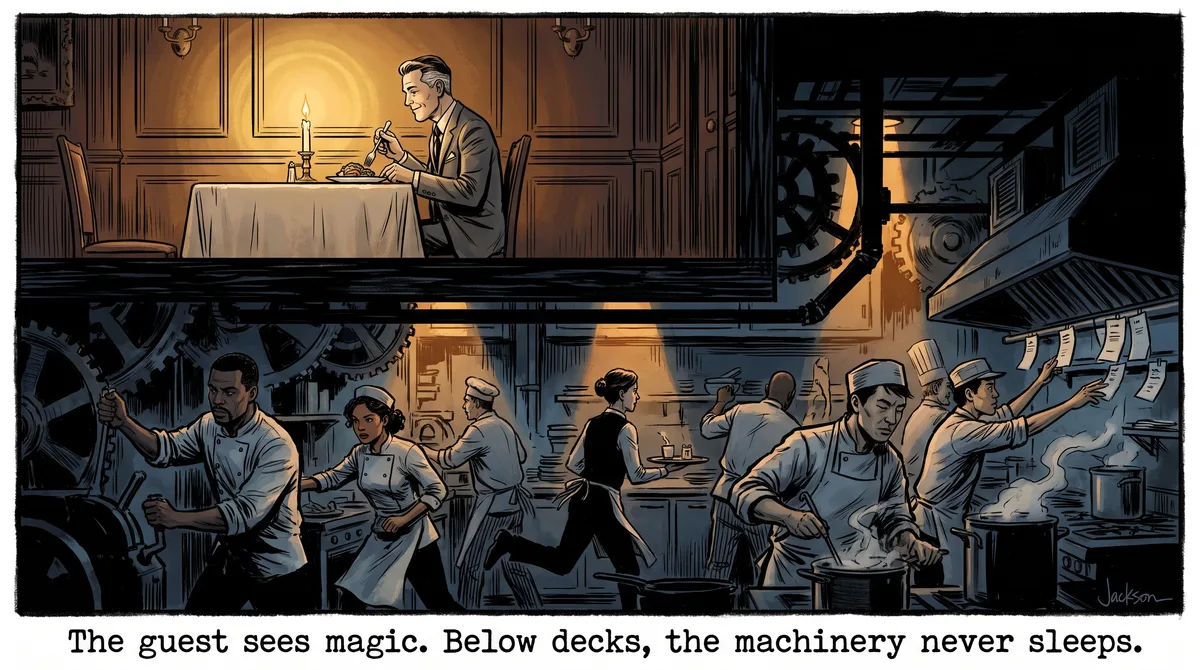
When something feels effortless, there’s usually a lot happening behind the scenes.
Think about a wonderful restaurant experience.
You make a reservation.
You arrive and are greeted.
You’re brought to your table.
Someone brings the menus and water.
Your order is taken, the food arrives, everyone gets the right meal, the table is cleared, and you’re offered dessert or coffee.
Eventually the check arrives, you pay, and you leave.
As a guest, you experience that as a series of little scenes.
But beneath each one is an entire system making it possible.
The reservation has to be recorded.
The table has to be ready.
The server has to know you’ve arrived.
The kitchen has to receive the correct order.
Every meal has to be prepared so it reaches the table at the same time.
I think of these as the two layers of your customer experience.
Above the line is everything your customer sees, hears, touches, and feels.
Below the line is everything required to make those moments happen: the systems, processes, checklists, training, communication, and preparation.
The magic is above the line.
But the machinery is below it.
That’s why “give great service” isn’t really an actionable instruction.
You have to storyboard the journey.
Start at the moment somebody says yes and map every meaningful checkpoint until they receive the outcome they came for.
Then ask two questions at every step:
What could create friction here?
What could turn this into a WOW?
Maybe the WOW is something surprising.
But often, it’s simply letting people know what happens next.
Answering a question before they have to ask it.
Remembering a small preference.
Checking in during a stretch when they might otherwise feel forgotten.
Those moments can feel spontaneous to the client, but they shouldn’t be accidental.
A dream come true experience is intentionally designed above the line…and reliably delivered by everything you’ve built below it.
The better the machinery, the more effortless the magic feels.